
Proteomics-driven innovations in plant-based foods: Current advances, emerging technologies, and future perspectives
IF 2.8
2区 生物学
Q2 BIOCHEMICAL RESEARCH METHODS
引用次数: 0
Abstract
Despite rapid market growth, plant-based foods such as meat analogs, plant-based milk, yogurt alternatives, and fermented products still fall short of matching the sensory, structural, and nutritional qualities of animal-based counterparts, primarily due to simple ingredient substitution that fails to reproduce the molecular structure, interactions, and functional properties required for optimal texture, flavor, and nutritional performance. Proteomics, using advanced mass spectrometry (MS) and label-free quantification methods, provides an approach to analyze plant protein composition, structure, interactions, and modifications, enabling targeted functional improvements. This review describes how proteomic workflows inform formulation across three areas. First, protein compositional and structural characterization employs techniques such as liquid chromatography-tandem mass spectrometry (LC-MS/MS) and differential scanning calorimetry (DSC) coupled with MS to map protein composition and structural behavior, supporting decisions on protein sources, fractionation, and purification. Second, indirect proteomic methods coupled with other non-proteomic complementary tools are used to determine structure–function relationships induced by processing to examine processing-induced crosslinking, enzymatic modifications, and lipid–protein interactions that influence texture. Third, targeted MS methods, including selected reaction monitoring (SRM) and parallel reaction monitoring (PRM), are applied to profile off-flavor compounds and identify protein modification sites relevant to sensory and nutritional properties. By integrating proteomic data with processing strategies, this review outlines how proteomics can be used to examine key functional attributes related to texture, flavor, and nutritional quality in plant-based foods.
Significance
This review highlights the pivotal role of proteomics in advancing next-generation plant-based foods. Proteomic analysis enables an in-depth understanding of plant protein structure, composition, interactions, and bioactivity, providing critical insights for the development of functionally enhanced and consumer-acceptable alternatives. By integrating proteomics with AI, machine learning, multi-omics approaches, and cutting-edge analytical tools such as spatial proteomics and mass spectrometry imaging, the review demonstrates how protein functionality, flavor, texture, nutrition, and allergenicity can be optimized. Furthermore, it emphasizes the potential of proteomics to accelerate innovation in personalized nutrition, support sustainable and circular food systems, improve food safety, and reduce waste by valorizing plant-based by-products. This work serves as a roadmap for researchers and industry stakeholders seeking to leverage proteomics to design novel, high-quality, and sustainable plant-based protein products.
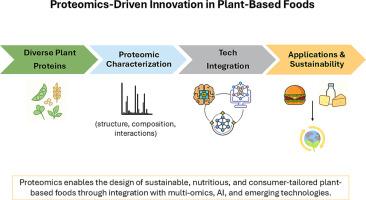
植物性食品中蛋白质组学驱动的创新:当前进展、新兴技术和未来展望
尽管市场快速增长,但植物性食品,如肉类类似物、植物性牛奶、酸奶替代品和发酵产品,在感官、结构和营养品质方面仍然无法与动物基食品相匹配,主要原因是简单的成分替代无法再现最佳质地、风味和营养性能所需的分子结构、相互作用和功能特性。蛋白质组学,使用先进的质谱(MS)和无标记的定量方法,提供了一种分析植物蛋白质组成、结构、相互作用和修饰的方法,从而实现有针对性的功能改进。这篇综述描述了蛋白质组工作流程如何在三个领域为配方提供信息。首先,蛋白质组成和结构表征采用液相色谱-串联质谱(LC-MS/MS)和差示扫描量热法(DSC)结合质谱等技术来绘制蛋白质组成和结构行为,支持蛋白质来源、分离和纯化的决策。其次,使用间接蛋白质组学方法结合其他非蛋白质组学补充工具来确定加工诱导的结构-功能关系,以检查加工诱导的交联、酶修饰和影响质地的脂质-蛋白质相互作用。第三,利用选择性反应监测(SRM)和平行反应监测(PRM)等靶向质谱方法分析异味化合物,确定与感官和营养特性相关的蛋白质修饰位点。通过将蛋白质组学数据与加工策略相结合,本文概述了蛋白质组学如何用于检测植物性食品中与质地、风味和营养质量相关的关键功能属性。这篇综述强调了蛋白质组学在推进下一代植物性食品中的关键作用。蛋白质组学分析能够深入了解植物蛋白质的结构、组成、相互作用和生物活性,为开发功能增强和消费者可接受的替代品提供关键见解。通过将蛋白质组学与人工智能、机器学习、多组学方法以及空间蛋白质组学和质谱成像等前沿分析工具相结合,该综述展示了如何优化蛋白质功能、风味、质地、营养和致敏性。此外,它还强调了蛋白质组学在加速个性化营养创新、支持可持续和循环粮食系统、提高食品安全以及通过植物性副产品定价减少浪费方面的潜力。这项工作为寻求利用蛋白质组学设计新颖、高质量和可持续的植物性蛋白质产品的研究人员和行业利益相关者提供了路线图。
本文章由计算机程序翻译,如有差异,请以英文原文为准。
求助全文
约1分钟内获得全文
求助全文
来源期刊
Journal of proteomics
生物-生化研究方法
CiteScore
7.10
自引率
3.00%
发文量
227
审稿时长
73 days
期刊介绍:
Journal of Proteomics is aimed at protein scientists and analytical chemists in the field of proteomics, biomarker discovery, protein analytics, plant proteomics, microbial and animal proteomics, human studies, tissue imaging by mass spectrometry, non-conventional and non-model organism proteomics, and protein bioinformatics. The journal welcomes papers in new and upcoming areas such as metabolomics, genomics, systems biology, toxicogenomics, pharmacoproteomics.
Journal of Proteomics unifies both fundamental scientists and clinicians, and includes translational research. Suggestions for reviews, webinars and thematic issues are welcome.
 求助内容:
求助内容: 应助结果提醒方式:

 京公网安备 11010802042870号


