
Neuroprotective effects of pepsin-hydrolyzed ovotransferrin on H2O2-induced oxidative damage in SH-SY5Y neuronal cells
IF 4.7
2区 医学
Q1 BIOCHEMISTRY & MOLECULAR BIOLOGY
引用次数: 0
Abstract
Neurodegenerative diseases are considered critical disorders due to the absence of effective treatments and serious damage to brain function. Ovotransferrin, an egg white protein, and its hydrolysate obtained using proteolytic enzymes have been reported to have beneficial effects on various bioactive functions. Therefore, the purpose of this study was to investigate the neuroprotective effects of enzymatically hydrolyzed ovotransferrin in SH-SY5Y cells exposed to oxidative stress. Hydrolyzed ovotransferrin showed higher antioxidative activities than pure ovotransferrin. Furthermore, 0.5 mg/mL of pepsin-derived ovotransferrin hydrolysate (OHPE) exhibited the highest cell viability (81.89%), and OHPE effectively reduced cellular ROS accumulation (72%) and decreased total apoptosis rate (46.41%). These anti-apoptotic and antioxidative effects were influenced by the regulation of the mRNA and protein expression of Bax, Bcl-2, caspase-9, caspase-3, Nrf2, and HO-1. Additionally, nine peptides comprising OHPE were identified by LC-MS/MS and compared with the sequences reported in DFBP to explore their potential as antioxidants. These results indicate that OHPE can be used as a nature-derived compound to prevent neurodegenerative diseases by inhibiting ROS interactions and regulating protein expression in neuronal cells.
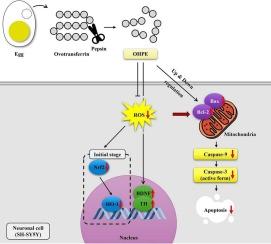
胃蛋白酶水解卵转铁蛋白对h2o2诱导的SH-SY5Y神经元细胞氧化损伤的神经保护作用
神经退行性疾病被认为是严重的疾病,因为缺乏有效的治疗和严重损害脑功能。卵黄转铁蛋白是一种蛋清蛋白,它的水解产物用蛋白水解酶获得,据报道对多种生物活性功能有有益的影响。因此,本研究的目的是研究酶解卵黄转铁蛋白对氧化应激SH-SY5Y细胞的神经保护作用。水解卵转铁蛋白比纯卵转铁蛋白具有更高的抗氧化活性。此外,0.5 mg/mL胃蛋白酶来源的卵黄转铁蛋白水解物(OHPE)表现出最高的细胞活力(81.89%),OHPE有效减少细胞ROS积累(72%),降低总凋亡率(46.41%)。这些抗凋亡和抗氧化作用受Bax、Bcl-2、caspase-9、caspase-3、Nrf2和HO-1 mRNA和蛋白表达的调控影响。此外,通过LC-MS/MS鉴定了含有OHPE的9个肽段,并与DFBP中报道的序列进行了比较,以探索它们作为抗氧化剂的潜力。这些结果表明,OHPE可以作为一种天然来源的化合物,通过抑制ROS相互作用和调节神经元细胞中的蛋白质表达来预防神经退行性疾病。
本文章由计算机程序翻译,如有差异,请以英文原文为准。
求助全文
约1分钟内获得全文
求助全文
来源期刊
Bioorganic Chemistry
生物-生化与分子生物学
CiteScore
9.70
自引率
3.90%
发文量
679
审稿时长
31 days
期刊介绍:
Bioorganic Chemistry publishes research that addresses biological questions at the molecular level, using organic chemistry and principles of physical organic chemistry. The scope of the journal covers a range of topics at the organic chemistry-biology interface, including: enzyme catalysis, biotransformation and enzyme inhibition; nucleic acids chemistry; medicinal chemistry; natural product chemistry, natural product synthesis and natural product biosynthesis; antimicrobial agents; lipid and peptide chemistry; biophysical chemistry; biological probes; bio-orthogonal chemistry and biomimetic chemistry.
For manuscripts dealing with synthetic bioactive compounds, the Journal requires that the molecular target of the compounds described must be known, and must be demonstrated experimentally in the manuscript. For studies involving natural products, if the molecular target is unknown, some data beyond simple cell-based toxicity studies to provide insight into the mechanism of action is required. Studies supported by molecular docking are welcome, but must be supported by experimental data. The Journal does not consider manuscripts that are purely theoretical or computational in nature.
The Journal publishes regular articles, short communications and reviews. Reviews are normally invited by Editors or Editorial Board members. Authors of unsolicited reviews should first contact an Editor or Editorial Board member to determine whether the proposed article is within the scope of the Journal.
 求助内容:
求助内容: 应助结果提醒方式:

 京公网安备 11010802042870号


