
An unprecedented potent inhibitor of MV4-11 cells: investigations into the mechanism of action beyond FLT3 inhibition
IF 4.7
2区 医学
Q1 BIOCHEMISTRY & MOLECULAR BIOLOGY
引用次数: 0
Abstract
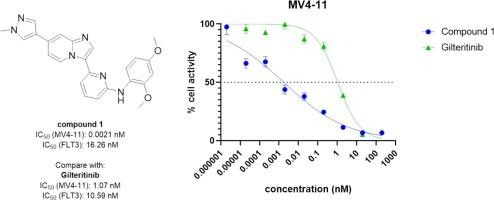
Activating mutations in FLT3 occur in 30% of acute myeloid leukemia (AML) cases. The AML patient-derived MV4–11 cell line contains a genetic alteration in FLT3 (“FLT3-ITD”), causing constitutive FLT3 activation. From screening, we identified compound 1 with unprecedently high anti-MV4–11 effects, with IC50 = 0.0021 ± 0.0003 nM. From the dose response curve, the effects of compound 1 are gradual and may have biphasic characteristics. Further studies identified compound 1 as a type-I FLT3 inhibitor with comparable potency to quizartinib and gilteritinib; however, compound 1 is much more potent against MV4–11 cells, indicating that it may have a second molecular mechanism of action independent of FLT3 inhibition. Interestingly, compound 1's high potency is uniquely toward MV4–11 cells, and distinct from other cell lines either with or without FLT3 mutations. Preliminary efforts to unravel this mechanism were undertaken. The results of apoptosis assay and cell cycle analysis showed that the effects of compound 1 on MV4–11 may be biphasic, with an immediate cell cycle stabilizing effect at low picomolar concentrations, and a stronger effect to arrest cell cycle and induce apoptosis at low nanomolar concentrations. However, kinase selectivity profiling demonstrates that other than FLT3, compound 1 lacks strong binding affinities with other kinases. Therefore, the high inhibitory potency of compound 1 on MV4–11 cells appear unlikely to be due to synergism of co-inhibition of FLT3 and any other kinases. Altogether, compound 1 may serve as a promising lead compound for further optimization and research on a potentially new molecular antiproliferative mechanism.
一种前所未有的MV4-11细胞的有效抑制剂:对FLT3抑制作用机制的研究
30%的急性髓性白血病(AML)病例发生FLT3激活突变。AML患者衍生的MV4-11细胞系含有FLT3的遗传改变(“FLT3- itd”),导致组成型FLT3激活。通过筛选,我们发现化合物1具有前所未有的高抗mv4 - 11作用,IC50 = 0.0021±0.0003 nM。从剂量响应曲线看,化合物1的作用是渐进的,可能具有双相特征。进一步的研究发现化合物1是一种i型FLT3抑制剂,其效力与quizartinib和gilteritinib相当;然而,化合物1对MV4-11细胞更有效,表明它可能具有独立于FLT3抑制的第二种分子作用机制。有趣的是,化合物1的高效力仅针对MV4-11细胞,与其他具有或不具有FLT3突变的细胞系不同。为解开这一机制进行了初步努力。细胞凋亡实验和细胞周期分析结果表明,化合物1对MV4-11的作用可能是双相的,在低皮摩尔浓度下具有立即稳定细胞周期的作用,在低纳摩尔浓度下具有更强的阻滞细胞周期和诱导细胞凋亡的作用。然而,激酶选择性分析表明,除了FLT3,化合物1与其他激酶缺乏很强的结合亲和力。因此,化合物1对MV4-11细胞的高抑制效能似乎不太可能是由于FLT3和任何其他激酶的协同抑制作用。综上所述,化合物1可以作为一个有前景的先导化合物,进一步优化和研究一种潜在的新的分子抗增殖机制。
本文章由计算机程序翻译,如有差异,请以英文原文为准。
求助全文
约1分钟内获得全文
求助全文
来源期刊
Bioorganic Chemistry
生物-生化与分子生物学
CiteScore
9.70
自引率
3.90%
发文量
679
审稿时长
31 days
期刊介绍:
Bioorganic Chemistry publishes research that addresses biological questions at the molecular level, using organic chemistry and principles of physical organic chemistry. The scope of the journal covers a range of topics at the organic chemistry-biology interface, including: enzyme catalysis, biotransformation and enzyme inhibition; nucleic acids chemistry; medicinal chemistry; natural product chemistry, natural product synthesis and natural product biosynthesis; antimicrobial agents; lipid and peptide chemistry; biophysical chemistry; biological probes; bio-orthogonal chemistry and biomimetic chemistry.
For manuscripts dealing with synthetic bioactive compounds, the Journal requires that the molecular target of the compounds described must be known, and must be demonstrated experimentally in the manuscript. For studies involving natural products, if the molecular target is unknown, some data beyond simple cell-based toxicity studies to provide insight into the mechanism of action is required. Studies supported by molecular docking are welcome, but must be supported by experimental data. The Journal does not consider manuscripts that are purely theoretical or computational in nature.
The Journal publishes regular articles, short communications and reviews. Reviews are normally invited by Editors or Editorial Board members. Authors of unsolicited reviews should first contact an Editor or Editorial Board member to determine whether the proposed article is within the scope of the Journal.
 求助内容:
求助内容: 应助结果提醒方式:

 京公网安备 11010802042870号


