Francisco Castillejos-Ibáñez, Marina Garcés-Albir, Isabel Mora-Oliver, Elena Muñoz-Forner, Dimitri Dorcaratto, Luis Sabater Ortí
{"title":"Is failure to rescue an appropriate quality indicator in a pancreatic surgery unit?","authors":"Francisco Castillejos-Ibáñez, Marina Garcés-Albir, Isabel Mora-Oliver, Elena Muñoz-Forner, Dimitri Dorcaratto, Luis Sabater Ortí","doi":"10.1016/j.cireng.2026.800289","DOIUrl":null,"url":null,"abstract":"<div><h3>Objective</h3><div>To evaluate the Failure to Rescue (FTR) rate in a pancreatic surgery unit between 2020 and 2024, and to identify the limitations of this indicator when interpreting successful outcomes.</div></div><div><h3>Material and methods</h3><div>A retrospective study based on a prospective database. All patients who underwent elective pancreatic surgery with curative intent between January 2020 and December 2024 were included. Preoperative, intraoperative, and postoperative clinical variables were collected. The 30- and 90-day FTR was defined as mortality among patients who experienced at least one major postoperative complication (MPC) (Clavien-Dindo ≥3).</div></div><div><h3>Results</h3><div>Of the 173 patients operated on, 37 (21.39%) developed major complications. The overall FTR rate was 8.11%. The most frequent complication was pancreatic fistula (17.92%), followed by intra-abdominal collections (15.03%), post-pancreatectomy haemorrhage (13.87%), and delayed gastric emptying (5.20%). The reoperation rate was 9.25%, and overall mortality was 1.73%.</div></div><div><h3>Conclusion</h3><div>The observed FTR rate is comparable to that of high-volume international centres. FTR, being a ratio between mortality and major complications, can be distorted in series with a low rate of such complications, which requires it to be interpreted with caution and not used as a standalone quality indicator of a surgical unit.</div></div>","PeriodicalId":93935,"journal":{"name":"Cirugia espanola","volume":"104 4","pages":"Article 800289"},"PeriodicalIF":0.0000,"publicationDate":"2026-04-01","publicationTypes":"Journal Article","fieldsOfStudy":null,"isOpenAccess":false,"openAccessPdf":"","citationCount":"0","resultStr":null,"platform":"Semanticscholar","paperid":null,"PeriodicalName":"Cirugia espanola","FirstCategoryId":"1085","ListUrlMain":"https://www.sciencedirect.com/science/article/pii/S2173507726000499","RegionNum":0,"RegionCategory":null,"ArticlePicture":[],"TitleCN":null,"AbstractTextCN":null,"PMCID":null,"EPubDate":"2026/2/5 0:00:00","PubModel":"Epub","JCR":"","JCRName":"","Score":null,"Total":0}
引用次数: 0
Abstract
Objective
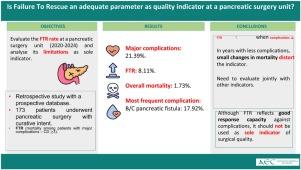
To evaluate the Failure to Rescue (FTR) rate in a pancreatic surgery unit between 2020 and 2024, and to identify the limitations of this indicator when interpreting successful outcomes.
Material and methods
A retrospective study based on a prospective database. All patients who underwent elective pancreatic surgery with curative intent between January 2020 and December 2024 were included. Preoperative, intraoperative, and postoperative clinical variables were collected. The 30- and 90-day FTR was defined as mortality among patients who experienced at least one major postoperative complication (MPC) (Clavien-Dindo ≥3).
Results
Of the 173 patients operated on, 37 (21.39%) developed major complications. The overall FTR rate was 8.11%. The most frequent complication was pancreatic fistula (17.92%), followed by intra-abdominal collections (15.03%), post-pancreatectomy haemorrhage (13.87%), and delayed gastric emptying (5.20%). The reoperation rate was 9.25%, and overall mortality was 1.73%.
Conclusion
The observed FTR rate is comparable to that of high-volume international centres. FTR, being a ratio between mortality and major complications, can be distorted in series with a low rate of such complications, which requires it to be interpreted with caution and not used as a standalone quality indicator of a surgical unit.


 求助内容:
求助内容: 应助结果提醒方式:

 京公网安备 11010802042870号


