Pilar Fernández-Veiga , Marta Martínez Míguez , Marta Paniagua García-Señorans , José Antonio Romero González , Fernando Fernández López , Raquel Vázquez Bouzán , Ramón López De los Reyes , Inés Aldrey Cao , José Enrique Casal Núñez
{"title":"Coloproctology practice during General and Digestive Surgery training. Survey of the Galician Coloproctology Group","authors":"Pilar Fernández-Veiga , Marta Martínez Míguez , Marta Paniagua García-Señorans , José Antonio Romero González , Fernando Fernández López , Raquel Vázquez Bouzán , Ramón López De los Reyes , Inés Aldrey Cao , José Enrique Casal Núñez","doi":"10.1016/j.cireng.2026.800288","DOIUrl":null,"url":null,"abstract":"<div><h3>Introduction</h3><div>In general surgery (GS), coloproctology (CP) constitutes one of the cornerstones in specialist training; however, it is unclear whether this training is sufficiently comprehensive and how trainees perceive it. In the same way, it’s interesting to assess whether advanced accreditation of units may have an influence on this. Our objective was to determine the quality of this training in our community and to compare the results between hospitals with advanced colorectal unit and those without accreditation.</div></div><div><h3>Materials and methods</h3><div>A cross-sectional study was conducted using the results of anonymous surveys completed by GS trainees in Galicia regarding their training in CP.</div></div><div><h3>Results</h3><div>A total of 57 residents participated (93.4%). Of them, 82.5% had never been evaluated during their residency. More than half stated that they had not received sufficient scientific training. They operated as first surgeon in proctological and colorectal procedures in 42.2% and 17.2% of cases, respectively. Only 3.7% did so in pelvic floor disorders. In accredited Units, the evaluation was significantly higher in the scientific domain (<em>p</em> = 0.003), in the clinical-care domain (<em>p</em> = 0.002), and in the overall achievement of objectives (<em>p</em> = 0.034). Additionally, there were statistically significant differences in the number of surgeries performed as first surgeon (<em>p</em> = 0.017) in favour of these Units.</div></div><div><h3>Conclusion</h3><div>There is wide room for improvement in CP training among our trainees, with special emphasis on the scientific domain. We observed that participation as first surgeon decreases in complex surgeries, which makes additional training essential to practice CP independently.</div></div>","PeriodicalId":93935,"journal":{"name":"Cirugia espanola","volume":"104 4","pages":"Article 800288"},"PeriodicalIF":0.0000,"publicationDate":"2026-04-01","publicationTypes":"Journal Article","fieldsOfStudy":null,"isOpenAccess":false,"openAccessPdf":"","citationCount":"0","resultStr":null,"platform":"Semanticscholar","paperid":null,"PeriodicalName":"Cirugia espanola","FirstCategoryId":"1085","ListUrlMain":"https://www.sciencedirect.com/science/article/pii/S2173507726000487","RegionNum":0,"RegionCategory":null,"ArticlePicture":[],"TitleCN":null,"AbstractTextCN":null,"PMCID":null,"EPubDate":"2026/2/5 0:00:00","PubModel":"Epub","JCR":"","JCRName":"","Score":null,"Total":0}
引用次数: 0
Abstract
Introduction
In general surgery (GS), coloproctology (CP) constitutes one of the cornerstones in specialist training; however, it is unclear whether this training is sufficiently comprehensive and how trainees perceive it. In the same way, it’s interesting to assess whether advanced accreditation of units may have an influence on this. Our objective was to determine the quality of this training in our community and to compare the results between hospitals with advanced colorectal unit and those without accreditation.
Materials and methods
A cross-sectional study was conducted using the results of anonymous surveys completed by GS trainees in Galicia regarding their training in CP.
Results
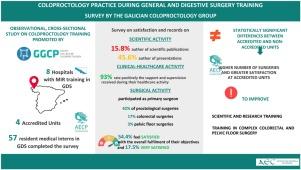
A total of 57 residents participated (93.4%). Of them, 82.5% had never been evaluated during their residency. More than half stated that they had not received sufficient scientific training. They operated as first surgeon in proctological and colorectal procedures in 42.2% and 17.2% of cases, respectively. Only 3.7% did so in pelvic floor disorders. In accredited Units, the evaluation was significantly higher in the scientific domain (p = 0.003), in the clinical-care domain (p = 0.002), and in the overall achievement of objectives (p = 0.034). Additionally, there were statistically significant differences in the number of surgeries performed as first surgeon (p = 0.017) in favour of these Units.
Conclusion
There is wide room for improvement in CP training among our trainees, with special emphasis on the scientific domain. We observed that participation as first surgeon decreases in complex surgeries, which makes additional training essential to practice CP independently.


 求助内容:
求助内容: 应助结果提醒方式:

 京公网安备 11010802042870号


