
The inhibitory mechanisms of PGG, a natural polyphenol enriched with gallate moieties, against Aβ42 amyloid aggregation: A unified experimental and molecular dynamics simulation study
IF 3
3区 医学
Q2 BIOCHEMISTRY & MOLECULAR BIOLOGY
Bioorganic & Medicinal Chemistry
Pub Date : 2026-05-01
Epub Date: 2026-02-04
DOI:10.1016/j.bmc.2026.118584
引用次数: 0
Abstract
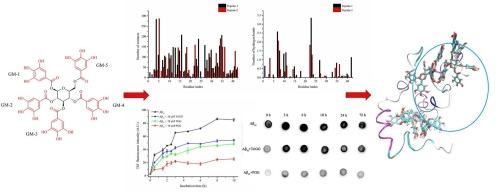
Alzheimer's disease currently affects over 44 million individuals worldwide. Inhibiting Aβ aggregation and preventing the formation of toxic Aβ oligomers were regarded as promising therapeutic approaches. Experimental studies demonstrated that 1,2,3,4,6-Penta-O-galloyl-β-d-glucopyranose (PGG), a natural polyphenol enriched with gallate moieties, significantly inhibited Aβ42 oligomerization and amyloid formation both in vitro and in vivo, underscoring its potential as a promising lead compound for AD therapy. Nevertheless, the detailed molecular mechanisms remained mostly unknown. Herein, we employed relevant biophysical methods to investigate the inhibitory effects of PGG and its analogs on Aβ42 amyloid aggregation, particularly on oligomer formation, providing direct evidence for the influence of gallate moiety number on its inhibitory activity against Aβ42 amyloid aggregation. Moreover, we further conducted 1500 ns all-atom MD simulations to explore how PGG inhibited Aβ amyloid aggregation. The simulations revealed that PGG promoted the adoption of a more loosely packed conformation of the Aβ42 dimer, and completely prevented the helix-to-β-sheet conformational change. Moreover, the binding of PGG molecules to the Aβ42 dimer resulted in the disruption of the inter-peptide interactions, and dramatically weakened the intra-peptide contacts. We observed that, apart from the usual hydrogen bonds and hydrophobic interactions, both π-π and cation-π interactions were also detected between specific residues of the Aβ42 dimer and the gallate moieties of PGG. We believed that these results might provide novel insights into the mechanisms underlying the inhibitory effects of PGG on Aβ42 amyloid aggregation and further support its potential for AD prevention and treatment.
富含没食子酸酯部分的天然多酚PGG对a - β42淀粉样蛋白聚集的抑制机制:统一的实验和分子动力学模拟研究
阿尔茨海默病目前影响着全球超过4400万人。抑制Aβ聚集和防止毒性Aβ低聚物的形成被认为是有前途的治疗方法。实验研究表明,1,2,3,4,6-五- o -没食子酸酯-β-d-葡萄糖吡喃糖(PGG)是一种富含没食子酸酯部分的天然多酚,在体外和体内都能显著抑制a- β42寡聚和淀粉样蛋白的形成,这表明它有潜力成为治疗AD的先导化合物。尽管如此,详细的分子机制仍然是未知的。本文采用相关的生物物理方法研究了PGG及其类似物对a - β42淀粉样蛋白聚集的抑制作用,特别是对寡聚物形成的抑制作用,为没食子酸酯片段数对其抑制a - β42淀粉样蛋白聚集活性的影响提供了直接证据。此外,我们进一步进行了1500 ns的全原子MD模拟,以探索PGG如何抑制β淀粉样蛋白聚集。模拟结果表明,PGG促进了a -β 42二聚体采用更松散的排列构象,并完全阻止了螺旋向-β-片的构象变化。此外,PGG分子与a- β42二聚体的结合导致肽间相互作用的中断,并显著削弱了肽内的接触。我们观察到,除了常见的氢键和疏水相互作用外,在a - β42二聚体的特定残基与PGG的没食子酸酯部分之间还检测到π-π和阳离子-π相互作用。我们相信这些结果可能为PGG抑制a - β42淀粉样蛋白聚集的机制提供新的见解,并进一步支持其预防和治疗AD的潜力。
本文章由计算机程序翻译,如有差异,请以英文原文为准。
求助全文
约1分钟内获得全文
求助全文
来源期刊
Bioorganic & Medicinal Chemistry
医学-生化与分子生物学
CiteScore
6.80
自引率
2.90%
发文量
413
审稿时长
17 days
期刊介绍:
Bioorganic & Medicinal Chemistry provides an international forum for the publication of full original research papers and critical reviews on molecular interactions in key biological targets such as receptors, channels, enzymes, nucleotides, lipids and saccharides.
The aim of the journal is to promote a better understanding at the molecular level of life processes, and living organisms, as well as the interaction of these with chemical agents. A special feature will be that colour illustrations will be reproduced at no charge to the author, provided that the Editor agrees that colour is essential to the information content of the illustration in question.
 求助内容:
求助内容: 应助结果提醒方式:

 京公网安备 11010802042870号


