
The hidden role of Mg–Si–COH fluids on mantle wedge metasomatism

IF 2.5 2区 地球科学 Q2 GEOCHEMISTRY & GEOPHYSICS
Lithos Pub Date : 2026-04-01 Epub Date: 2026-01-28 DOI:10.1016/j.lithos.2026.108436
Carla Tiraboschi , Dimitri Sverjensky , Carmen Sanchez-Valle
{"title":"The hidden role of Mg–Si–COH fluids on mantle wedge metasomatism","authors":"Carla Tiraboschi ,&nbsp;Dimitri Sverjensky ,&nbsp;Carmen Sanchez-Valle","doi":"10.1016/j.lithos.2026.108436","DOIUrl":null,"url":null,"abstract":"<div><div>COH fluids have long been thought to play a key role in subduction zone processes as their release from the subducting slab drives metasomatic alteration in the overlying mantle wedge. Among these, graphite-saturated COH fluids derived from a model peridotitic assemblage exhibit high solute concentrations of Mg and Si, compared to COH- and H<sub>2</sub>O-only fluids: up to 17 wt% at 1 GPa and 900 °C, making them potentially efficient metasomatic agents. Probing experimentally the metasomatic effect of these fluids is however limited by the inability to recover the fluid phase with its solute load upon quenching, to further test the interaction with relevant graphite-free mantle wedge lithologies. To overcome this challenge, we employ thermodynamic modeling to both reproduce the solute load observed in experiments and subsequently simulate fluid–rock interactions at controlled conditions.</div><div>Here we use EQ3/6 coupled with the Deep Earth Water model to investigate the metasomatic effects of COH fluids generated by the dissolution of forsterite and enstatite in graphite-saturated COH fluids, interacting with graphite-free lherzolite, harzburgite, and dunite at 1 GPa and 700–900 °C, over a range of fluid/rock ratios. For comparison, we also simulate metasomatism by a H<sub>2</sub>O-only fluid at identical conditions.</div><div>Our results confirm that Mg–Si–COH fluids drive significant compositional changes in the host rocks. While H<sub>2</sub>O-only fluids primarily stabilize clinochlore up to 800 °C, graphite-saturated COH fluids promote orthopyroxene formation, doubling its mineral proportions for high fluid/rock ratios. These results highlight the enhanced metasomatic potential of carbon-bearing fluids, which, in the model, can generate orthopyroxene-rich assemblages and silica-enriched mantle domains comparable to those observed in natural subduction settings. They also expose a paradox: carbon is essential to produce the solute-rich fluid, yet no carbon-bearing phases remain in the final rock assemblage. This implies that carbon-bearing fluids may have been more influential in subduction zone metasomatism than previously recognized, despite leaving no direct mineralogical evidence in the exhumed rock record.</div></div>","PeriodicalId":18070,"journal":{"name":"Lithos","volume":"526 ","pages":"Article 108436"},"PeriodicalIF":2.5000,"publicationDate":"2026-04-01","publicationTypes":"Journal Article","fieldsOfStudy":null,"isOpenAccess":false,"openAccessPdf":"","citationCount":"0","resultStr":null,"platform":"Semanticscholar","paperid":null,"PeriodicalName":"Lithos","FirstCategoryId":"89","ListUrlMain":"https://www.sciencedirect.com/science/article/pii/S002449372600037X","RegionNum":2,"RegionCategory":"地球科学","ArticlePicture":[],"TitleCN":null,"AbstractTextCN":null,"PMCID":null,"EPubDate":"2026/1/28 0:00:00","PubModel":"Epub","JCR":"Q2","JCRName":"GEOCHEMISTRY & GEOPHYSICS","Score":null,"Total":0}
引用次数: 0

Abstract

COH fluids have long been thought to play a key role in subduction zone processes as their release from the subducting slab drives metasomatic alteration in the overlying mantle wedge. Among these, graphite-saturated COH fluids derived from a model peridotitic assemblage exhibit high solute concentrations of Mg and Si, compared to COH- and H2O-only fluids: up to 17 wt% at 1 GPa and 900 °C, making them potentially efficient metasomatic agents. Probing experimentally the metasomatic effect of these fluids is however limited by the inability to recover the fluid phase with its solute load upon quenching, to further test the interaction with relevant graphite-free mantle wedge lithologies. To overcome this challenge, we employ thermodynamic modeling to both reproduce the solute load observed in experiments and subsequently simulate fluid–rock interactions at controlled conditions.
Here we use EQ3/6 coupled with the Deep Earth Water model to investigate the metasomatic effects of COH fluids generated by the dissolution of forsterite and enstatite in graphite-saturated COH fluids, interacting with graphite-free lherzolite, harzburgite, and dunite at 1 GPa and 700–900 °C, over a range of fluid/rock ratios. For comparison, we also simulate metasomatism by a H2O-only fluid at identical conditions.
Our results confirm that Mg–Si–COH fluids drive significant compositional changes in the host rocks. While H2O-only fluids primarily stabilize clinochlore up to 800 °C, graphite-saturated COH fluids promote orthopyroxene formation, doubling its mineral proportions for high fluid/rock ratios. These results highlight the enhanced metasomatic potential of carbon-bearing fluids, which, in the model, can generate orthopyroxene-rich assemblages and silica-enriched mantle domains comparable to those observed in natural subduction settings. They also expose a paradox: carbon is essential to produce the solute-rich fluid, yet no carbon-bearing phases remain in the final rock assemblage. This implies that carbon-bearing fluids may have been more influential in subduction zone metasomatism than previously recognized, despite leaving no direct mineralogical evidence in the exhumed rock record.
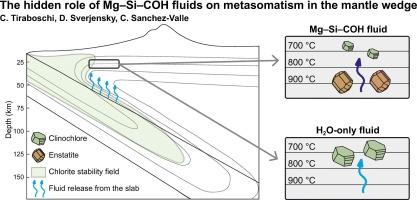
Abstract Image

Mg-Si-COH流体在地幔楔块交代中的隐藏作用
长期以来,人们一直认为COH流体在俯冲带过程中起着关键作用,因为它们从俯冲板块释放出来,驱动上覆地幔楔的交代蚀变。其中,与仅含COH和h2o的流体相比,来自橄榄岩模型组合的石墨饱和COH流体表现出较高的Mg和Si溶质浓度:在1 GPa和900°C下高达17 wt%,使其成为潜在的高效交代剂。然而,由于无法在淬灭后恢复溶质负载的流体相,因此无法进一步测试与相关无石墨地幔楔体岩性的相互作用,因此无法通过实验探测这些流体的代谢效应。为了克服这一挑战,我们采用热力学建模来重现实验中观察到的溶质载荷,并随后模拟受控条件下的流体-岩石相互作用。在此,我们利用EQ3/6和Deep Earth Water模型结合,研究了在1 GPa和700-900℃范围内,饱和COH流体中由橄榄石和辉唆石溶解产生的COH流体的交代效应,以及与不含石墨的橄榄石、辉唆石和白云石的相互作用。为了比较,我们还模拟了相同条件下纯水流体的交代作用。我们的研究结果证实,Mg-Si-COH流体驱动了宿主岩石的显著成分变化。在800°C以下,纯水流体主要稳定斜长石,而石墨饱和的COH流体促进正辉石的形成,使其矿物比例翻倍,实现高流体/岩石比。这些结果强调了含碳流体的交代潜力增强,在该模型中,可以产生与自然俯冲环境中观察到的类似的富正辉石岩组合和富二氧化硅的地幔域。它们也暴露了一个悖论:碳是产生富含溶质的流体所必需的,但最终的岩石组合中却没有留下含碳阶段。这意味着含碳流体对俯冲带交代作用的影响可能比以前认识到的更大,尽管在挖掘出的岩石记录中没有留下直接的矿物学证据。
本文章由计算机程序翻译,如有差异,请以英文原文为准。
求助全文
约1分钟内获得全文 求助全文
来源期刊
Lithos
Lithos 地学-地球化学与地球物理
CiteScore
6.80
自引率
11.40%
发文量
286
审稿时长
3.5 months
期刊介绍: Lithos publishes original research papers on the petrology, geochemistry and petrogenesis of igneous and metamorphic rocks. Papers on mineralogy/mineral physics related to petrology and petrogenetic problems are also welcomed.

×
引用
GB/T 7714-2015
复制
MLA
复制
APA
复制
导出至
BibTeX EndNote RefMan NoteFirst NoteExpress
×
提示
您的信息不完整,为了账户安全,请先补充。
现在去补充
×
提示
您因"违规操作"
具体请查看互助需知
我知道了
×
提示
确定
请完成安全验证×
copy
已复制链接
快去分享给好友吧!
我知道了
右上角分享
点击右上角分享
0
联系我们:info@booksci.cn Book学术提供免费学术资源搜索服务,方便国内外学者检索中英文文献。致力于提供最便捷和优质的服务体验。 Copyright © 2023 布克学术 All rights reserved.
京ICP备2023020795号-1
ghs 京公网安备 11010802042870号
Book学术文献互助
Book学术文献互助群
群 号:604180095
Book学术官方微信
小红书


