
Substituted 1-(benzo[d]thiazol-2-yl)-3-phenylurea derivatives as anti-invasion agents
IF 2.3
4区 医学
Q3 CHEMISTRY, MEDICINAL
Bioorganic & Medicinal Chemistry Letters
Pub Date : 2026-06-01
Epub Date: 2026-01-31
DOI:10.1016/j.bmcl.2026.130568
引用次数: 0
Abstract
Developing small molecule drugs to treat metastatic cancer remains challenging and relies on the identification of novel druggable targets within the multistep metastatic cascade. To this end, the pro-metastatic scaffolding protein, MDA-9/Syntenin-1 was identified and confirmed as a suitable target uniquely involved in the multiple stages of metastasis. Recently, the first-in class PDZ1 domain inhibitor for MDA-9, PDZ1i, was identified displaying significant anti-invasion activity improving survival in an in vivo glioblastoma and in multiple metastatic cancer mouse models. Herein, we report a focused library of substituted 1-(benzo[d]thiazol-2-yl)-3-phenylurea derivatives inspired by the anti-invasion and anti-metastatic agent, PDZ1i. Our studies revealed that 1-(benzo[d]thiazol-2-yl)-3-phenylurea analogs bearing 6-trifluoromethyl (3y) and 6-bromo (3aa) substituents display anti-invasion activity comparable to PDZ1i. However, compounds 3y and 3aa displayed overall decreased cancer cell selectivity and MDA-9 activity relative to PDZ1i. Nonetheless, the reported 1-(benzo[d]thiazol-2-yl)-3-phenylurea derivatives serve as promising starting points for future development of small molecule anti-invasion agents with potential to prevent and treat metastatic cancers.
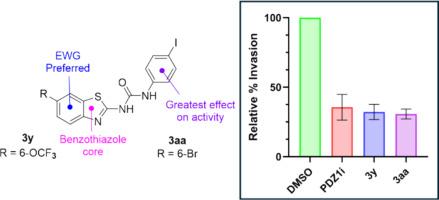
取代1-(苯并[d]噻唑-2-基)-3-苯脲衍生物作为抗侵入剂。
开发小分子药物来治疗转移性癌症仍然具有挑战性,并且依赖于在多步骤转移级联中识别新的可药物靶点。为此,促转移支架蛋白MDA-9/Syntenin-1被鉴定并证实是一个独特参与多阶段转移的合适靶点。最近,一类MDA-9的PDZ1结构域抑制剂PDZ1i被发现在体内胶质母细胞瘤和多发性转移癌小鼠模型中表现出显著的抗侵袭活性,提高了生存率。在此,我们报道了一个受抗侵袭和抗转移剂PDZ1i启发的取代的1-(苯并[d]噻唑-2-基)-3-苯脲衍生物的重点文库。我们的研究表明,含有6-三氟甲基(3y)和6-溴(3aa)取代基的1-(苯并[d]噻唑-2-基)-3-苯脲类似物具有与PDZ1i相当的抗入侵活性。然而,与PDZ1i相比,化合物3y和3aa总体上显示出癌细胞选择性和MDA-9活性的降低。尽管如此,报道的1-(苯并[d]噻唑-2-基)-3-苯脲衍生物为未来开发具有预防和治疗转移性癌症潜力的小分子抗侵袭药物提供了有希望的起点。
本文章由计算机程序翻译,如有差异,请以英文原文为准。
求助全文
约1分钟内获得全文
求助全文
来源期刊
CiteScore
5.70
自引率
3.70%
发文量
463
审稿时长
27 days
期刊介绍:
Bioorganic & Medicinal Chemistry Letters presents preliminary experimental or theoretical research results of outstanding significance and timeliness on all aspects of science at the interface of chemistry and biology and on major advances in drug design and development. The journal publishes articles in the form of communications reporting experimental or theoretical results of special interest, and strives to provide maximum dissemination to a large, international audience.
 求助内容:
求助内容: 应助结果提醒方式:

 京公网安备 11010802042870号


