
Optimizing kitchen ventilation with an integrated stove air supply-exhaust system for reducing PM2.5 intake fraction and enhancing energy efficiency

Q1 Engineering
Energy and Built Environment Pub Date : 2026-02-01 Epub Date: 2024-10-21 DOI:10.1016/j.enbenv.2024.10.003
Yu Liu, Chong Li, Hongqiang Ma, Xinmei Luo
{"title":"Optimizing kitchen ventilation with an integrated stove air supply-exhaust system for reducing PM2.5 intake fraction and enhancing energy efficiency","authors":"Yu Liu,&nbsp;Chong Li,&nbsp;Hongqiang Ma,&nbsp;Xinmei Luo","doi":"10.1016/j.enbenv.2024.10.003","DOIUrl":null,"url":null,"abstract":"<div><div>Ensuring good ventilation is crucial for reducing the pollution caused by cooking activities in the indoor environment. Among them, fume exhaust devices as a vital component of kitchen ventilation, and their performance is particularly critical. Merely increasing the air volume of exhaust devices to remove fumes not only leads to the higher energy consumption of exhaust fans, but also has limited practical effect on reducing pollution. For improving the ventilation condition and reducing the energy consumption of supply and exhaust fan, a new ventilation system for kitchen with integrated stove air supply-exhaust (ISASE) was developed in this study. Firstly, the orthogonal experiment was utilized for arranging different combination schemes of five influencing factors, including the emission rate, exhaust flow, upper air supply angle, upper and lower air supply velocities. Then, the effect of ISASE in reducing the intake fraction of PM<sub>2.5</sub> under each scheme was studied by using the computational fluid dynamics method. The energy consumption of this system under different ventilation schemes was investigated with on-site testing. Finally, performance-gaining rate was proposed by introducing intake fraction reduction rate and energy consumption growth rate to quantitatively evaluate the performance advantage of ISASE. Polynomial fitting was also used to explore the energy-saving effect of ISASE at high emission rate. The results showed that at low, medium, and high emission rates, the intake fraction of PM<sub>2.5</sub> was reduced by 65.0 %–84.2 %. However, the energy consumption of ISASE merely increased by 7.4 %–16.8 % compared with traditional integrated stove without air supply conditions. Its maximum performance-gaining rate reached 0.49–0.66. The energy-saving rate of ISASE was 46.7 % compared with traditional integrated stove without air supply when the same intake fraction was achieved at high emission rate. The practical schemes of ISASE at different emission rates were given in this study, which optimized the working performance of integrated stove and provided a useful reference for its innovative design.</div></div>","PeriodicalId":33659,"journal":{"name":"Energy and Built Environment","volume":"7 1","pages":"Pages 227-238"},"PeriodicalIF":0.0000,"publicationDate":"2026-02-01","publicationTypes":"Journal Article","fieldsOfStudy":null,"isOpenAccess":false,"openAccessPdf":"","citationCount":"0","resultStr":null,"platform":"Semanticscholar","paperid":null,"PeriodicalName":"Energy and Built Environment","FirstCategoryId":"1085","ListUrlMain":"https://www.sciencedirect.com/science/article/pii/S2666123324001028","RegionNum":0,"RegionCategory":null,"ArticlePicture":[],"TitleCN":null,"AbstractTextCN":null,"PMCID":null,"EPubDate":"2024/10/21 0:00:00","PubModel":"Epub","JCR":"Q1","JCRName":"Engineering","Score":null,"Total":0}
引用次数: 0

Abstract

Ensuring good ventilation is crucial for reducing the pollution caused by cooking activities in the indoor environment. Among them, fume exhaust devices as a vital component of kitchen ventilation, and their performance is particularly critical. Merely increasing the air volume of exhaust devices to remove fumes not only leads to the higher energy consumption of exhaust fans, but also has limited practical effect on reducing pollution. For improving the ventilation condition and reducing the energy consumption of supply and exhaust fan, a new ventilation system for kitchen with integrated stove air supply-exhaust (ISASE) was developed in this study. Firstly, the orthogonal experiment was utilized for arranging different combination schemes of five influencing factors, including the emission rate, exhaust flow, upper air supply angle, upper and lower air supply velocities. Then, the effect of ISASE in reducing the intake fraction of PM2.5 under each scheme was studied by using the computational fluid dynamics method. The energy consumption of this system under different ventilation schemes was investigated with on-site testing. Finally, performance-gaining rate was proposed by introducing intake fraction reduction rate and energy consumption growth rate to quantitatively evaluate the performance advantage of ISASE. Polynomial fitting was also used to explore the energy-saving effect of ISASE at high emission rate. The results showed that at low, medium, and high emission rates, the intake fraction of PM2.5 was reduced by 65.0 %–84.2 %. However, the energy consumption of ISASE merely increased by 7.4 %–16.8 % compared with traditional integrated stove without air supply conditions. Its maximum performance-gaining rate reached 0.49–0.66. The energy-saving rate of ISASE was 46.7 % compared with traditional integrated stove without air supply when the same intake fraction was achieved at high emission rate. The practical schemes of ISASE at different emission rates were given in this study, which optimized the working performance of integrated stove and provided a useful reference for its innovative design.
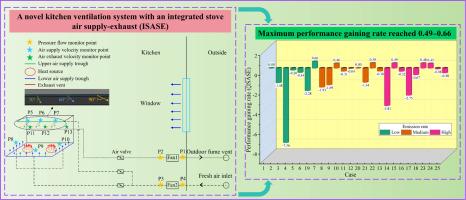
Abstract Image

优化厨房通风,采用一体化炉具送风排风系统,减少PM2.5的吸入,提高能源效率
确保良好的通风对于减少烹饪活动对室内环境造成的污染至关重要。其中,排烟装置作为厨房通风的重要组成部分,其性能尤为关键。单纯增加排烟装置的风量来排烟,不仅会导致排风机的能耗增加,而且对减少污染的实际效果有限。为改善厨房通风条件,降低送风机和排风机的能耗,设计了一种新型的厨房综合送风机系统。首先,利用正交试验对排放率、排气流量、上送风角度、上送风速度和下送风速度5个影响因素的不同组合方案进行了排序。然后,采用计算流体力学方法研究了ISASE在各方案下降低PM2.5进气分数的效果。通过现场试验研究了该系统在不同通风方式下的能耗。最后,通过引入进气分数降低率和能耗增长率,提出了性能增益率,定量评价了ISASE的性能优势。采用多项式拟合的方法探讨了ISASE在高排放率下的节能效果。结果表明,在低、中、高排放速率下,PM2.5的进气分数降低了65.0% ~ 84.2%。然而,与无送风条件的传统集成炉相比,ISASE的能耗仅增加了7.4% - 16.8%。其性能增益率最高可达0.49-0.66。在相同进气分数和高排放率的情况下,与传统不送风一体化炉相比,ISASE的节能率为46.7%。本文给出了不同排放速率下ISASE的实用方案,优化了一体化炉具的工作性能,为其创新设计提供了有益的参考。
本文章由计算机程序翻译,如有差异,请以英文原文为准。
求助全文
约1分钟内获得全文 求助全文
来源期刊
Energy and Built Environment
Energy and Built Environment Engineering-Building and Construction
CiteScore
15.90
自引率
0.00%
发文量
104
审稿时长
49 days

×
引用
GB/T 7714-2015
复制
MLA
复制
APA
复制
导出至
BibTeX EndNote RefMan NoteFirst NoteExpress
×
提示
您的信息不完整,为了账户安全,请先补充。
现在去补充
×
提示
您因"违规操作"
具体请查看互助需知
我知道了
×
提示
确定
请完成安全验证×
copy
已复制链接
快去分享给好友吧!
我知道了
右上角分享
点击右上角分享
0
联系我们:info@booksci.cn Book学术提供免费学术资源搜索服务,方便国内外学者检索中英文文献。致力于提供最便捷和优质的服务体验。 Copyright © 2023 布克学术 All rights reserved.
京ICP备2023020795号-1
ghs 京公网安备 11010802042870号
Book学术文献互助
Book学术文献互助群
群 号:604180095
Book学术官方微信
小红书


