
Numerical investigation of urban heat island effect in various urban forms
Q1 Engineering
Energy and Built Environment
Pub Date : 2026-02-01
Epub Date: 2024-11-05
DOI:10.1016/j.enbenv.2024.11.001
引用次数: 0
Abstract
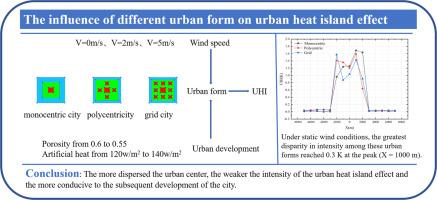
The urban heat island effect is a widespread phenomenon in major cities worldwide, exerting significant impacts on urban environments, human health, and energy consumption, thus attracting extensive research interest. The manifestation of the urban heat island effect varies across different urban forms. This study employs a three-dimensional porous media model to comprehensively analyze the urban heat island effect and the influence of wind speed on three typical urban layouts: single-center, multi-center, and grid.
The results indicate: (1) The more dispersed the city center, the weaker the urban heat island intensity, with differences in peak heat island intensity of up to 0.3 K among different urban forms. (2) Under favorable environmental wind conditions, higher wind speeds lead to weaker heat island intensity. At v = 5 m/s, the grid-based heat island intensity decreases by 0.57 K. (3) With increasing building density, the urban heat island effect intensifies in all three types of cities, with the single-center city exhibiting the largest increase in heat island intensity, up to 23.5 %
不同城市形态下城市热岛效应的数值研究
城市热岛效应是全球主要城市普遍存在的现象,对城市环境、人类健康和能源消费产生了重大影响,引起了广泛的研究兴趣。城市热岛效应的表现在不同的城市形态中存在差异。本文采用三维多孔介质模型,综合分析了城市热岛效应和风速对单中心、多中心和网格三种典型城市布局的影响。结果表明:(1)城市中心越分散,城市热岛强度越弱,不同城市形态之间的热岛强度峰值差异可达0.3 K。(2)在有利的环境风条件下,风速越大,热岛强度越弱。在v = 5 m/s时,网格热岛强度降低0.57 K。③随着建筑密度的增加,三种类型城市的热岛效应都在加剧,其中单中心城市的热岛强度增幅最大,达到23.5%
本文章由计算机程序翻译,如有差异,请以英文原文为准。
求助全文
约1分钟内获得全文
求助全文
来源期刊

Energy and Built Environment
Engineering-Building and Construction
CiteScore
15.90
自引率
0.00%
发文量
104
审稿时长
49 days
 求助内容:
求助内容: 应助结果提醒方式:

 京公网安备 11010802042870号


