
Design, synthesis, and mechanism of anti-cancer activity of novel spiro tetramic acids
IF 2.2
4区 医学
Q3 CHEMISTRY, MEDICINAL
Bioorganic & Medicinal Chemistry Letters
Pub Date : 2026-06-01
Epub Date: 2026-01-29
DOI:10.1016/j.bmcl.2026.130566
引用次数: 0
Abstract
Targeted therapies have pioneered a more effective new pathway in cancer treatment by leveraging their precision-targeting advantages. Spiro tetramic acids are a kind of unique pyrrolidine-2,4-dione core structure containing a spiro ring structure, primarily employed as agro-chemicals with limited application in the field of anti-cancer. In this paper, fourteen novel 3-acetyl and 3-phenyl spiro tetramic acids were designed, synthesized, and evaluated for anti-proliferation in cancer cells. 3-Acetyl and 3-phenyl spirotetramic acids exhibited toxic effects against tested cancer cell lines. Among the 14 compounds, compound 8d was the most effective against RKO and H1299 with Half Maximal Inhibitory Concentration (IC50) 3 ± 1 and 19 ± 2 μM. Further molecular structural prediction, bioinformatics analysis, and molecular docking revealed that compound 8d may target MMP1, MMP7 and PLK1. Additionally, 8d induced cell cycle arrest in G1 phase by increasing the expression of p21 protein and decreasing the expression of CCND1 and CCNB1 proteins. 8d also induced cell apoptosis through the mitochondrial pathways, as evidenced by alterations in the expressions of pertinent proteins, including Bcl-2 and Bax. These results indicated that the novel spirotetramine derivative 8d is a potential anti-cancer candidate drug and provides a new structural basis for the development of anti-cancer drugs.
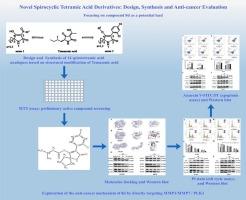
新型螺旋体四聚酸的设计、合成及其抗癌作用机理。
靶向治疗利用其精确靶向的优势,为癌症治疗开辟了一条更有效的新途径。螺旋四羧酸是一种独特的含有螺旋环结构的吡咯烷-2,4-二酮核心结构,主要用作农用化学品,在抗癌领域的应用有限。本文设计、合成了14种新型的3-乙酰基和3-苯基螺四酸,并对其在癌细胞中的抗增殖作用进行了评价。3-乙酰基和3-苯基螺戊酸对所测试的癌细胞表现出毒性作用。14个化合物中,化合物8d对RKO和H1299的抑制效果最好,IC50分别为3 ± 1和19 ± 2 μM。进一步的分子结构预测、生物信息学分析和分子对接表明,化合物8d可能靶向MMP1、MMP7和PLK1。此外,8d通过增加p21蛋白的表达,降低CCND1和CCNB1蛋白的表达,诱导细胞周期阻滞在G1期。8d还通过线粒体途径诱导细胞凋亡,相关蛋白包括Bcl-2和Bax的表达改变证明了这一点。这些结果表明,新的螺虫胺衍生物8d是一种潜在的抗癌候选药物,为抗癌药物的开发提供了新的结构基础。
本文章由计算机程序翻译,如有差异,请以英文原文为准。
求助全文
约1分钟内获得全文
求助全文
来源期刊
CiteScore
5.70
自引率
3.70%
发文量
463
审稿时长
27 days
期刊介绍:
Bioorganic & Medicinal Chemistry Letters presents preliminary experimental or theoretical research results of outstanding significance and timeliness on all aspects of science at the interface of chemistry and biology and on major advances in drug design and development. The journal publishes articles in the form of communications reporting experimental or theoretical results of special interest, and strives to provide maximum dissemination to a large, international audience.
 求助内容:
求助内容: 应助结果提醒方式:

 京公网安备 11010802042870号


