{"title":"Reversal of Cushing syndrome by antibody-mediated neutralization of ACBP/DBI.","authors":"Zhe Shen, Hui Pan, Xiaolian Deng, Oliver Kepp, Isabelle Martins, Guido Kroemer","doi":"10.15698/cst2026.01.314","DOIUrl":null,"url":null,"abstract":"<p><p>Cushing syndrome (CS) is caused by an increase in endogenous or exogenous glucocorticoids, leading to major alterations in body composition, including visceral obesity, sarcopenia, osteoporosis, type 2 diabetes, and dyslipidemia. Cardiovascular complications resulting from CS are often lethal. We previously demonstrated that CS induced by oral corticosterone (CORT) supplementation in mice can be prevented by inhibition of the peptide hormone acyl-CoA binding protein (ACBP), encoded by the gene diazepam binding inhibitor (DBI). Here, we investigated whether ACBP/DBI inhibition could be used to treat, rather than prevent, CS. To this end, we initiated treatment with anti-ACBP/DBI monoclonal antibodies (mAbs) in mice three weeks after the start of CORT supplementation, when hyperphagia and body weight gain were already established. Two anti-ACBP/DBI mAbs, 7G4a (specific for mouse ACBP/DBI only) and 82 (which recognizes both mouse and human ACBP/DBI), were able to normalize food intake and halt weight gain in mice under continuous CORT treatment. In addition, both mAbs attenuated CORT-induced sarcopenia, adiposity in inguinal, perigonadal, and visceral fat depots, and fully restored metabolic parameters, including type-2 diabetes, insulinemia, free fatty acids, triglycerides, and liver transaminases. In conclusion, neutralization of ACBP/DBI may serve as an effective therapeutic strategy for the treatment of established CS.</p>","PeriodicalId":36371,"journal":{"name":"Cell Stress","volume":"10 ","pages":"1-8"},"PeriodicalIF":3.4000,"publicationDate":"2026-01-26","publicationTypes":"Journal Article","fieldsOfStudy":null,"isOpenAccess":false,"openAccessPdf":"https://www.ncbi.nlm.nih.gov/pmc/articles/PMC12845394/pdf/","citationCount":"0","resultStr":null,"platform":"Semanticscholar","paperid":null,"PeriodicalName":"Cell Stress","FirstCategoryId":"1085","ListUrlMain":"https://doi.org/10.15698/cst2026.01.314","RegionNum":0,"RegionCategory":null,"ArticlePicture":[],"TitleCN":null,"AbstractTextCN":null,"PMCID":null,"EPubDate":"2026/1/1 0:00:00","PubModel":"eCollection","JCR":"Q2","JCRName":"CELL BIOLOGY","Score":null,"Total":0}
引用次数: 0
Abstract
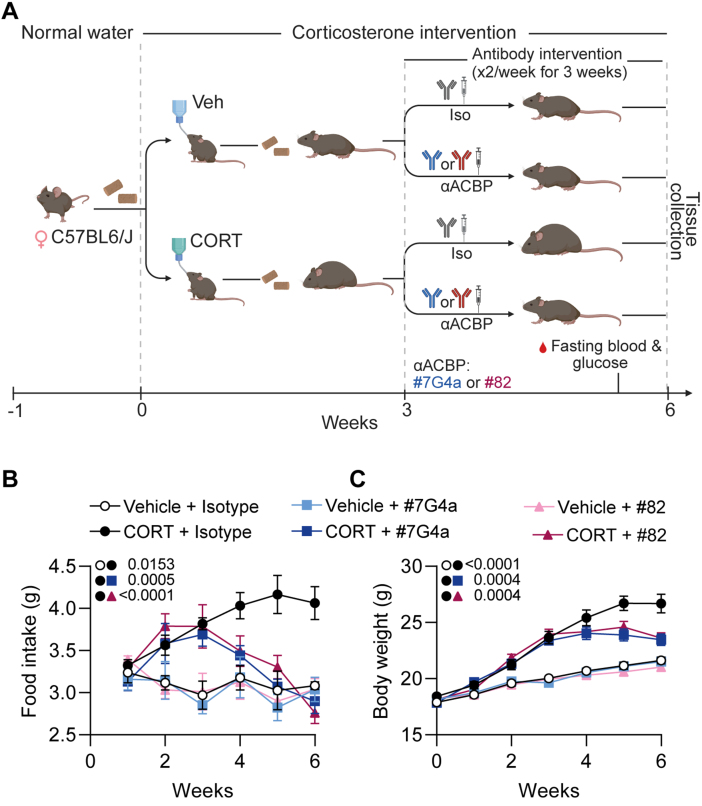
Cushing syndrome (CS) is caused by an increase in endogenous or exogenous glucocorticoids, leading to major alterations in body composition, including visceral obesity, sarcopenia, osteoporosis, type 2 diabetes, and dyslipidemia. Cardiovascular complications resulting from CS are often lethal. We previously demonstrated that CS induced by oral corticosterone (CORT) supplementation in mice can be prevented by inhibition of the peptide hormone acyl-CoA binding protein (ACBP), encoded by the gene diazepam binding inhibitor (DBI). Here, we investigated whether ACBP/DBI inhibition could be used to treat, rather than prevent, CS. To this end, we initiated treatment with anti-ACBP/DBI monoclonal antibodies (mAbs) in mice three weeks after the start of CORT supplementation, when hyperphagia and body weight gain were already established. Two anti-ACBP/DBI mAbs, 7G4a (specific for mouse ACBP/DBI only) and 82 (which recognizes both mouse and human ACBP/DBI), were able to normalize food intake and halt weight gain in mice under continuous CORT treatment. In addition, both mAbs attenuated CORT-induced sarcopenia, adiposity in inguinal, perigonadal, and visceral fat depots, and fully restored metabolic parameters, including type-2 diabetes, insulinemia, free fatty acids, triglycerides, and liver transaminases. In conclusion, neutralization of ACBP/DBI may serve as an effective therapeutic strategy for the treatment of established CS.
Cell StressBiochemistry, Genetics and Molecular Biology-Biochemistry, Genetics and Molecular Biology (miscellaneous)
CiteScore
13.50
自引率
0.00%
发文量
21
审稿时长
15 weeks
期刊介绍:
Cell Stress is an open-access, peer-reviewed journal that is dedicated to publishing highly relevant research in the field of cellular pathology. The journal focuses on advancing our understanding of the molecular, mechanistic, phenotypic, and other critical aspects that underpin cellular dysfunction and disease. It specifically aims to foster cell biology research that is applicable to a range of significant human diseases, including neurodegenerative disorders, myopathies, mitochondriopathies, infectious diseases, cancer, and pathological aging.
The scope of Cell Stress is broad, welcoming submissions that represent a spectrum of research from fundamental to translational and clinical studies. The journal is a valuable resource for scientists, educators, and policymakers worldwide, as well as for any individual with an interest in cellular pathology. It serves as a platform for the dissemination of research findings that are instrumental in the investigation, classification, diagnosis, and therapeutic management of major diseases. By being open-access, Cell Stress ensures that its content is freely available to a global audience, thereby promoting international scientific collaboration and accelerating the exchange of knowledge within the research community.



 求助内容:
求助内容: 应助结果提醒方式:

 京公网安备 11010802042870号


