{"title":"Crosslinking of tarsal collagen as a hypothetical therapy for dry eye disease.","authors":"Alexandra I Manta, Shuko Suzuki, Traian V Chirila","doi":"10.51329/mehdiophthal1535","DOIUrl":null,"url":null,"abstract":"<p><strong>Background: </strong>Dry eye disease (DED) is one of the most prevalent and distressing ocular conditions worldwide; it primarily results from alterations in the natural tear film that covers the ocular surface and is often due to enhanced evaporation of its aqueous component. This process is frequently associated with dysfunction of the meibomian glands (MGs), which are embedded within the tarsal plate of our eyelids and secrete the meibum, an oily mixture of proteins and lipids. Meibum forms the outermost layer of the tear film, playing a critical role in controlling water evaporation and stabilizing the tear film by lowering surface tension. Meibomian gland dysfunction (MGD) may result from structural abnormalities in the MGs, such as tortuosity, which impair normal delivery of meibum. Increased laxity of the eyelid is also associated with development of MGD and DED, likely due to insufficient mechanical support for the glands, and causing morphological changes.</p><p><strong>Hypothesis: </strong>We designed and initiated the development of a noninvasive method to strengthen and stiffen the tarsal collagen containing the embedded MGs. By reducing tissue laxity, our aim is to halt further morphological deterioration of the glands and promote uniform and smooth delivery of meibum to the ocular surface. Our previous studies showed that both mechanical tensile strength and rigidity (Young's modulus) of tarsal collagen in animal and human eyelids were significantly enhanced by exposure to ultraviolet-A (UV-A) radiation with a wavelength of 365 nm in the presence of riboflavin as a photosensitizer.</p><p><strong>Conclusions: </strong>We propose that performing this procedure at the initial manifestations of MGD and DED may prevent disease progression by restoring and preserving the normal morphology of the glands through reduced laxity, thereby ensuring proper secretion of the meibum into the tear film. The underlying principles and safety of the procedure were discussed in detail, and further pre-clinical evaluation steps were proposed and justified. Based on the proposed concept and the results of previous ex-vivo studies, in-vivo animal experiments and human clinical trials are currently in preparation.</p>","PeriodicalId":36524,"journal":{"name":"Medical Hypothesis, Discovery, and Innovation in Ophthalmology","volume":"14 4","pages":"233-250"},"PeriodicalIF":0.0000,"publicationDate":"2025-12-17","publicationTypes":"Journal Article","fieldsOfStudy":null,"isOpenAccess":false,"openAccessPdf":"https://www.ncbi.nlm.nih.gov/pmc/articles/PMC12840572/pdf/","citationCount":"0","resultStr":null,"platform":"Semanticscholar","paperid":null,"PeriodicalName":"Medical Hypothesis, Discovery, and Innovation in Ophthalmology","FirstCategoryId":"1085","ListUrlMain":"https://doi.org/10.51329/mehdiophthal1535","RegionNum":0,"RegionCategory":null,"ArticlePicture":[],"TitleCN":null,"AbstractTextCN":null,"PMCID":null,"EPubDate":"2025/1/1 0:00:00","PubModel":"eCollection","JCR":"Q2","JCRName":"Medicine","Score":null,"Total":0}
引用次数: 0
Abstract
Background: Dry eye disease (DED) is one of the most prevalent and distressing ocular conditions worldwide; it primarily results from alterations in the natural tear film that covers the ocular surface and is often due to enhanced evaporation of its aqueous component. This process is frequently associated with dysfunction of the meibomian glands (MGs), which are embedded within the tarsal plate of our eyelids and secrete the meibum, an oily mixture of proteins and lipids. Meibum forms the outermost layer of the tear film, playing a critical role in controlling water evaporation and stabilizing the tear film by lowering surface tension. Meibomian gland dysfunction (MGD) may result from structural abnormalities in the MGs, such as tortuosity, which impair normal delivery of meibum. Increased laxity of the eyelid is also associated with development of MGD and DED, likely due to insufficient mechanical support for the glands, and causing morphological changes.
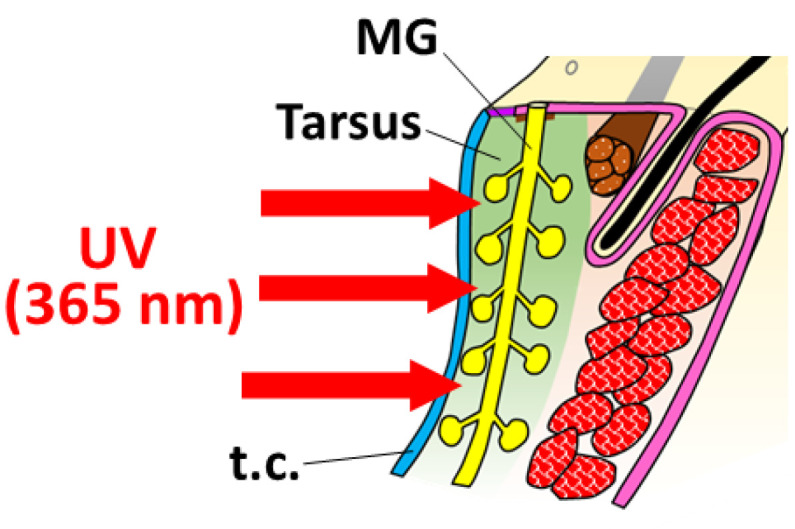
Hypothesis: We designed and initiated the development of a noninvasive method to strengthen and stiffen the tarsal collagen containing the embedded MGs. By reducing tissue laxity, our aim is to halt further morphological deterioration of the glands and promote uniform and smooth delivery of meibum to the ocular surface. Our previous studies showed that both mechanical tensile strength and rigidity (Young's modulus) of tarsal collagen in animal and human eyelids were significantly enhanced by exposure to ultraviolet-A (UV-A) radiation with a wavelength of 365 nm in the presence of riboflavin as a photosensitizer.
Conclusions: We propose that performing this procedure at the initial manifestations of MGD and DED may prevent disease progression by restoring and preserving the normal morphology of the glands through reduced laxity, thereby ensuring proper secretion of the meibum into the tear film. The underlying principles and safety of the procedure were discussed in detail, and further pre-clinical evaluation steps were proposed and justified. Based on the proposed concept and the results of previous ex-vivo studies, in-vivo animal experiments and human clinical trials are currently in preparation.



 求助内容:
求助内容: 应助结果提醒方式:

 京公网安备 11010802042870号


