
miR-322-5p mediates maternal immune activation-induced schizophrenia-like behaviors via regulation of the BDNF/TrkB/AKT signaling pathway
IF 7.6
2区 医学
Q1 IMMUNOLOGY
Brain, Behavior, and Immunity
Pub Date : 2026-05-01
Epub Date: 2026-01-29
DOI:10.1016/j.bbi.2026.106298
引用次数: 0
Abstract
Maternal immune activation (MIA) is a key environmental risk factor for neurodevelopmental disorders such as schizophrenia. MicroRNAs are critical regulators of brain development, yet their role in MIA-induced pathology remains unclear. We found that miR-322-5p was significantly upregulated in the prefrontal cortex of MIA-exposed offspring and directly targeted the 3′ untranslated region of brain-derived neurotrophic factor (BDNF), inhibiting its expression. This upregulation impaired BDNF/TrkB/AKT signaling and reduced the synaptic protein PSD95, leading to hypoactivity, cognitive deficits, social impairments, and disrupted sensorimotor gating. Inhibition of miR-322-5p or overexpression of BDNF in the prefrontal cortex restored signaling and reversed both behavioral and molecular abnormalities. These results identify miR-322-5p as a key mediator of MIA-induced neuropathology via repression of BDNF signaling and suggest its potential as a therapeutic target in neurodevelopmental disorders.
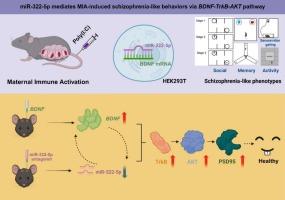
miR-322-5p通过调控BDNF/TrkB/AKT信号通路介导母体免疫激活诱导的精神分裂症样行为。
母体免疫激活(MIA)是精神分裂症等神经发育障碍的关键环境危险因素。microrna是大脑发育的关键调节因子,但它们在mia诱导的病理中的作用尚不清楚。我们发现miR-322-5p在mia暴露后代的前额皮质中显著上调,并直接靶向脑源性神经营养因子(BDNF)的3'非翻译区,抑制其表达。这种上调损害了BDNF/TrkB/AKT信号,降低了突触蛋白PSD95,导致活动减退、认知缺陷、社交障碍和感觉运动门控中断。抑制前额皮质中miR-322-5p或BDNF的过表达可以恢复信号传导并逆转行为和分子异常。这些结果表明,miR-322-5p通过抑制BDNF信号传导,是mia诱导的神经病理的关键介质,并表明其作为神经发育障碍的治疗靶点的潜力。
本文章由计算机程序翻译,如有差异,请以英文原文为准。
求助全文
约1分钟内获得全文
求助全文
来源期刊
CiteScore
29.60
自引率
2.00%
发文量
290
审稿时长
28 days
期刊介绍:
Established in 1987, Brain, Behavior, and Immunity proudly serves as the official journal of the Psychoneuroimmunology Research Society (PNIRS). This pioneering journal is dedicated to publishing peer-reviewed basic, experimental, and clinical studies that explore the intricate interactions among behavioral, neural, endocrine, and immune systems in both humans and animals.
As an international and interdisciplinary platform, Brain, Behavior, and Immunity focuses on original research spanning neuroscience, immunology, integrative physiology, behavioral biology, psychiatry, psychology, and clinical medicine. The journal is inclusive of research conducted at various levels, including molecular, cellular, social, and whole organism perspectives. With a commitment to efficiency, the journal facilitates online submission and review, ensuring timely publication of experimental results. Manuscripts typically undergo peer review and are returned to authors within 30 days of submission. It's worth noting that Brain, Behavior, and Immunity, published eight times a year, does not impose submission fees or page charges, fostering an open and accessible platform for scientific discourse.
 求助内容:
求助内容: 应助结果提醒方式:

 京公网安备 11010802042870号


