
A549 and Ci-hAELVi cell lines coculture as a new human alveolar epithelium model for air-liquid interface exposure
IF 2.7
3区 医学
Q3 TOXICOLOGY
引用次数: 0
Abstract
Air pollution represents a growing threat to human health, particularly affecting the respiratory system through the inhalation of gaseous pollutants and fine particles that reach the alveolar region composed mainly of alveolar epithelial type I (AT1) and type II (AT2) cells at the air-liquid interface (ALI). To reduce reliance on animal models, physiologically relevant and experimentally accessible in vitro models are increasingly needed for inhalation toxicology. In this study, we developed and characterized a simple and robust human alveolar coculture model at ALI using commercially available cell lines, A549 (AT2 phenotype-like) and Ci-hAELVi (AT1 phenotype-like). Two ALI acclimatization periods (24 h and six days) were evaluated under incubator control and clean air exposure conditions. The coculture exhibited stable metabolic activity, controlled proliferation, and reduced variability compared to monoculture. The model expressed complementary AT1- (Podoplanin, Caveolin-1, Aquaporin-5, HTI56) and AT2 pneumocyte-associated markers (surfactant proteins and HTII280) at the gene and protein levels, resulting in a mix of both the alveolar epithelial phenotypes. Importantly, the coculture model maintained epithelial integrity and functional stability during prolonged ALI exposure for up to 72 h, exceeding the typical exposure window of monoculture system. In addition, responsiveness of coculture with ZnO aerosol and lipopolysaccharides exposure, was tested demonstrating its functional relevance. Overall, this relevant coculture model provides a valuable in vitro tool for preliminary toxicological screening.
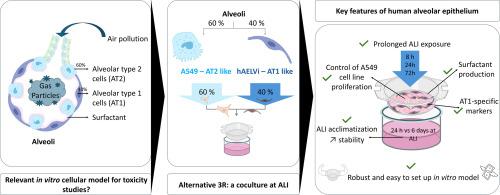
A549和CI-hAELVi细胞系共培养作为新的人肺泡上皮气液界面暴露模型。
空气污染对人类健康的威胁越来越大,特别是通过吸入气体污染物和细小颗粒影响呼吸系统,这些颗粒到达主要由肺泡上皮I型(AT1)和II型(AT2)细胞在气液界面(ALI)组成的肺泡区。为了减少对动物模型的依赖,吸入毒理学研究越来越需要生理学上相关的和实验上可获得的体外模型。在这项研究中,我们利用市售的A549 (AT2表型样)和Ci-hAELVi (AT1表型样)细胞系,在ALI建立了一个简单而强大的人类肺泡共培养模型并进行了表征。在培养箱控制和清洁空气暴露条件下,评估了两个ALI驯化期(24 h和6天)。与单一培养相比,共培养表现出稳定的代谢活性、增殖控制和变异性降低。该模型在基因和蛋白质水平上表达互补的AT1- (Podoplanin, Caveolin-1, Aquaporin-5, HTI56)和AT2肺细胞相关标志物(表面活性剂蛋白和HTII280),导致肺泡上皮表型混合。重要的是,共培养模型在长达72 h的长时间ALI暴露中保持了上皮的完整性和功能稳定性,超过了单培养系统的典型暴露窗口。此外,还测试了氧化锌气溶胶和脂多糖暴露共同培养的响应性,以证明其功能相关性。总之,这个相关的共培养模型为初步毒理学筛选提供了一个有价值的体外工具。
本文章由计算机程序翻译,如有差异,请以英文原文为准。
求助全文
约1分钟内获得全文
求助全文
来源期刊
Toxicology in Vitro
医学-毒理学
CiteScore
6.50
自引率
3.10%
发文量
181
审稿时长
65 days
期刊介绍:
Toxicology in Vitro publishes original research papers and reviews on the application and use of in vitro systems for assessing or predicting the toxic effects of chemicals and elucidating their mechanisms of action. These in vitro techniques include utilizing cell or tissue cultures, isolated cells, tissue slices, subcellular fractions, transgenic cell cultures, and cells from transgenic organisms, as well as in silico modelling. The Journal will focus on investigations that involve the development and validation of new in vitro methods, e.g. for prediction of toxic effects based on traditional and in silico modelling; on the use of methods in high-throughput toxicology and pharmacology; elucidation of mechanisms of toxic action; the application of genomics, transcriptomics and proteomics in toxicology, as well as on comparative studies that characterise the relationship between in vitro and in vivo findings. The Journal strongly encourages the submission of manuscripts that focus on the development of in vitro methods, their practical applications and regulatory use (e.g. in the areas of food components cosmetics, pharmaceuticals, pesticides, and industrial chemicals). Toxicology in Vitro discourages papers that record reporting on toxicological effects from materials, such as plant extracts or herbal medicines, that have not been chemically characterized.
 求助内容:
求助内容: 应助结果提醒方式:

 京公网安备 11010802042870号


