
Loss of Galectin-3 in the epidermis exacerbates psoriasis pathogenesis via inhibiting autophagy
IF 5.1
2区 医学
Q1 MEDICINE, RESEARCH & EXPERIMENTAL
引用次数: 0
Abstract
Aims
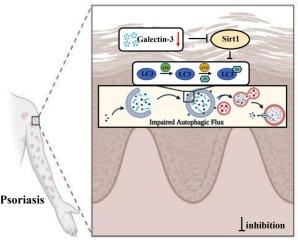
Galectin-3 (Gal3) is linked to psoriasis pathophysiology, however, the detailed mechanism of Gal3 involved in this course still needs further addressing. This study aimed to elucidate the role of Gal3 in psoriasis.
Materials and methods
Imiquimod (IMQ)-induced psoriasis model in wild-type (WT) as well as Gal3 knockout (Gal3−/−) mice were established to investigate the impact of Gal3 expression on the development of psoriasis. Autophagy markers LC3 and P62 (SQSTM1) were detected. In vitro, HaCaT cells with Gal3 knockdown were established to detect the effect on the autophagic flux. Then the Sirt1 agonist SRT1720 was used to demonstrate whether Gal3 affects autophagy via Sirt1. The regulation of Sirt1 by Gal3 was demonstrated through half-life experiments.
Key findings
Gal3 was significantly reduced in the epidermis in IMQ-induced psoriasis model. The skin inflammation in Gal3−/− mice more severe than that in WT controls. A deficiency of Gal3 not only reduced the autophagy in psoriatic lesions of the mice model but also effectively inhibited autophagy in a cultured HaCaT cell model. Gal3 was demonstrated to be involved in the assembly of autophagosomes by regulating autophagic flux. In Gal3-depleted mouse skin and HaCaT cells, Sirt1 was downregulated, and SRT1720 could compensate for the impaired autophagy caused by Gal3 deficiency. Gal3 may be involved in the regulation of Sirt1 protein stability.
Significance
Gal3 loss exacerbates psoriasis by impairing the autophagic process. These findings position Gal3 as a key protective factor against psoriasis, providing new insights into its role in the pathogenesis of this disease.
表皮中半乳糖凝集素-3的缺失通过抑制自噬加剧了银屑病的发病机制
目的galectin -3 (Gal3)与银屑病的病理生理有关,但Gal3在这一过程中的具体机制还有待进一步研究。本研究旨在阐明Gal3在银屑病中的作用。材料与方法建立咪喹莫特(IMQ)诱导的野生型(WT)和Gal3敲除(Gal3−/−)小鼠银屑病模型,研究Gal3表达对银屑病发展的影响。检测自噬标志物LC3和P62 (SQSTM1)。体外建立敲低Gal3的HaCaT细胞,检测其对自噬通量的影响。然后使用Sirt1激动剂SRT1720来证明Gal3是否通过Sirt1影响自噬。通过半衰期实验证实了Gal3对Sirt1的调控作用。主要发现:imq诱导的银屑病模型中表皮gal3显著降低。Gal3−/−小鼠的皮肤炎症较WT对照组严重。缺乏Gal3不仅可以减少小鼠银屑病模型的自噬,还可以有效抑制培养的HaCaT细胞模型的自噬。研究证实Gal3通过调节自噬通量参与自噬体的组装。在Gal3缺失的小鼠皮肤和HaCaT细胞中,Sirt1下调,SRT1720可以补偿Gal3缺失导致的自噬受损。Gal3可能参与Sirt1蛋白稳定性的调控。egal3丢失通过损害自噬过程加重银屑病。这些发现表明Gal3是预防牛皮癣的关键保护因子,为其在牛皮癣发病机制中的作用提供了新的见解。
本文章由计算机程序翻译,如有差异,请以英文原文为准。
求助全文
约1分钟内获得全文
求助全文
来源期刊
Life sciences
医学-药学
CiteScore
12.20
自引率
1.60%
发文量
841
审稿时长
6 months
期刊介绍:
Life Sciences is an international journal publishing articles that emphasize the molecular, cellular, and functional basis of therapy. The journal emphasizes the understanding of mechanism that is relevant to all aspects of human disease and translation to patients. All articles are rigorously reviewed.
The Journal favors publication of full-length papers where modern scientific technologies are used to explain molecular, cellular and physiological mechanisms. Articles that merely report observations are rarely accepted. Recommendations from the Declaration of Helsinki or NIH guidelines for care and use of laboratory animals must be adhered to. Articles should be written at a level accessible to readers who are non-specialists in the topic of the article themselves, but who are interested in the research. The Journal welcomes reviews on topics of wide interest to investigators in the life sciences. We particularly encourage submission of brief, focused reviews containing high-quality artwork and require the use of mechanistic summary diagrams.
 求助内容:
求助内容: 应助结果提醒方式:

 京公网安备 11010802042870号


