
In vivo multi-omics evaluation of ellagic Acid–Gold nanoparticles from Syzygium cumini for glycemic improvement and β-cell preservation in type 2 diabetic mice
Advances in biomarker sciences and technology
Pub Date : 2026-11-01
Epub Date: 2026-01-21
DOI:10.1016/j.abst.2026.01.007
引用次数: 0
Abstract
Diabetes mellitus remains a major global health challenge, affecting over 537 million adults worldwide and this number is expected to rise 783 million by 2045, underscoring the need for improved therapeutic strategies. In this study, we synthesized and evaluated ellagic-acid-loaded gold nanoparticles (EA-AuNPs) prepared from Syzygium cumini seed extract as a potential antidiabetic intervention. EA-AuNPs exhibited a spherical morphology with an average size of 68.4 ± 5.2 nm, zeta potential of −24.6 mV, and encapsulation efficiency of 81.3 ± 2.7 %, indicating stability and optimal drug-loading capacity. In vivo testing in streptozotocin-induced diabetic mice (n = 40) revealed that EA-AuNPs (25 mg/kg, orally, for 28 days) reduced fasting blood glucose by 68.3 % (p < 0.001) and HbA1c by 43.5 % (p < 0.01), while enhancing serum insulin by 2.8-fold. Histological assessment showed restoration of islet morphology with an increase in β-cell area, consistent with protective and recovery-associated effects. Multi-omics analyses supported modulation of metabolic and inflammatory pathways, including PI3K/AKT, AMPK, and NF-κB, consistent with improved glucose homeostasis and reduced oxidative stress (MDA ↓52.4 %, SOD ↑2.1-fold). Collectively, these findings suggest that EA-AuNPs may offer a promising nanophytochemical approach for managing Type 2 diabetes, warranting further mechanistic and translational investigation.
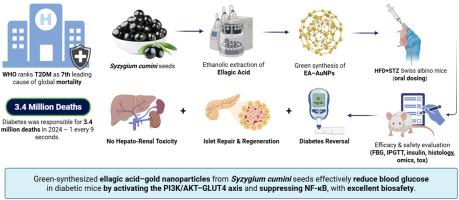
鸢尾鞣花酸-金纳米颗粒对2型糖尿病小鼠血糖改善和β细胞保存的体内多组学评价
糖尿病仍然是一项重大的全球健康挑战,影响着全世界5.37亿多成年人,预计到2045年这一数字将增加7.83亿,这突出表明需要改进治疗策略。在这项研究中,我们合成并评估了从西洋参种子提取物中制备的鞣花酸负载金纳米颗粒(EA-AuNPs)作为潜在的抗糖尿病干预措施。EA-AuNPs呈球形,平均粒径为68.4±5.2 nm, zeta电位为- 24.6 mV,包封效率为81.3±2.7%,具有良好的稳定性和最佳的载药量。对链脲霉素诱导的糖尿病小鼠(n = 40)的体内试验显示,EA-AuNPs (25 mg/kg,口服,28天)使空腹血糖降低68.3% (p < 0.001),使糖化血红蛋白降低43.5% (p < 0.01),使血清胰岛素提高2.8倍。组织学评估显示胰岛形态的恢复与β细胞面积的增加,符合保护和恢复相关的作用。多组学分析支持代谢和炎症途径的调节,包括PI3K/AKT、AMPK和NF-κB,与改善葡萄糖稳态和降低氧化应激(MDA↓52.4%,SOD↑2.1倍)一致。总的来说,这些发现表明EA-AuNPs可能为治疗2型糖尿病提供了一种有前途的纳米植物化学方法,值得进一步的机制和转化研究。
本文章由计算机程序翻译,如有差异,请以英文原文为准。
求助全文
约1分钟内获得全文
求助全文
来源期刊

Advances in biomarker sciences and technology
Biotechnology, Clinical Biochemistry, Molecular Medicine, Public Health and Health Policy
自引率
0.00%
发文量
0
审稿时长
20 weeks
 求助内容:
求助内容: 应助结果提醒方式:

 京公网安备 11010802042870号


