Haily Liduin Koyou, Vasudevan Ramachandran, Mohd Nazil Salleh, Wan Aliaa Wan Sulaiman, Mohd Hazmi Mohamed, Mohd Jaamia Qaadir Mohd Badrin, Caroline Satu Jelemie
{"title":"S100 Protein and Interleukin Biomarkers Among COVID-19 Subjects With and Without Pneumonia: A Systematic Review and Meta-Analysis.","authors":"Haily Liduin Koyou, Vasudevan Ramachandran, Mohd Nazil Salleh, Wan Aliaa Wan Sulaiman, Mohd Hazmi Mohamed, Mohd Jaamia Qaadir Mohd Badrin, Caroline Satu Jelemie","doi":"10.3389/bjbs.2025.15355","DOIUrl":null,"url":null,"abstract":"<p><strong>Background: </strong>The global spread of COVID-19, caused by SARS-CoV-2, has resulted in a wide spectrum of clinical manifestations, ranging from asymptomatic cases to severe complications, such as pneumonia, acute respiratory distress syndrome (ARDS), and multiple organ failure. Identifying effective biomarkers is essential for predicting disease severity and improving patient management.</p><p><strong>Objectives: </strong>This meta-analysis aims to assess the significance of S100 proteins (S100A4, S100A8, S100A9, S100A12, S100B, S100P) and interleukins (IL) (IL-6, IL-8, IL-10, IL-17, IL-1β) in COVID-19 patients, comparing those with and without pneumonia or organ failure.</p><p><strong>Methods: </strong>A systematic literature search was conducted on different databases, yielding 47 relevant studies published between 2020 and 2024. Data on the prevalence of IL and S100 protein levels were extracted and analyzed using pooled standardized mean differences (SMD) and heterogeneity (I<sup>2</sup>) to evaluate their associations with disease severity.</p><p><strong>Results: </strong>IL-6 and IL-10 levels were significantly elevated in COVID-19 patients suffering from pneumonia or organ failure. IL-6 levels were notably higher in pneumonia patients compared to those without (SMD = 0.34 [95% CI: 0.17, 0.52], I<sup>2</sup> = 29%). Similarly, elevated S100B levels were observed in severe cases (SMD = 0.51 [95% CI: 0.19, 0.83], I<sup>2</sup> = 0%). While IL-10 levels showed high variability (I<sup>2</sup> = 90%), they remained consistently linked with worse outcomes.</p><p><strong>Conclusion: </strong>This meta-analysis underscores the potential of IL-6, IL-10, and S100 proteins as important biomarkers in evaluating COVID-19 severity, offering valuable insights to help clinical management.</p>","PeriodicalId":9236,"journal":{"name":"British Journal of Biomedical Science","volume":"82 ","pages":"15355"},"PeriodicalIF":4.6000,"publicationDate":"2026-01-08","publicationTypes":"Journal Article","fieldsOfStudy":null,"isOpenAccess":false,"openAccessPdf":"https://www.ncbi.nlm.nih.gov/pmc/articles/PMC12823546/pdf/","citationCount":"0","resultStr":null,"platform":"Semanticscholar","paperid":null,"PeriodicalName":"British Journal of Biomedical Science","FirstCategoryId":"3","ListUrlMain":"https://doi.org/10.3389/bjbs.2025.15355","RegionNum":4,"RegionCategory":"医学","ArticlePicture":[],"TitleCN":null,"AbstractTextCN":null,"PMCID":null,"EPubDate":"2025/1/1 0:00:00","PubModel":"eCollection","JCR":"Q2","JCRName":"MEDICAL LABORATORY TECHNOLOGY","Score":null,"Total":0}
引用次数: 0
Abstract
Background: The global spread of COVID-19, caused by SARS-CoV-2, has resulted in a wide spectrum of clinical manifestations, ranging from asymptomatic cases to severe complications, such as pneumonia, acute respiratory distress syndrome (ARDS), and multiple organ failure. Identifying effective biomarkers is essential for predicting disease severity and improving patient management.
Objectives: This meta-analysis aims to assess the significance of S100 proteins (S100A4, S100A8, S100A9, S100A12, S100B, S100P) and interleukins (IL) (IL-6, IL-8, IL-10, IL-17, IL-1β) in COVID-19 patients, comparing those with and without pneumonia or organ failure.
Methods: A systematic literature search was conducted on different databases, yielding 47 relevant studies published between 2020 and 2024. Data on the prevalence of IL and S100 protein levels were extracted and analyzed using pooled standardized mean differences (SMD) and heterogeneity (I2) to evaluate their associations with disease severity.
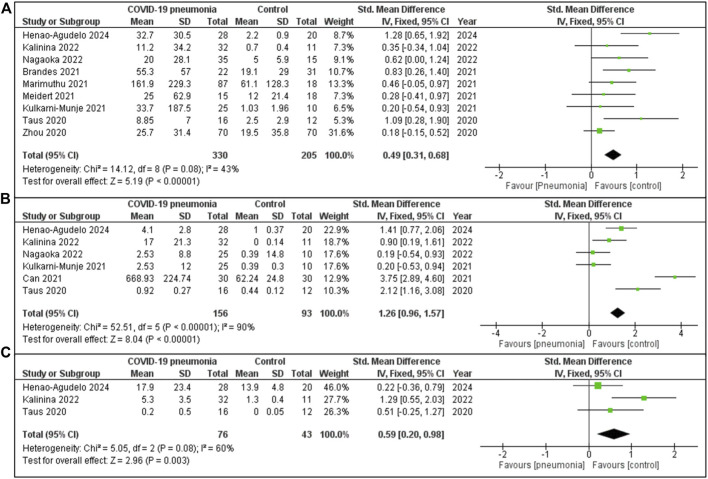
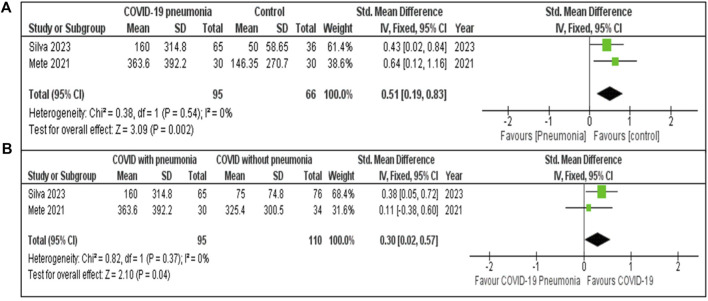
Results: IL-6 and IL-10 levels were significantly elevated in COVID-19 patients suffering from pneumonia or organ failure. IL-6 levels were notably higher in pneumonia patients compared to those without (SMD = 0.34 [95% CI: 0.17, 0.52], I2 = 29%). Similarly, elevated S100B levels were observed in severe cases (SMD = 0.51 [95% CI: 0.19, 0.83], I2 = 0%). While IL-10 levels showed high variability (I2 = 90%), they remained consistently linked with worse outcomes.
Conclusion: This meta-analysis underscores the potential of IL-6, IL-10, and S100 proteins as important biomarkers in evaluating COVID-19 severity, offering valuable insights to help clinical management.
期刊介绍:
The British Journal of Biomedical Science is committed to publishing high quality original research that represents a clear advance in the practice of biomedical science, and reviews that summarise recent advances in the field of biomedical science. The overall aim of the Journal is to provide a platform for the dissemination of new and innovative information on the diagnosis and management of disease that is valuable to the practicing laboratory scientist.


 求助内容:
求助内容: 应助结果提醒方式:

 京公网安备 11010802042870号


