
Deep Reinforcement Learning in Software Defined Networking: A Survey, Research Challenges, and Future Perspectives
IF 50.6
1区 计算机科学
Q1 COMPUTER SCIENCE, INFORMATION SYSTEMS
IEEE Communications Surveys and Tutorials
Pub Date : 2026-01-01
Epub Date: 2026-01-21
DOI:10.1109/COMST.2026.3656733
引用次数: 0
Abstract
Recent advancements in mobile and internet communication technologies have resulted in the increased complexity and heterogeneity of networking systems. In order to manage these heterogeneous systems more efficiently, there is a requirement for greater intelligence. Since traditional networks with decentralized architecture face challenges in implementing machine learning (ML) techniques to manage the network, the Software Defined Networking (SDN) paradigm offers a solution by decoupling the network’s control functions and data forwarding functions, and centralizing network management through a programmable controller. The centralized controller enables ML techniques to optimize network-wide policies. However, traditional ML techniques, like Reinforcement Learning (RL), face challenges in managing complex networks due to a large state space. Deep Reinforcement Learning (DRL) addresses these issues by combining RL with Deep Learning (DL) that improves the learning efficiency of traditional RL. In this paper, we provide a survey of DRL applications in various SDN domains. First, related work and a brief background of SDN and DRL are provided. Then, we present an overview of existing DRL methods. Further, we systematically review how DRL methods are applied in the SDN from various perspectives, including Traffic Engineering, Quality of Service/Quality of Experience optimization, and Security. We present case studies that highlight the effectiveness of DRL in dynamic network environments, and also analyze the training architecture of DRL in SDN. Finally, we highlight current research challenges, recent advances, and outline future research directions.软件定义网络中的深度强化学习:调查、研究挑战和未来展望
移动和互联网通信技术的最新进展导致网络系统的复杂性和异质性增加。为了更有效地管理这些异构系统,需要更高的智能。由于具有分散架构的传统网络在实现机器学习(ML)技术来管理网络方面面临挑战,软件定义网络(SDN)范式通过解耦网络的控制功能和数据转发功能,并通过可编程控制器集中网络管理,提供了一种解决方案。集中式控制器使机器学习技术能够优化网络范围的策略。然而,传统的机器学习技术,如强化学习(RL),由于状态空间大,在管理复杂网络方面面临挑战。深度强化学习(DRL)通过将强化学习与深度学习(DL)相结合来解决这些问题,从而提高了传统强化学习的学习效率。在本文中,我们提供了一个调查在各种SDN域的DRL应用。首先,介绍了SDN和DRL的相关工作和背景。然后,我们对现有的DRL方法进行了概述。此外,我们从流量工程、服务质量/体验质量优化和安全性等多个角度系统地回顾了DRL方法在SDN中的应用。我们通过案例研究强调了DRL在动态网络环境中的有效性,并分析了SDN中DRL的训练体系结构。最后,我们强调了当前的研究挑战、最新进展,并概述了未来的研究方向。
本文章由计算机程序翻译,如有差异,请以英文原文为准。
求助全文
约1分钟内获得全文
求助全文
来源期刊
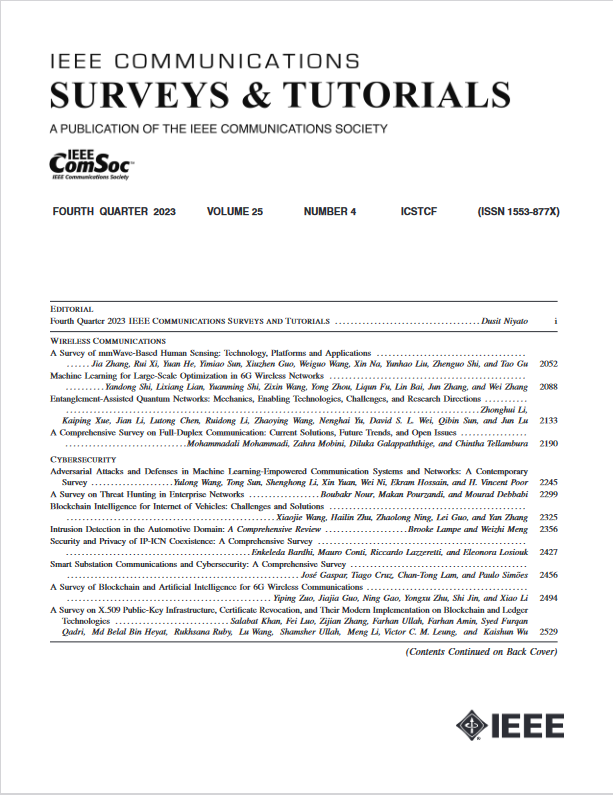
IEEE Communications Surveys and Tutorials
COMPUTER SCIENCE, INFORMATION SYSTEMS-TELECOMMUNICATIONS
CiteScore
80.20
自引率
2.50%
发文量
84
审稿时长
6 months
期刊介绍:
IEEE Communications Surveys & Tutorials is an online journal published by the IEEE Communications Society for tutorials and surveys covering all aspects of the communications field. Telecommunications technology is progressing at a rapid pace, and the IEEE Communications Society is committed to providing researchers and other professionals the information and tools to stay abreast. IEEE Communications Surveys and Tutorials focuses on integrating and adding understanding to the existing literature on communications, putting results in context. Whether searching for in-depth information about a familiar area or an introduction into a new area, IEEE Communications Surveys & Tutorials aims to be the premier source of peer-reviewed, comprehensive tutorials and surveys, and pointers to further sources. IEEE Communications Surveys & Tutorials publishes only articles exclusively written for IEEE Communications Surveys & Tutorials and go through a rigorous review process before their publication in the quarterly issues.
A tutorial article in the IEEE Communications Surveys & Tutorials should be designed to help the reader to become familiar with and learn something specific about a chosen topic. In contrast, the term survey, as applied here, is defined to mean a survey of the literature. A survey article in IEEE Communications Surveys & Tutorials should provide a comprehensive review of developments in a selected area, covering its development from its inception to its current state and beyond, and illustrating its development through liberal citations from the literature. Both tutorials and surveys should be tutorial in nature and should be written in a style comprehensible to readers outside the specialty of the article.
 求助内容:
 应助结果提醒方式:


 京公网安备 11010802042870号


