
Economic analysis of a low-threshold mobile medical unit dispensing buprenorphine for opioid use disorder
IF 1.9
0 PSYCHOLOGY, CLINICAL
Journal of substance use and addiction treatment
Pub Date : 2026-05-01
Epub Date: 2026-01-22
DOI:10.1016/j.josat.2026.209900
引用次数: 0
Abstract
Background
The University of Illinois Chicago (UIC) Community Outreach Intervention Project (COIP) established a low-threshold mobile medical unit that is among the first to carry and dispense buprenorphine on-site at point of care in Chicago neighborhoods with high opioid overdose rates. A deeper understanding of the mobile medical unit implementation and operation costs is needed to inform sustainability and financial planning for healthcare systems across the country. This study measured the implementation, operation, and indirect patient costs of the UIC COIP mobile medical unit.
Methods
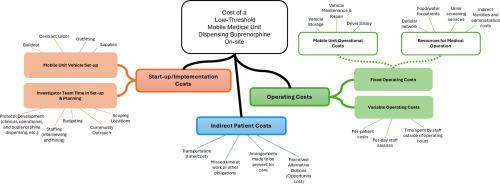
We conducted three analyses to determine start-up, direct fixed operating, direct variable operating, and indirect costs of the UIC COIP mobile medical unit. (1) Micro-costing of administrative purchasing records and on-site time-motion studies determined operation costs. (2) Interviews with staff and providers identified resources and time invested in implementation, and supplemented time-motion observations. (3) Interviews with patients collected indirect costs (i.e. transportation time/cost, missed commitments, perceived alternatives). Additionally, we conducted sensitivity analyses to assess uncertainty in resources used, costs, and mobile medical unit operation assumptions.
Results
The startup costs for a mobile medical unit with buprenorphine dispensing capabilities were $148,690, including buildout, supplies, and labor. Annual fixed operating costs were $131,040, encompassing vehicle operations (i.e. fuel, maintenance) and resources for medical operations (i.e. cellular network, urine testing). Variable operating costs included patient care cost of $85.24 per patient, and aggregate salaries for staff on the mobile medical unit, which were $1082 per day. Indirect patient costs were assessed in 30 individuals; the average transportation time to the care site was 35 min, most individuals did not miss other obligations to present for care, and 40% of individuals would not seek care elsewhere if the mobile unit was not available.
Conclusion
We report start-up and operation costs of a mobile medical unit that provides care and on-site buprenorphine dispensing in Chicago neighborhoods with high need. Understanding the implementation and operation costs of a low-threshold mobile medical unit is imperative to justify the continuation and expansion, as well as inform future research assessing the value and cost-effectiveness of such an intervention for the health system and community.
低门槛流动医疗单位分配丁丙诺啡治疗阿片类药物使用障碍的经济分析。
背景:伊利诺伊大学芝加哥分校(UIC)社区外展干预项目(COIP)建立了一个低门槛的移动医疗单位,这是第一个在阿片类药物过量率高的芝加哥社区的护理点携带和分发丁丙诺啡的单位。需要更深入地了解移动医疗单位的实施和运营成本,以便为全国医疗保健系统的可持续性和财务规划提供信息。本研究测量了UIC COIP移动医疗单元的实施、操作和间接患者成本。方法:采用三种分析方法确定UIC COIP移动医疗单元的启动成本、直接固定运营成本、直接可变运营成本和间接成本。(1)行政采购记录和现场时动研究的微观成本决定了运营成本。(2)与工作人员和提供者的面谈确定了在执行方面投入的资源和时间,并补充了时间运动观察。(3)与患者的访谈收集了间接成本(即运输时间/成本、未履行的承诺、可感知的替代方案)。此外,我们还进行了敏感性分析,以评估资源使用、成本和移动医疗单位运作假设的不确定性。结果:一个具有丁丙诺啡配药能力的移动医疗单元的启动成本为148,690美元,包括建设、用品和人工。每年固定业务费用为131 40美元,包括车辆业务(即燃料、维修)和医疗业务资源(即蜂窝网络、尿检)。可变业务费用包括每名病人85.24美元的病人护理费用和流动医疗单位工作人员每天1082美元的薪金总额。对30名患者的间接费用进行了评估;到护理地点的平均交通时间为35 分钟,大多数人没有错过其他义务,如果没有移动设备,40%的人不会在其他地方寻求护理。结论:我们报告了在芝加哥高需求社区提供护理和现场丁丙诺啡分配的移动医疗单位的启动和运营成本。了解低门槛移动医疗单位的实施和运营成本是必要的,以证明其继续和扩大的合理性,并为未来评估这种干预对卫生系统和社区的价值和成本效益的研究提供信息。
本文章由计算机程序翻译,如有差异,请以英文原文为准。
求助全文
约1分钟内获得全文
求助全文
来源期刊

Journal of substance use and addiction treatment
Biological Psychiatry, Neuroscience (General), Psychiatry and Mental Health, Psychology (General)
自引率
0.00%
发文量
0
 求助内容:
求助内容: 应助结果提醒方式:

 京公网安备 11010802042870号


