
Recent widespread forest expansion and densification in Southwest China
IF 8
1区 环境科学与生态学
Q1 GEOGRAPHY, PHYSICAL
Geography and Sustainability
Pub Date : 2026-02-01
Epub Date: 2025-12-29
DOI:10.1016/j.geosus.2025.100404
引用次数: 0
Abstract
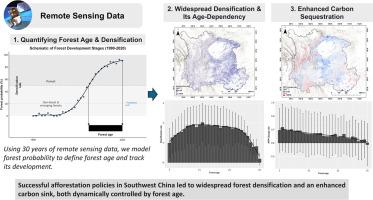
Large-scale afforestation and forest conservation policies have been widely implemented in Southwest China over past decades. These efforts have significantly protected the remaining long-established forests in the region and greatly expanded forested areas. Utilizing nearly 30 years of satellite time-series data, we reveal that the region’s enhanced carbon sequestration (3 × 10¹² g·C annually) is primarily driven by crucial changes in forest structure and age, occurring alongside a nearly 120 % increase in forested land area. We observe that dense forests maintain a rapid growth rate of approximately 2.5 % annually for carbon sequestration in the initial years after establishment. However, this growth rate decelerates with increasing apparent forest age. Meanwhile, the densification (modeled as an increasing forest probability) rate of forests reaches its peak growth during the 10–20 year period, sustaining a high annual growth rate of about 1.8 %. We also find that improvements in forest structure, particularly the increasing of forest canopy density and apparent forest age coupled with a notable reduction in forest fragmentation, are also the main driving factors for the enhanced carbon sequestration capacity. Based on these findings, we conclude that forest restoration policies in Southwest China have been successful not only in facilitating large-scale forest growth in Southwest China but, more critically, in promoting the structural maturation (e.g., densification and reduced fragmentation) that is essential for enhancing the region’s carbon sink capacity and its resilience.
中国西南地区近期广泛的森林扩张和密实化
在过去的几十年里,中国西南地区广泛实施了大规模的造林和森林保护政策。这些努力极大地保护了该地区现存的历史悠久的森林,并大大扩大了森林面积。利用近30年的卫星时间序列数据,我们发现该地区碳固存的增强(每年3 × 10¹² g·C)主要是由森林结构和年龄的关键变化驱动的,与此同时森林面积增加了近120%。我们观察到,茂密的森林在建立后的最初几年里,其固碳量保持每年约2.5%的快速增长率。然而,这一增长率随着森林表观年龄的增加而减慢。与此同时,森林的密实化(模拟为森林概率的增加)率在10-20年期间达到高峰,保持1.8%左右的高年增长率。森林结构的改善,特别是林冠密度和林龄的增加,以及森林破碎化程度的显著降低,也是森林固碳能力增强的主要驱动因素。基于这些发现,我们得出结论,中国西南地区的森林恢复政策不仅成功地促进了西南地区森林的大规模生长,而且更重要的是,促进了结构成熟(如密实化和减少破碎化),这对增强该地区的碳汇能力和恢复力至关重要。
本文章由计算机程序翻译,如有差异,请以英文原文为准。
求助全文
约1分钟内获得全文
求助全文
来源期刊
Geography and Sustainability
Social Sciences-Geography, Planning and Development
CiteScore
16.70
自引率
3.10%
发文量
32
审稿时长
41 days
期刊介绍:
Geography and Sustainability serves as a central hub for interdisciplinary research and education aimed at promoting sustainable development from an integrated geography perspective. By bridging natural and human sciences, the journal fosters broader analysis and innovative thinking on global and regional sustainability issues.
Geography and Sustainability welcomes original, high-quality research articles, review articles, short communications, technical comments, perspective articles and editorials on the following themes:
Geographical Processes: Interactions with and between water, soil, atmosphere and the biosphere and their spatio-temporal variations;
Human-Environmental Systems: Interactions between humans and the environment, resilience of socio-ecological systems and vulnerability;
Ecosystem Services and Human Wellbeing: Ecosystem structure, processes, services and their linkages with human wellbeing;
Sustainable Development: Theory, practice and critical challenges in sustainable development.
 求助内容:
求助内容: 应助结果提醒方式:

 京公网安备 11010802042870号


