
Effect of ice recrystallization inhibition on hydrogen bonding interactions and membrane leakage of liposomes
IF 2.4
3区 生物学
Q3 BIOCHEMISTRY & MOLECULAR BIOLOGY
Biochimica et biophysica acta. Biomembranes
Pub Date : 2026-04-01
Epub Date: 2026-01-20
DOI:10.1016/j.bbamem.2026.184502
引用次数: 0
Abstract
In this study, effects of ice recrystallization on membrane stability of liposomes were investigated using liposomes encapsulating a fluorescent dye. Membrane leakage was studied after freezing and storage at varying temperatures in solutions supplemented with polyvinyl alcohol (PVA), polyethylene glycol (PEG), dimethyl sulfoxide (DMSO) and combinations thereof. Leakage studies were corroborated with studies on ice crystal growth and hydrogen bonding interactions during holding at temperatures just below the ice melting temperature, i.e., at −10 °C. Cryomicroscopic observations confirmed that PVA exhibits ice recrystallization inhibition activity, whereas PEG did not. Both PVA and PEG reduced freezing-induced liposome leakage, alone and in combination with low DMSO concentrations. Temperature-scanning infrared spectroscopy (FTIR) combined with principal component analysis (PCA) was used as a novel approach to probe differences in hydrogen bonding interactions between frozen buffered saline (PBS) containing PVA and PEG. Score and loading plots show that symmetric hydrogen bonds are predominant with addition of PVA, and that the cluster of principal component data points remain compact during holding under ice recrystallization conditions. By contrast, PBS supplemented with PEG and PBS control solutions are characterized by weak hydrogen bonding interactions and more disperse clusters of principal component data points denoting rearrangements in hydrogen bonding interactions associated with ice crystal growth during holding. In conclusion, beneficial effects of adding PVA or PEG in cryopreservation solutions for liposomes are most evident under suboptimal cryopreservation conditions, e.g., during storage at elevated subzero temperatures, and when low concentrations of DMSO are used.
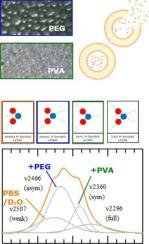
冰重结晶抑制对脂质体氢键相互作用和膜渗漏的影响。
用荧光染料包封脂质体,研究了冰重结晶对脂质体膜稳定性的影响。研究了在添加了聚乙烯醇(PVA)、聚乙二醇(PEG)、二甲亚砜(DMSO)及其混合物的溶液中冷冻和不同储存温度下的膜泄漏。在低于冰融化温度(即-10 °C)的温度下,对冰晶生长和氢键相互作用的研究证实了泄漏研究。低温显微镜观察证实PVA具有抑制冰再结晶的活性,而PEG则没有。PVA和PEG单独或与低DMSO浓度联合均可减少冷冻诱导的脂质体渗漏。采用温度扫描红外光谱(FTIR)与主成分分析(PCA)相结合的方法,研究了含PVA和PEG的冷冻缓冲盐水(PBS)之间氢键相互作用的差异。分数图和加载图表明,PVA的加入使对称氢键占优势,主成分数据点簇在冰重结晶条件下保持紧密。相比之下,添加PEG和PBS对照溶液的PBS具有弱氢键相互作用和更分散的主成分数据点簇的特点,表明在保持过程中与冰晶生长相关的氢键相互作用重排。综上所述,在脂质体冷冻保存溶液中添加PVA或PEG的有益效果在次优冷冻保存条件下最为明显,例如,在零度以下的高温储存期间,以及使用低浓度的DMSO时。
本文章由计算机程序翻译,如有差异,请以英文原文为准。
求助全文
约1分钟内获得全文
求助全文
来源期刊
Biochimica et biophysica acta. Biomembranes
生物-生化与分子生物学
CiteScore
8.20
自引率
5.90%
发文量
175
审稿时长
2.3 months
期刊介绍:
BBA Biomembranes has its main focus on membrane structure, function and biomolecular organization, membrane proteins, receptors, channels and anchors, fluidity and composition, model membranes and liposomes, membrane surface studies and ligand interactions, transport studies, and membrane dynamics.
 求助内容:
求助内容: 应助结果提醒方式:

 京公网安备 11010802042870号


