{"title":"Rutin Exhibits In-Vitro Anticoagulant Activity in Human Blood Samples by Prolonging Coagulation Pathway Times.","authors":"Anjan Palikhey, Laxmi Zaiswal, Amit Kumar Shrivastava, Laxmi Shrestha, Manish Thakur, Jharana Shrestha","doi":"10.1177/27536130261419403","DOIUrl":null,"url":null,"abstract":"<p><strong>Background: </strong>Rutin is a plant-derived flavonoid with reported biological activities, but its effect on blood coagulation parameters has not been clearly characterized under in-vitro conditions.</p><p><strong>Objective: </strong>This study aimed to evaluate the in-vitro anticoagulant activity of rutin in human blood by measuring changes in clotting time (CT), prothrombin time (PT), and activated partial thromboplastin time (aPTT) at increasing concentrations, compared with baseline control values.</p><p><strong>Materials and methods: </strong>Rutin (1-6 mg/mL) was added to human blood samples, and standard CT, PT, and aPTT assays were used to measure coagulation parameters. Heparin and Phosphate-buffered saline (PBS) were used as controls.</p><p><strong>Results: </strong>In a concentration-dependent manner, rutin significantly increased activated partial thromboplastin time (aPTT), prothrombin time (PT), and clotting time (CT) compared with the PBS control, with the most pronounced effects observed at higher concentrations (4 and 6 mg/mL; <i>P</i> < 0.05 vs control). At 6 mg/mL, CT increased to 11.42 ± 1.11 minutes, PT to 21.33 ± 3.28 seconds, and aPTT to 57.20 ± 9.31 seconds.</p><p><strong>Conclusion: </strong>Rutin exhibits significant in vitro anticoagulant activity, supporting its potential as a natural anticoagulant candidate.</p>","PeriodicalId":73159,"journal":{"name":"Global advances in integrative medicine and health","volume":"15 ","pages":"27536130261419403"},"PeriodicalIF":1.3000,"publicationDate":"2026-01-19","publicationTypes":"Journal Article","fieldsOfStudy":null,"isOpenAccess":false,"openAccessPdf":"https://www.ncbi.nlm.nih.gov/pmc/articles/PMC12816505/pdf/","citationCount":"0","resultStr":null,"platform":"Semanticscholar","paperid":null,"PeriodicalName":"Global advances in integrative medicine and health","FirstCategoryId":"1085","ListUrlMain":"https://doi.org/10.1177/27536130261419403","RegionNum":0,"RegionCategory":null,"ArticlePicture":[],"TitleCN":null,"AbstractTextCN":null,"PMCID":null,"EPubDate":"2026/1/1 0:00:00","PubModel":"eCollection","JCR":"","JCRName":"","Score":null,"Total":0}
引用次数: 0
Abstract
Background: Rutin is a plant-derived flavonoid with reported biological activities, but its effect on blood coagulation parameters has not been clearly characterized under in-vitro conditions.
Objective: This study aimed to evaluate the in-vitro anticoagulant activity of rutin in human blood by measuring changes in clotting time (CT), prothrombin time (PT), and activated partial thromboplastin time (aPTT) at increasing concentrations, compared with baseline control values.
Materials and methods: Rutin (1-6 mg/mL) was added to human blood samples, and standard CT, PT, and aPTT assays were used to measure coagulation parameters. Heparin and Phosphate-buffered saline (PBS) were used as controls.
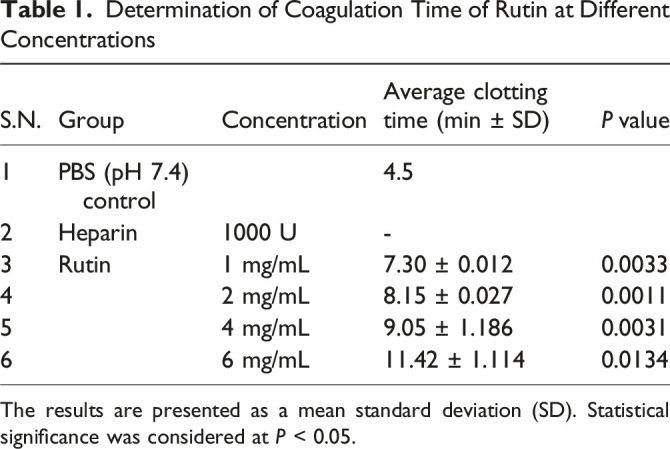
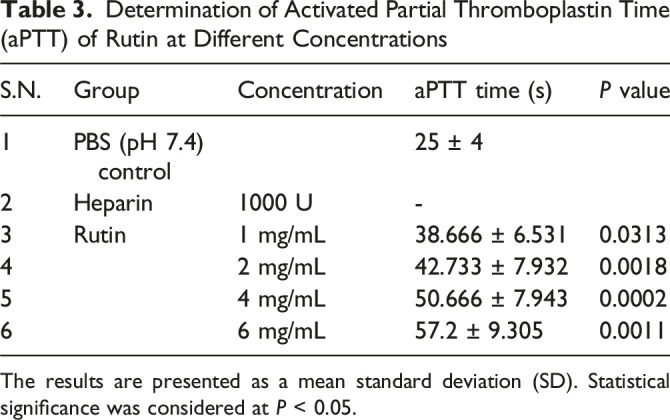
Results: In a concentration-dependent manner, rutin significantly increased activated partial thromboplastin time (aPTT), prothrombin time (PT), and clotting time (CT) compared with the PBS control, with the most pronounced effects observed at higher concentrations (4 and 6 mg/mL; P < 0.05 vs control). At 6 mg/mL, CT increased to 11.42 ± 1.11 minutes, PT to 21.33 ± 3.28 seconds, and aPTT to 57.20 ± 9.31 seconds.
Conclusion: Rutin exhibits significant in vitro anticoagulant activity, supporting its potential as a natural anticoagulant candidate.



 求助内容:
求助内容: 应助结果提醒方式:

 京公网安备 11010802042870号


