
Prognostic value of human serum alpha-klotho concentrations in patients with heart failure with reduced ejection fraction
IF 2.3
3区 医学
Q2 MEDICAL LABORATORY TECHNOLOGY
Clinical biochemistry
Pub Date : 2026-03-01
Epub Date: 2026-01-19
DOI:10.1016/j.clinbiochem.2026.111086
引用次数: 0
Abstract
Objective
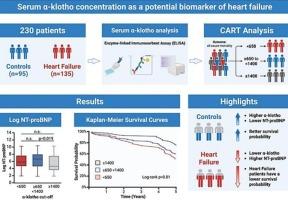
Heart Failure (HF) is a major health problem with high prevalence and mortality. Identifying new biomarkers involved in controlling heart failure progression has become particularly important. This study evaluated the association between serum α-klotho concentrations and long-term all-cause mortality in patients with stable HF.
Design and methods
We analyzed serum α-klotho levels in 230 adults (135 patients with HF with reduced ejection fraction and 95 age and sex-matched healthy controls). A classification and regression tree analysis was used to stratify patients by α-klotho concentration, using all-cause mortality within a 5-year follow-up as the primary endpoint. Differences in log-NT-proBNP levels across α-klotho groups were assessed using the Kruskal-Wallis test with Dunn’s post-hoc comparisons. Kaplan-Meier survival analysis evaluated the association between α-klotho stratified groups and 5-year all-cause mortality.
Results
Patients with higher serum α-klotho levels had significantly lower mortality and lower log NT-proBNP across α-klotho groups (χ2(2) = 8.05, p = 0.018) when compared to lower α-klotho concentration levels. Kaplan-Meier curves show the significant difference in survival across α-klotho stratification (log-rank p < 0.01).
Conclusion
Patients with higher serum α-klotho concentrations were associated with lower log-NT-proBNP levels and better 5-year survival in all patients as well as in patients with heart failure, compared to those with lower. These findings support the role of α-klotho as a promising cardioprotective biomarker for risk stratification in patients with HF.
人血清α -克洛索浓度对心力衰竭伴射血分数降低患者的预后价值。
目的:心力衰竭(HF)是一种发病率高、死亡率高的主要健康问题。识别与控制心力衰竭进展相关的新生物标志物变得尤为重要。本研究评估了稳定型心衰患者血清α-克洛索浓度与长期全因死亡率之间的关系。设计和方法:我们分析了230名成人(135名伴有射血分数降低的心衰患者和95名年龄和性别匹配的健康对照)的血清α-klotho水平。采用分类和回归树分析,以5年随访期间的全因死亡率为主要终点,按α-克洛索浓度对患者进行分层。α-klotho组间log-NT-proBNP水平的差异采用Kruskal-Wallis测试和Dunn’s事后比较进行评估。Kaplan-Meier生存分析评估α-klotho分层组与5年全因死亡率之间的关系。结果:血清α-klotho水平较高的患者死亡率显著低于α-klotho水平较低的患者(χ2(2) = 8.05,p = 0.018),α-klotho水平组的NT-proBNP对数显著低于α-klotho水平组。Kaplan-Meier曲线显示不同α-klotho浓度患者的生存率有显著差异(log-rank p )结论:血清α-klotho浓度较高的患者与所有患者以及心力衰竭患者的log-NT-proBNP水平较低相关,且与较低的患者相比,其5年生存率更高。这些发现支持α-klotho作为心衰患者危险分层的有希望的心脏保护生物标志物的作用。
本文章由计算机程序翻译,如有差异,请以英文原文为准。
求助全文
约1分钟内获得全文
求助全文
来源期刊
Clinical biochemistry
医学-医学实验技术
CiteScore
5.10
自引率
0.00%
发文量
151
审稿时长
25 days
期刊介绍:
Clinical Biochemistry publishes articles relating to clinical chemistry, molecular biology and genetics, therapeutic drug monitoring and toxicology, laboratory immunology and laboratory medicine in general, with the focus on analytical and clinical investigation of laboratory tests in humans used for diagnosis, prognosis, treatment and therapy, and monitoring of disease.
 求助内容:
求助内容: 应助结果提醒方式:

 京公网安备 11010802042870号


