
Glutathione- responsive Phototheranostic platform for imaging-guided enhanced oxidation photoimmunotherapy-ferroptosis synergistic hepatocellular carcinoma therapy
IF 9.7
1区 化学
Q1 CHEMISTRY, PHYSICAL
Journal of Colloid and Interface Science
Pub Date : 2026-05-01
Epub Date: 2026-01-17
DOI:10.1016/j.jcis.2026.139927
引用次数: 0
Abstract
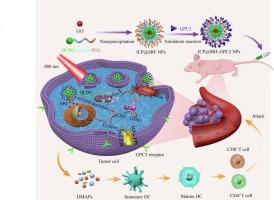
Phototheranostics have emerged as a promising approach in precision medicine. However, the poor tumor selectivity of photosensitizers, insufficient oxidative stress and the intrinsic antioxidant system of tumors compromise the efficacy of phototherapeutic strategies. In this study, we designed a novel phototheranostic platform (ICP@SRF-GPC3 NPs) for active tumor-targeted imaging and oxidation-enhanced photoimmunotherapy-ferroptosis combined therapy. The ICP@SRF-GPC3 NPs were fabricated by conjugating near-infrared photosensitizer IR780 with cystine-polyethylene glycol, modifying it with the Glypican-3 monoclonal antibody and encapsulating of the ferroptosis inducer sorafenib (SRF). ICP@SRF-GPC3 NPs with improved water solubility and liver tumor specificity can produce reactive oxygen species (ROS) upon 808 nm laser irradiation and enable photoimmunotherapy-mediated oxidation treatment. In the tumor microenvironment, the high concentration of glutathione (GSH) cleaved the linkage between the IR780 and the cystine moiety, realizing superior near-infrared fluorescence imaging and synergistic photoimmunotherapy-ferroptosis therapy. The released SRF inhibited cystine/glutamate antiporter, thereby blocking cystine uptake in tumor cells and suppressing GSH synthesis. By depleting existing GSH reserves while simultaneously inhibiting its biosynthetic pathway, ICP@SRF-GPC3 NPs effectively exhausted intracellular GSH, weakening the anti-oxidation ability of tumor cells and amplifying oxidative stress. In a BALB/c nude mouse model bearing GPC3-overexpressing Hepa1–6 allografts, the combination of photoimmunotherapy with ferroptosis not only effectively suppressed primary tumor growth through amplified ROS generation, but also promoted damage-associated molecular patterns release, thereby eliciting a robust immune response that eliminated metastatic and distant tumors. Overall, ICP@SRF-GPC3 NPs offers a promising strategy for regulating GSH and ROS levels in synergistic photoimmunotherapy-ferroptosis antitumor therapy, which has potential clinical applications.
谷胱甘肽响应光治疗平台成像引导增强氧化光免疫治疗-铁下垂协同肝癌治疗。
光疗已经成为精准医学中一种很有前途的方法。然而,光敏剂的肿瘤选择性差、氧化应激不足以及肿瘤固有的抗氧化系统影响了光疗策略的效果。在这项研究中,我们设计了一个新的光治疗平台(ICP@SRF-GPC3 NPs),用于主动肿瘤靶向成像和氧化增强光免疫治疗-铁下垂联合治疗。通过将近红外光敏剂IR780与半胱氨酸-聚乙二醇偶联,用Glypican-3单克隆抗体修饰,包封铁衰诱导剂sorafenib (SRF)制备ICP@SRF-GPC3 NPs。ICP@SRF-GPC3 NPs具有较好的水溶性和肝脏肿瘤特异性,可在808 nm激光照射下产生活性氧(ROS),实现光免疫治疗介导的氧化治疗。在肿瘤微环境中,高浓度谷胱甘肽(GSH)切断了IR780与胱氨酸片段之间的连接,实现了优越的近红外荧光成像和协同光免疫治疗-铁凋亡治疗。释放的SRF抑制胱氨酸/谷氨酸反转运蛋白,从而阻断肿瘤细胞对胱氨酸的摄取,抑制GSH合成。ICP@SRF-GPC3 NPs通过消耗现有的GSH储备,同时抑制其生物合成途径,有效地耗尽细胞内GSH,削弱肿瘤细胞的抗氧化能力,放大氧化应激。在携带gpc3过表达Hepa1-6同种异体移植物的BALB/c裸鼠模型中,光免疫治疗与铁上沉联合治疗不仅通过扩增ROS生成有效抑制原发肿瘤生长,而且还促进损伤相关分子模式的释放,从而引发强大的免疫应答,消除转移性和远处肿瘤。总之,ICP@SRF-GPC3 NPs在光免疫-铁下垂协同抗肿瘤治疗中提供了一种很有前景的调节GSH和ROS水平的策略,具有潜在的临床应用价值。
本文章由计算机程序翻译,如有差异,请以英文原文为准。
求助全文
约1分钟内获得全文
求助全文
来源期刊
CiteScore
16.10
自引率
7.10%
发文量
2568
审稿时长
2 months
期刊介绍:
The Journal of Colloid and Interface Science publishes original research findings on the fundamental principles of colloid and interface science, as well as innovative applications in various fields. The criteria for publication include impact, quality, novelty, and originality.
Emphasis:
The journal emphasizes fundamental scientific innovation within the following categories:
A.Colloidal Materials and Nanomaterials
B.Soft Colloidal and Self-Assembly Systems
C.Adsorption, Catalysis, and Electrochemistry
D.Interfacial Processes, Capillarity, and Wetting
E.Biomaterials and Nanomedicine
F.Energy Conversion and Storage, and Environmental Technologies
 求助内容:
求助内容: 应助结果提醒方式:

 京公网安备 11010802042870号


