{"title":"Comparative effectiveness of long-term anti-obesity medications in routine clinical practice: a retrospective cohort study using real-world data.","authors":"Chul-Gyu Kim, Jung-Min Koh, Kyun-Seop Bae","doi":"10.12793/tcp.2025.33.e20","DOIUrl":null,"url":null,"abstract":"<p><p>Orlistat, phentermine/topiramate, and liraglutide are widely used obesity pharmacotherapies, but comparative data from Asian real-world settings remain limited. We compared their effects on body weight, glycemic control, and persistence. We performed a retrospective cohort study using electronic health records from a tertiary hospital in Korea. Adults prescribed orlistat, phentermine/topiramate, or liraglutide between 2018 and 2025 were included. The primary endpoint was percentage weight change at 6 months. Secondary endpoints were the proportions achieving ≥5% and ≥10% weight loss, weight change at 3, 6, and 12 months, change in HbA1c, and 12-month treatment persistence. We applied multivariable linear and logistic regression, linear mixed-effects models, propensity score-weighted models, and Kaplan-Meier and restricted mean survival time (RMST) methods. Among 1,910 treatment episodes, 505 involved orlistat, 777 phentermine/topiramate, and 628 liraglutide. Phentermine/topiramate showed greater mean percentage weight loss at 6 months than orlistat (adjusted difference, -1.59 percentage points; <i>p</i> < 0.001), whereas liraglutide produced similar weight loss to orlistat. The odds of achieving ≥5% weight loss were higher with phentermine/topiramate than with orlistat (adjusted odds ratio, 2.21), while liraglutide showed a smaller effect. Liraglutide tended to reduce HbA1c more than orlistat, but this difference was attenuated after propensity score weighting. Twelve-month treatment persistence and RMST were lower with liraglutide than with the oral agents. In this real-world cohort, phentermine/topiramate achieved the most pronounced and sustained weight loss. Liraglutide and orlistat produced similar overall weight reduction, but liraglutide showed lower long-term persistence.</p>","PeriodicalId":23288,"journal":{"name":"Translational and Clinical Pharmacology","volume":"33 4","pages":"224-237"},"PeriodicalIF":1.5000,"publicationDate":"2025-12-01","publicationTypes":"Journal Article","fieldsOfStudy":null,"isOpenAccess":false,"openAccessPdf":"https://www.ncbi.nlm.nih.gov/pmc/articles/PMC12806651/pdf/","citationCount":"0","resultStr":null,"platform":"Semanticscholar","paperid":null,"PeriodicalName":"Translational and Clinical Pharmacology","FirstCategoryId":"1085","ListUrlMain":"https://doi.org/10.12793/tcp.2025.33.e20","RegionNum":0,"RegionCategory":null,"ArticlePicture":[],"TitleCN":null,"AbstractTextCN":null,"PMCID":null,"EPubDate":"2025/12/18 0:00:00","PubModel":"Epub","JCR":"Q4","JCRName":"PHARMACOLOGY & PHARMACY","Score":null,"Total":0}
引用次数: 0
Abstract
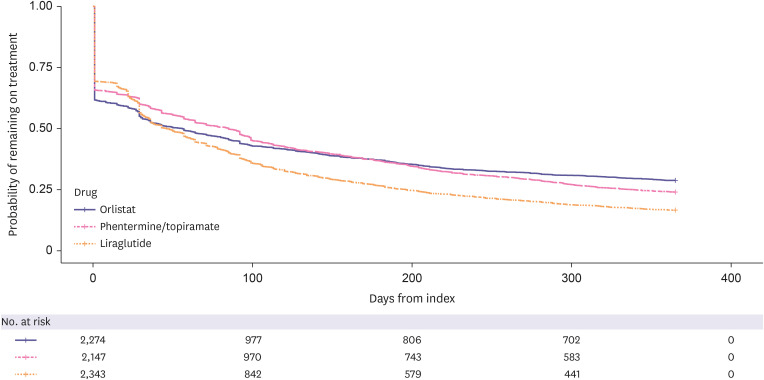
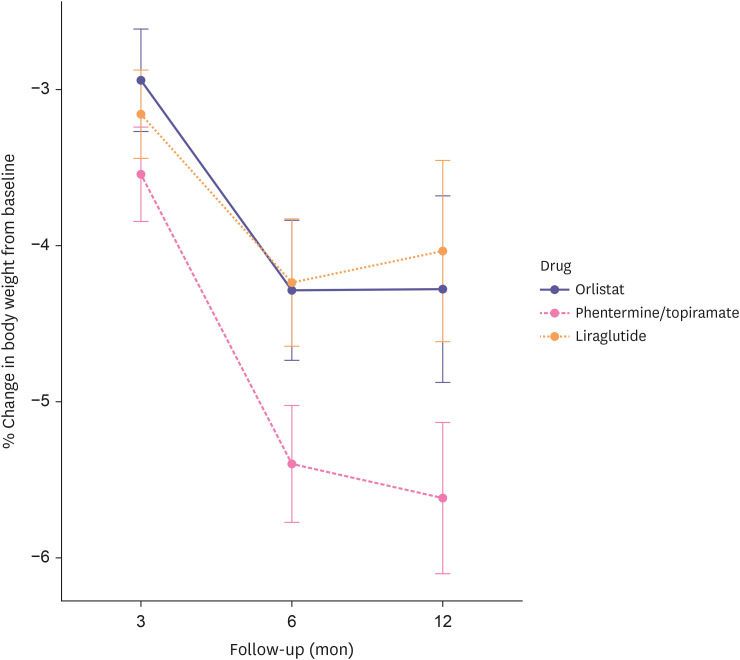
Orlistat, phentermine/topiramate, and liraglutide are widely used obesity pharmacotherapies, but comparative data from Asian real-world settings remain limited. We compared their effects on body weight, glycemic control, and persistence. We performed a retrospective cohort study using electronic health records from a tertiary hospital in Korea. Adults prescribed orlistat, phentermine/topiramate, or liraglutide between 2018 and 2025 were included. The primary endpoint was percentage weight change at 6 months. Secondary endpoints were the proportions achieving ≥5% and ≥10% weight loss, weight change at 3, 6, and 12 months, change in HbA1c, and 12-month treatment persistence. We applied multivariable linear and logistic regression, linear mixed-effects models, propensity score-weighted models, and Kaplan-Meier and restricted mean survival time (RMST) methods. Among 1,910 treatment episodes, 505 involved orlistat, 777 phentermine/topiramate, and 628 liraglutide. Phentermine/topiramate showed greater mean percentage weight loss at 6 months than orlistat (adjusted difference, -1.59 percentage points; p < 0.001), whereas liraglutide produced similar weight loss to orlistat. The odds of achieving ≥5% weight loss were higher with phentermine/topiramate than with orlistat (adjusted odds ratio, 2.21), while liraglutide showed a smaller effect. Liraglutide tended to reduce HbA1c more than orlistat, but this difference was attenuated after propensity score weighting. Twelve-month treatment persistence and RMST were lower with liraglutide than with the oral agents. In this real-world cohort, phentermine/topiramate achieved the most pronounced and sustained weight loss. Liraglutide and orlistat produced similar overall weight reduction, but liraglutide showed lower long-term persistence.
期刊介绍:
Translational and Clinical Pharmacology (Transl Clin Pharmacol, TCP) is the official journal of the Korean Society for Clinical Pharmacology and Therapeutics (KSCPT). TCP is an interdisciplinary journal devoted to the dissemination of knowledge relating to all aspects of translational and clinical pharmacology. The categories for publication include pharmacokinetics (PK) and drug disposition, drug metabolism, pharmacodynamics (PD), clinical trials and design issues, pharmacogenomics and pharmacogenetics, pharmacometrics, pharmacoepidemiology, pharmacovigilence, and human pharmacology. Studies involving animal models, pharmacological characterization, and clinical trials are appropriate for consideration.



 求助内容:
求助内容: 应助结果提醒方式:

 京公网安备 11010802042870号


