Y. Bouderba, A. Benali, K. Benghanem, A. Lemgharbi, E. Aganou, M. E. Honore
{"title":"H-Component Variations Induced by Geomagnetic Storms during Solar Cycle 24: Insights from TAM Observatory","authors":"Y. Bouderba, A. Benali, K. Benghanem, A. Lemgharbi, E. Aganou, M. E. Honore","doi":"10.1134/S0016793225600109","DOIUrl":null,"url":null,"abstract":"<p>Geomagnetic storms (GSs), driven by solar activity, produce significant disturbances in the Earth’s magnetic field—particularly in its horizontal component (H). This study investigates the response of the <i>H</i>-component to GSs during solar cycle 24 (2009–2019), using ground-based magnetometer data recorded at the TAM observatory in Tamanrasset, Algeria (22.79° N, 5.53° E), part of the INTERMAGNET network. A total of 130 storms were identified based on <i>Dst-</i>index thresholds and classified into 104 moderate (–100 nT < <i>Dst</i> ≤ –50 nT) and 26 intense (<i>Dst</i> ≤ –100 nT) events. The <i>H</i>-component was derived from the orthogonal north and east components (<i>X</i>, <i>Y</i>) of the geomagnetic field. The results reveal a gradual upward trend in the <i>H</i>-component over the solar cycle, consistent with secular geomagnetic field variations. However, during storm periods, the <i>H</i>-component exhibited significant decreases. These disturbances were quantified using the maximum deviation parameter Δ<i>H</i><sub>max</sub>, which displayed a statistically significant positive correlation with storm intensity (<i>r</i> = 0.71). Notably, the correlation was stronger for intense storms (<i>r</i> = 0.75) than moderate ones (<i>r</i> = 0.38). These results highlight the greater sensitivity of low-latitude geomagnetic observatories to high-intensity storms and demonstrate the diagnostic value of Δ<i>H</i><sub>max</sub> for space weather monitoring.</p>","PeriodicalId":55597,"journal":{"name":"Geomagnetism and Aeronomy","volume":"65 4","pages":"71 - 78"},"PeriodicalIF":0.7000,"publicationDate":"2025-08-09","publicationTypes":"Journal Article","fieldsOfStudy":null,"isOpenAccess":false,"openAccessPdf":"","citationCount":"0","resultStr":null,"platform":"Semanticscholar","paperid":null,"PeriodicalName":"Geomagnetism and Aeronomy","FirstCategoryId":"89","ListUrlMain":"https://link.springer.com/article/10.1134/S0016793225600109","RegionNum":4,"RegionCategory":"地球科学","ArticlePicture":[],"TitleCN":null,"AbstractTextCN":null,"PMCID":null,"EPubDate":"","PubModel":"","JCR":"Q4","JCRName":"GEOCHEMISTRY & GEOPHYSICS","Score":null,"Total":0}
引用次数: 0
Abstract
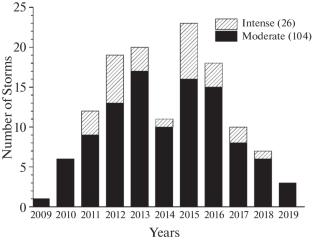
Geomagnetic storms (GSs), driven by solar activity, produce significant disturbances in the Earth’s magnetic field—particularly in its horizontal component (H). This study investigates the response of the H-component to GSs during solar cycle 24 (2009–2019), using ground-based magnetometer data recorded at the TAM observatory in Tamanrasset, Algeria (22.79° N, 5.53° E), part of the INTERMAGNET network. A total of 130 storms were identified based on Dst-index thresholds and classified into 104 moderate (–100 nT < Dst ≤ –50 nT) and 26 intense (Dst ≤ –100 nT) events. The H-component was derived from the orthogonal north and east components (X, Y) of the geomagnetic field. The results reveal a gradual upward trend in the H-component over the solar cycle, consistent with secular geomagnetic field variations. However, during storm periods, the H-component exhibited significant decreases. These disturbances were quantified using the maximum deviation parameter ΔHmax, which displayed a statistically significant positive correlation with storm intensity (r = 0.71). Notably, the correlation was stronger for intense storms (r = 0.75) than moderate ones (r = 0.38). These results highlight the greater sensitivity of low-latitude geomagnetic observatories to high-intensity storms and demonstrate the diagnostic value of ΔHmax for space weather monitoring.
期刊介绍:
Geomagnetism and Aeronomy is a bimonthly periodical that covers the fields of interplanetary space; geoeffective solar events; the magnetosphere; the ionosphere; the upper and middle atmosphere; the action of solar variability and activity on atmospheric parameters and climate; the main magnetic field and its secular variations, excursion, and inversion; and other related topics.

 求助内容:
求助内容: 应助结果提醒方式:

 京公网安备 11010802042870号


