Yanlei Ma, Eric T Roberts, Jessica Phelan, Kenton J Johnston, E John Orav, Ellen R Meara, Jose F Figueroa
{"title":"Federal Look-Alike Plan Termination Policy and Dual-Eligible Enrollment in Integrated Care Programs.","authors":"Yanlei Ma, Eric T Roberts, Jessica Phelan, Kenton J Johnston, E John Orav, Ellen R Meara, Jose F Figueroa","doi":"10.1001/jamahealthforum.2025.6294","DOIUrl":null,"url":null,"abstract":"<p><strong>Importance: </strong>In 2023, the Centers for Medicare & Medicaid Services terminated dual-eligible special needs plan look-alikes-Medicare Advantage plans with beneficiary panels composed of more than 80% dual-eligible individuals but lacking Medicaid integration. Understanding whether this policy promoted dual-eligible enrollment in integrated care plans, particularly those attaining high-level integration, is critical.</p><p><strong>Objective: </strong>To describe dual-eligible enrollment transitions after the look-alike plan termination and evaluate whether the policy was associated with increased enrollment in highly integrated plans.</p><p><strong>Design, setting, and participants: </strong>This repeated cross-sectional study analyzed US Medicare administrative data from January 2017 to January 2023. Samples were limited to full-benefit dual-eligible beneficiaries.</p><p><strong>Main outcomes and measures: </strong>First, a beneficiary-level analysis was conducted on 2023 enrollment patterns among full-benefit dual-eligible individuals whose 2022 plans were terminated, including factors associated with enrollment in highly integrated plans in 2023. Next, a county-year-level difference-in-differences design was used to compare changes in full-benefit dual-eligible enrollment before (2017-2022) and after (2023) the termination policy between counties with vs without terminated look-alike plans. A difference-in-differences design was used to evaluate whether the look-alike termination policy was associated with the proportion of full-benefit dual-eligible individuals enrolled in highly integrated care plans.</p><p><strong>Results: </strong>Between 2017 and 2022, 482 of 2576 counties had full-benefit dual-eligible individuals enrolled in look-alike plans for at least 1 year. Of the 170 399 full-benefit dual-eligible individuals enrolled in look-alike plans in 2022 (58.9% female; 20.6% Asian, 44.8% Hispanic, 11.3% non-Hispanic Black, 21.4% non-Hispanic White, and 2% other) and remained dual-eligible in 2023, only 5.4% transitioned to highly integrated plans, while 55.6% moved to nonintegrated plans. Dual-eligible individuals transitioning to highly integrated plans were more likely to be older (65-74 years: adjusted difference, 3.4 percentage points [pp]; 95% CI, 2.8-4.1 pp; 75-84 years: adjusted difference, 4.1 pp; 95% CI, 3.3-4.8 pp; ≥85 years: adjusted difference, 5.0 pp; 95% CI, 4.0-5.9 pp), female (adjusted difference: 0.6 pp; 95% CI, 0.2-0.9 pp), without disabilities (adjusted difference, -0.7 pp; 95% CI, -1.2 to -0.2 pp), and less likely to be Asian (adjusted difference, -5.0 pp; 95% CI, -5.6 to -4.4 pp) or Black (adjusted difference, -0.9 pp; 95% CI, -1.6 to -0.2 pp). The termination policy was not associated with a significant differential increase in enrollment into highly integrated plans in counties with look-alike plans compared with those without (0.6 pp; 95% CI, -0.4 to 1.6 pp). However, there was a 2.6-pp differential increase (95% CI, 0.01-5.1 pp) in enrollment into plans offering some integration, primarily driven by enrollment growth in plans with lower levels of integration. Enrollment also increased in conventional Medicare Advantage plans with fewer than 80% of dual-eligible enrollees (2.6 pp; 95% CI, 0.7-4.5 pp) after the termination policy.</p><p><strong>Conclusions and relevance: </strong>In this study, the termination of look-alike plans was insufficient to significantly shift dual-eligible individuals toward highly integrated plans. Complementary strategies are necessary to ensure that dual-eligible individuals enroll into highly integrated care models that may improve outcomes.</p>","PeriodicalId":53180,"journal":{"name":"JAMA Health Forum","volume":"7 1","pages":"e256294"},"PeriodicalIF":11.3000,"publicationDate":"2026-01-02","publicationTypes":"Journal Article","fieldsOfStudy":null,"isOpenAccess":false,"openAccessPdf":"https://www.ncbi.nlm.nih.gov/pmc/articles/PMC12811809/pdf/","citationCount":"0","resultStr":null,"platform":"Semanticscholar","paperid":null,"PeriodicalName":"JAMA Health Forum","FirstCategoryId":"1085","ListUrlMain":"https://doi.org/10.1001/jamahealthforum.2025.6294","RegionNum":0,"RegionCategory":null,"ArticlePicture":[],"TitleCN":null,"AbstractTextCN":null,"PMCID":null,"EPubDate":"","PubModel":"","JCR":"Q1","JCRName":"HEALTH CARE SCIENCES & SERVICES","Score":null,"Total":0}
引用次数: 0
Abstract
Importance: In 2023, the Centers for Medicare & Medicaid Services terminated dual-eligible special needs plan look-alikes-Medicare Advantage plans with beneficiary panels composed of more than 80% dual-eligible individuals but lacking Medicaid integration. Understanding whether this policy promoted dual-eligible enrollment in integrated care plans, particularly those attaining high-level integration, is critical.
Objective: To describe dual-eligible enrollment transitions after the look-alike plan termination and evaluate whether the policy was associated with increased enrollment in highly integrated plans.
Design, setting, and participants: This repeated cross-sectional study analyzed US Medicare administrative data from January 2017 to January 2023. Samples were limited to full-benefit dual-eligible beneficiaries.
Main outcomes and measures: First, a beneficiary-level analysis was conducted on 2023 enrollment patterns among full-benefit dual-eligible individuals whose 2022 plans were terminated, including factors associated with enrollment in highly integrated plans in 2023. Next, a county-year-level difference-in-differences design was used to compare changes in full-benefit dual-eligible enrollment before (2017-2022) and after (2023) the termination policy between counties with vs without terminated look-alike plans. A difference-in-differences design was used to evaluate whether the look-alike termination policy was associated with the proportion of full-benefit dual-eligible individuals enrolled in highly integrated care plans.
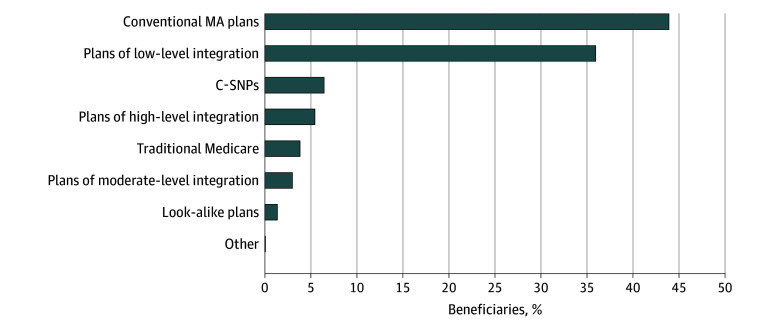
Results: Between 2017 and 2022, 482 of 2576 counties had full-benefit dual-eligible individuals enrolled in look-alike plans for at least 1 year. Of the 170 399 full-benefit dual-eligible individuals enrolled in look-alike plans in 2022 (58.9% female; 20.6% Asian, 44.8% Hispanic, 11.3% non-Hispanic Black, 21.4% non-Hispanic White, and 2% other) and remained dual-eligible in 2023, only 5.4% transitioned to highly integrated plans, while 55.6% moved to nonintegrated plans. Dual-eligible individuals transitioning to highly integrated plans were more likely to be older (65-74 years: adjusted difference, 3.4 percentage points [pp]; 95% CI, 2.8-4.1 pp; 75-84 years: adjusted difference, 4.1 pp; 95% CI, 3.3-4.8 pp; ≥85 years: adjusted difference, 5.0 pp; 95% CI, 4.0-5.9 pp), female (adjusted difference: 0.6 pp; 95% CI, 0.2-0.9 pp), without disabilities (adjusted difference, -0.7 pp; 95% CI, -1.2 to -0.2 pp), and less likely to be Asian (adjusted difference, -5.0 pp; 95% CI, -5.6 to -4.4 pp) or Black (adjusted difference, -0.9 pp; 95% CI, -1.6 to -0.2 pp). The termination policy was not associated with a significant differential increase in enrollment into highly integrated plans in counties with look-alike plans compared with those without (0.6 pp; 95% CI, -0.4 to 1.6 pp). However, there was a 2.6-pp differential increase (95% CI, 0.01-5.1 pp) in enrollment into plans offering some integration, primarily driven by enrollment growth in plans with lower levels of integration. Enrollment also increased in conventional Medicare Advantage plans with fewer than 80% of dual-eligible enrollees (2.6 pp; 95% CI, 0.7-4.5 pp) after the termination policy.
Conclusions and relevance: In this study, the termination of look-alike plans was insufficient to significantly shift dual-eligible individuals toward highly integrated plans. Complementary strategies are necessary to ensure that dual-eligible individuals enroll into highly integrated care models that may improve outcomes.
期刊介绍:
JAMA Health Forum is an international, peer-reviewed, online, open access journal that addresses health policy and strategies affecting medicine, health, and health care. The journal publishes original research, evidence-based reports, and opinion about national and global health policy. It covers innovative approaches to health care delivery and health care economics, access, quality, safety, equity, and reform.
In addition to publishing articles, JAMA Health Forum also features commentary from health policy leaders on the JAMA Forum. It covers news briefs on major reports released by government agencies, foundations, health policy think tanks, and other policy-focused organizations.
JAMA Health Forum is a member of the JAMA Network, which is a consortium of peer-reviewed, general medical and specialty publications. The journal presents curated health policy content from across the JAMA Network, including journals such as JAMA and JAMA Internal Medicine.



 求助内容:
求助内容: 应助结果提醒方式:

 京公网安备 11010802042870号


