I. A. Panteleev, A. A. Petrushov, V. O. Mikhailov, M. S. Volkova, A. Yu. Izyumova
{"title":"On the Applicability of Mogi Model to Interpret Displacements on Volcanic Slopes","authors":"I. A. Panteleev, A. A. Petrushov, V. O. Mikhailov, M. S. Volkova, A. Yu. Izyumova","doi":"10.1134/S1069351325700867","DOIUrl":null,"url":null,"abstract":"<p><b>Abstract</b>—Analytical and numerical methods for calculating ground surface displacements in isotropic linear elastic medium with a spherical cavity under excess pressure are compared. The comparison is conducted with varying the depth of the spherical cavity for two ground surface geometries: flat and with conical relief of varying inclinations. In the analytical model, a simplified topography approximation is used. The analysis of the discrepancy between the numerical and analytical solutions suggests the necessity to take into account finite size of the deformation source, especially at shallow depths (less than a kilometer) and to use higher-order terms in the small parameter expansion of the solution for a spherical cavity. For a computational domain with steep conical topography, such as that of the Koryakskii Volcano, Kamchatka Peninsula, the discrepancies between the numerical and analytical solutions are more than 30% for vertical displacement and more than 45% for horizontal component with a source depth of 1450 and 3000 m, respectively. These errors are quite large and significantly exceed the typical error of satellite measurements obtained in favorable conditions. Therefore, using the spherical source model combined with approximate topography representation in regions with steep terrain can lead to significant errors. The discrepancies decrease rapidly as the terrain flattens. The locations of the maxima of the displacement vector components relative to the summit of a conical edifice do not coincide in the analytical solution and in the direct numerical calculation. A simplified consideration of the topography may also give a wrong idea of the position of the deformation source relative to the volcano’s summit.</p>","PeriodicalId":602,"journal":{"name":"Izvestiya, Physics of the Solid Earth","volume":"61 6","pages":"1082 - 1091"},"PeriodicalIF":1.0000,"publicationDate":"2026-01-16","publicationTypes":"Journal Article","fieldsOfStudy":null,"isOpenAccess":false,"openAccessPdf":"","citationCount":"0","resultStr":null,"platform":"Semanticscholar","paperid":null,"PeriodicalName":"Izvestiya, Physics of the Solid Earth","FirstCategoryId":"89","ListUrlMain":"https://link.springer.com/article/10.1134/S1069351325700867","RegionNum":4,"RegionCategory":"地球科学","ArticlePicture":[],"TitleCN":null,"AbstractTextCN":null,"PMCID":null,"EPubDate":"","PubModel":"","JCR":"Q4","JCRName":"GEOCHEMISTRY & GEOPHYSICS","Score":null,"Total":0}
引用次数: 0
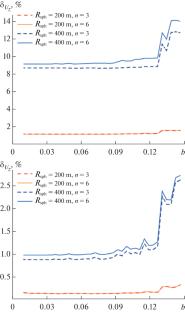
Abstract—Analytical and numerical methods for calculating ground surface displacements in isotropic linear elastic medium with a spherical cavity under excess pressure are compared. The comparison is conducted with varying the depth of the spherical cavity for two ground surface geometries: flat and with conical relief of varying inclinations. In the analytical model, a simplified topography approximation is used. The analysis of the discrepancy between the numerical and analytical solutions suggests the necessity to take into account finite size of the deformation source, especially at shallow depths (less than a kilometer) and to use higher-order terms in the small parameter expansion of the solution for a spherical cavity. For a computational domain with steep conical topography, such as that of the Koryakskii Volcano, Kamchatka Peninsula, the discrepancies between the numerical and analytical solutions are more than 30% for vertical displacement and more than 45% for horizontal component with a source depth of 1450 and 3000 m, respectively. These errors are quite large and significantly exceed the typical error of satellite measurements obtained in favorable conditions. Therefore, using the spherical source model combined with approximate topography representation in regions with steep terrain can lead to significant errors. The discrepancies decrease rapidly as the terrain flattens. The locations of the maxima of the displacement vector components relative to the summit of a conical edifice do not coincide in the analytical solution and in the direct numerical calculation. A simplified consideration of the topography may also give a wrong idea of the position of the deformation source relative to the volcano’s summit.
期刊介绍:
Izvestiya, Physics of the Solid Earth is an international peer reviewed journal that publishes results of original theoretical and experimental research in relevant areas of the physics of the Earth''s interior and applied geophysics. The journal welcomes manuscripts from all countries in the English or Russian language.

 求助内容:
求助内容: 应助结果提醒方式:

 京公网安备 11010802042870号


