
Simulating forest transition for sustainable forestry planning in Japan: A backcasting model of roundwood supply and carbon stocks with operational and regional considerations
IF 8.3
Q1 ENVIRONMENTAL SCIENCES
Resources, conservation & recycling advances
Pub Date : 2026-03-01
Epub Date: 2026-01-08
DOI:10.1016/j.rcradv.2026.200314
引用次数: 0
Abstract
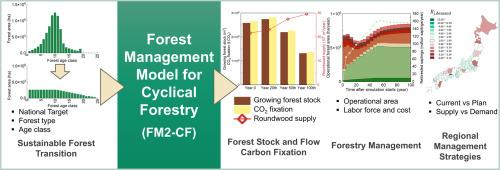
Forests are essential for global ecological stability, carbon balance, and the sustainable supply of roundwood resources. Forests in Japan are undergoing a policy-driven transition aimed at enhancing forest health and roundwood supply. This study presents the Forest Management Model for Cyclical Forestry (FM2-CF), a backcasting simulation model designed to support this transition over a 100-year horizon. The model integrates forest structural factors, forestry operational factors, and regulatory factors to investigate the long-term implications regarding Japan’s forest resources under the transition. It characterizes the national age-class transition of single-storied forests, quantifying roundwood supply and CO2 fixation potential. Regional analyses across all 47 prefectures reveal pronounced spatial disparities in forest resources, indicating the necessity of localized strategies. In addition, FM2-CF evaluates the required forestry operational efforts measured by forest area, labor force, and cost. The simulated forestry management has revealed a shift of operational focus from reforestation and weeding in the early stages toward more balanced harvesting and thinning activities in matured forests. Scenario-based projections of roundwood supply–demand dynamics have highlighted surpluses and shortfalls across regions and time. Our results provided insights into the sufficiency and timing of supply relative to evolving policy-related utilization demand. While the model is primarily structured as a supply-side strategic planning tool, it provides a valuable roadmap for aligning long-term forest renewal with sustainable management practices and assessing policy feasibility. Future extensions may incorporate growth modeling and demand-side mechanisms to improve applicability across broader contexts and other countries.
日本森林可持续规划的森林转型模拟:考虑业务和区域因素的圆材供应和碳储量的反演模型
森林对全球生态稳定、碳平衡和圆材资源的可持续供应至关重要。日本的森林正在进行政策驱动的转型,旨在加强森林健康和圆材供应。本研究提出了循环林业的森林管理模型(FM2-CF),这是一个回溯模拟模型,旨在支持100年范围内的这种转变。该模型综合了森林结构因素、林业经营因素和监管因素,考察了转型对日本森林资源的长期影响。它描述了全国单层森林的年龄等级转变,量化了圆材供应和二氧化碳固定潜力。对所有47个县的区域分析显示,森林资源的空间差异明显,表明有必要采取地方化战略。此外,FM2-CF还通过森林面积、劳动力和成本来评估所需的林业经营努力。模拟森林管理显示,业务重点从早期阶段的重新造林和除草转向成熟森林中更平衡的采伐和间伐活动。基于情景的圆木供需动态预测突出了各区域和时间的过剩和短缺。我们的结果提供了对供应的充分性和时机的见解,相对于不断发展的政策相关的利用需求。虽然该模型主要是作为供应方战略规划工具构建的,但它为将长期森林更新与可持续管理实践相结合并评估政策可行性提供了宝贵的路线图。未来的扩展可能包括增长建模和需求侧机制,以提高在更广泛的背景和其他国家的适用性。
本文章由计算机程序翻译,如有差异,请以英文原文为准。
求助全文
约1分钟内获得全文
求助全文
来源期刊

Resources, conservation & recycling advances
Environmental Science (General)
CiteScore
11.70
自引率
0.00%
发文量
0
审稿时长
76 days
 求助内容:
求助内容: 应助结果提醒方式:

 京公网安备 11010802042870号


