
A unified multiscale framework for stress-Based topology optimization using local constraint enforcement
IF 7.3
1区 工程技术
Q1 ENGINEERING, MULTIDISCIPLINARY
Computer Methods in Applied Mechanics and Engineering
Pub Date : 2026-04-15
Epub Date: 2026-01-13
DOI:10.1016/j.cma.2025.118692
引用次数: 0
Abstract
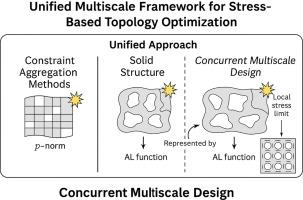
This study presents a robust multiscale formulation for stress-constrained topology optimization aimed at designing lightweight and structurally resilient components. Unlike classical compliance-based methods, which may result in topologies unable to support applied loads, the proposed approach minimizes structural volume while rigorously enforcing local stress constraints. A dual-scale framework integrates macro-structural optimization with periodic micro-structural design, leveraging the Solid Isotropic Material with Penalization (SIMP) method; though it remains adaptable to other established topology optimization techniques. To address the computational challenges arising from numerous local stress constraints, we implement an Augmented Lagrangian strategy combined with polynomial vanishing constraints, eliminating the need for aggregation functions such as the p-norm or Kreisselmeier-Steinhauser functions. The resulting optimization algorithm is accurate and scalable, supported by a detailed sensitivity analysis and adjoint-based gradient computation. Numerical experiments in two dimensions validate the effectiveness of the method, demonstrating superior stress distribution and structural efficiency compared to classical formulations. This work contributes a comprehensive and scalable methodology for multiscale topology optimization under stress constraints, suitable for high-performance engineering applications.
基于局部约束的应力拓扑优化统一多尺度框架
本研究提出了一种鲁棒的多尺度应力约束拓扑优化公式,旨在设计轻量化和结构弹性构件。与传统的基于顺应性的方法不同,这种方法可能导致拓扑结构无法支持施加的载荷,而所提出的方法在严格执行局部应力约束的同时最小化了结构体积。双尺度框架将宏观结构优化与周期性微观结构设计相结合,利用固体各向同性材料惩罚(SIMP)方法;尽管它仍然适用于其他已建立的拓扑优化技术。为了解决由众多局部应力约束引起的计算挑战,我们实现了一种结合多项式消失约束的增广拉格朗日策略,消除了对p-范数或Kreisselmeier-Steinhauser函数等聚集函数的需求。通过详细的灵敏度分析和基于伴随的梯度计算,所得到的优化算法具有准确性和可扩展性。二维数值实验验证了该方法的有效性,表明与经典公式相比,该方法具有更好的应力分布和结构效率。这项工作为应力约束下的多尺度拓扑优化提供了一种全面、可扩展的方法,适用于高性能工程应用。
本文章由计算机程序翻译,如有差异,请以英文原文为准。
求助全文
约1分钟内获得全文
求助全文
来源期刊
CiteScore
12.70
自引率
15.30%
发文量
719
审稿时长
44 days
期刊介绍:
Computer Methods in Applied Mechanics and Engineering stands as a cornerstone in the realm of computational science and engineering. With a history spanning over five decades, the journal has been a key platform for disseminating papers on advanced mathematical modeling and numerical solutions. Interdisciplinary in nature, these contributions encompass mechanics, mathematics, computer science, and various scientific disciplines. The journal welcomes a broad range of computational methods addressing the simulation, analysis, and design of complex physical problems, making it a vital resource for researchers in the field.
 求助内容:
求助内容: 应助结果提醒方式:

 京公网安备 11010802042870号


