
Green energy transition financing in the East African community: A dynamic fixed effects - autoregressive distributed lag model

Francis Muhire, Dickson Turyareeba, Anthony M Olyanga, Muyiwa S Adaramola
{"title":"Green energy transition financing in the East African community: A dynamic fixed effects - autoregressive distributed lag model","authors":"Francis Muhire,&nbsp;Dickson Turyareeba,&nbsp;Anthony M Olyanga,&nbsp;Muyiwa S Adaramola","doi":"10.1016/j.rset.2025.100134","DOIUrl":null,"url":null,"abstract":"<div><div>The East African Community faces significant challenges in financing its Green Energy Transition (GET) despite its green energy potential to meet energy needs and climate commitments. To address this, this study evaluates the impact of green energy financial flows on GET in the EAC using a Dynamic Fixed Effects-Autoregressive Distributed Lag model on panel data from 2000 to 2022. Anchored in the PESTEL framework and the Techno-Economic, Socio-Technical, and Political Co-Evolution Theory, study findings reveal that green grants, the quality of environmental policies, the overall policy and institutional environment, and access to electricity are significant short- and long-run drivers of GET in the EAC. This research uniquely provides empirical evidence on the effects of green energy financial flows within a developing economic bloc, highlighting the co-evolutionary interplay among political, economic, socio-technical, and environmental factors. Additionally, it focuses specifically on green energy rather than renewable energy. The empirical results underscore the critical role of targeted financial incentives, robust regulatory and institutional frameworks, and expanded electricity access. Furthermore, observed cross-sectional dependency among EAC nations calls for cooperative regional policy initiatives. This study recommends diversifying financing sources, strengthening governance, and removing barriers to private and public engagement, which are crucial to a sustainable EAC energy future.</div></div>","PeriodicalId":101071,"journal":{"name":"Renewable and Sustainable Energy Transition","volume":"9 ","pages":"Article 100134"},"PeriodicalIF":0.0000,"publicationDate":"2026-06-01","publicationTypes":"Journal Article","fieldsOfStudy":null,"isOpenAccess":false,"openAccessPdf":"","citationCount":"0","resultStr":null,"platform":"Semanticscholar","paperid":null,"PeriodicalName":"Renewable and Sustainable Energy Transition","FirstCategoryId":"1085","ListUrlMain":"https://www.sciencedirect.com/science/article/pii/S2667095X25000339","RegionNum":0,"RegionCategory":null,"ArticlePicture":[],"TitleCN":null,"AbstractTextCN":null,"PMCID":null,"EPubDate":"2025/12/23 0:00:00","PubModel":"Epub","JCR":"","JCRName":"","Score":null,"Total":0}
引用次数: 0

Abstract

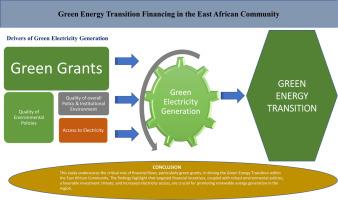
The East African Community faces significant challenges in financing its Green Energy Transition (GET) despite its green energy potential to meet energy needs and climate commitments. To address this, this study evaluates the impact of green energy financial flows on GET in the EAC using a Dynamic Fixed Effects-Autoregressive Distributed Lag model on panel data from 2000 to 2022. Anchored in the PESTEL framework and the Techno-Economic, Socio-Technical, and Political Co-Evolution Theory, study findings reveal that green grants, the quality of environmental policies, the overall policy and institutional environment, and access to electricity are significant short- and long-run drivers of GET in the EAC. This research uniquely provides empirical evidence on the effects of green energy financial flows within a developing economic bloc, highlighting the co-evolutionary interplay among political, economic, socio-technical, and environmental factors. Additionally, it focuses specifically on green energy rather than renewable energy. The empirical results underscore the critical role of targeted financial incentives, robust regulatory and institutional frameworks, and expanded electricity access. Furthermore, observed cross-sectional dependency among EAC nations calls for cooperative regional policy initiatives. This study recommends diversifying financing sources, strengthening governance, and removing barriers to private and public engagement, which are crucial to a sustainable EAC energy future.
Abstract Image

东非共同体绿色能源转型融资:一个动态固定效应-自回归分布滞后模型
尽管东非共同体拥有满足能源需求和气候承诺的绿色能源潜力,但它在绿色能源转型(GET)融资方面面临重大挑战。为了解决这个问题,本研究利用2000年至2022年面板数据的动态固定效应-自回归分布滞后模型评估了绿色能源资金流动对EAC中GET的影响。在PESTEL框架和技术-经济、社会-技术和政治共同进化理论的基础上,研究结果表明,绿色赠款、环境政策的质量、总体政策和制度环境以及电力获取是东非地区GET的重要短期和长期驱动因素。本研究为发展中经济集团内绿色能源资金流动的影响提供了独特的经验证据,突出了政治、经济、社会技术和环境因素之间的共同进化相互作用。此外,它特别关注绿色能源,而不是可再生能源。实证结果强调了有针对性的财政激励、健全的监管和制度框架以及扩大电力供应的关键作用。此外,观察到的东非共同体国家之间的横断面依赖性要求合作的区域政策倡议。本研究建议实现融资来源多样化,加强治理,消除私营部门和公共部门参与的障碍,这些对实现可持续的东亚共同体能源未来至关重要。
本文章由计算机程序翻译,如有差异,请以英文原文为准。
求助全文
约1分钟内获得全文 求助全文
来源期刊
CiteScore
5.50
自引率
0.00%
发文量
0
×
引用
GB/T 7714-2015
复制
MLA
复制
APA
复制
导出至
BibTeX EndNote RefMan NoteFirst NoteExpress
×
提示
您的信息不完整,为了账户安全,请先补充。
现在去补充
×
提示
您因"违规操作"
具体请查看互助需知
我知道了
×
提示
确定
请完成安全验证×
copy
已复制链接
快去分享给好友吧!
我知道了
右上角分享
点击右上角分享
0
联系我们:info@booksci.cn Book学术提供免费学术资源搜索服务,方便国内外学者检索中英文文献。致力于提供最便捷和优质的服务体验。 Copyright © 2023 布克学术 All rights reserved.
京ICP备2023020795号-1
ghs 京公网安备 11010802042870号
Book学术文献互助
Book学术文献互助群
群 号:604180095
Book学术官方微信
小红书



