
Phosphorescent carbon nanodot inks for scalable and high-resolution invisible printing
IF 13.5
2区 化学
Q1 CHEMISTRY, PHYSICAL
引用次数: 0
Abstract
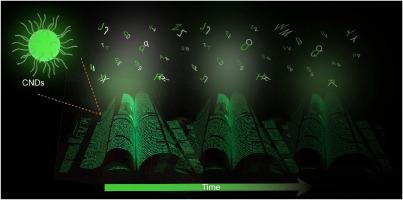
Phosphorescent inks based on carbon nanodots (CNDs) offer an environmentally friendly and low-cost alternative for persistent visibility and time-delayed information retrieval. However, current matrix-dependent phosphorescent CNDs suffer from poor processability and limited substrate compatibility, hindering their application in scalable, high-resolution invisible printing. Here, we report water-soluble phosphorescent CND inks that enable high-resolution, environmentally stable, and invisible printing. The triplet excitons in CNDs are stabilized by spatial confinement during printing, resulting in bright and long-lived phosphorescence. The phosphorescent CND inks enable invisible yet high-fidelity printing of complex textual patterns with micrometer resolution (2480 × 3508 dpi, ∼100 μm feature size), supporting font sizes down to 5 pt and line widths as thin as 0.05 pt across five types of paper substrates. The printed patterns exhibit over 98.7 % accuracy across approximately 8.7 million pixels, demonstrating excellent fidelity. Based on these excellent invisible printing properties, a 200-page wordless book using phosphorescent CND inks was demonstrated. This work presents a scalable, low-cost, and high-resolution platform for phosphorescent ink printing, marking a significant advance in invisible printing technology.
磷光碳纳米点油墨用于可扩展和高分辨率不可见印刷
基于碳纳米点(CNDs)的磷光油墨为持久可见性和延时信息检索提供了一种环保且低成本的替代方案。然而,目前依赖基质的磷光CNDs存在加工性能差和衬底兼容性有限的问题,阻碍了它们在可扩展、高分辨率不可见印刷中的应用。在这里,我们报告了水溶性磷光CND油墨,可实现高分辨率,环境稳定和隐形打印。在印刷过程中,纳米发光材料中的三态激子通过空间约束得到稳定,从而产生明亮和长寿命的磷光。磷光CND油墨能够以微米分辨率(2480 × 3508 dpi,约100 μm特征尺寸)打印不可见但高保真的复杂文本图案,支持字体大小低至5 pt,线宽薄至0.05 pt,跨五种类型的纸张基材。打印的图案在大约870万像素上显示出超过98.7%的精度,显示出出色的保真度。基于这些优异的隐形印刷性能,使用磷光CND油墨制作了一本200页的无字书。本研究提出了一种可扩展、低成本、高分辨率的磷光油墨印刷平台,标志着隐形印刷技术的重大进步。
本文章由计算机程序翻译,如有差异,请以英文原文为准。
求助全文
约1分钟内获得全文
求助全文
 求助内容:
求助内容: 应助结果提醒方式:

 京公网安备 11010802042870号


