Austin Frisch, Loren Marino, Deena Alsaadi, Aditya Kasarabada, Gwen Hua, Germame Ajebo, Stephen Medlin, Zartash Gul
{"title":"Cyclophosphamide for the Treatment of Refractory Immune Effector Cell-Associated Neurotoxicity Syndrome Following CD19-Targeted CAR T-Cell Therapy.","authors":"Austin Frisch, Loren Marino, Deena Alsaadi, Aditya Kasarabada, Gwen Hua, Germame Ajebo, Stephen Medlin, Zartash Gul","doi":"10.14740/jmc5211","DOIUrl":null,"url":null,"abstract":"<p><p>Immune effector cell-associated neurotoxicity syndrome (ICANS) is a serious complication of chimeric antigen receptor T-cell (CAR-T) therapy, associated with significant morbidity and mortality. While corticosteroids and anakinra are cornerstones of treatment, a subset of patients develop severe, steroid-refractory ICANS, highlighting a critical need for more effective therapies. We present the case of a 51-year-old male with relapsed/refractory Philadelphia chromosome-positive (Ph+) B-cell acute lymphoblastic leukemia (B-ALL) who developed grade 4 ICANS following brexucabtagene autoleucel CAR-T therapy. His neurotoxicity was refractory to high-dose corticosteroids, anakinra, and intrathecal chemotherapy. Following administration of low-dose cyclophosphamide (375 mg/m<sup>2</sup>), patient achieved full neurological recovery. This case suggests that earlier, lower-dose cyclophosphamide may be an effective strategy to mitigate ICANS while preserving CAR-T function, warranting further investigation to define its role in treatment algorithms.</p>","PeriodicalId":101328,"journal":{"name":"Journal of medical cases","volume":"17 1","pages":"28-31"},"PeriodicalIF":0.9000,"publicationDate":"2025-12-24","publicationTypes":"Journal Article","fieldsOfStudy":null,"isOpenAccess":false,"openAccessPdf":"https://www.ncbi.nlm.nih.gov/pmc/articles/PMC12758060/pdf/","citationCount":"0","resultStr":null,"platform":"Semanticscholar","paperid":null,"PeriodicalName":"Journal of medical cases","FirstCategoryId":"1085","ListUrlMain":"https://doi.org/10.14740/jmc5211","RegionNum":0,"RegionCategory":null,"ArticlePicture":[],"TitleCN":null,"AbstractTextCN":null,"PMCID":null,"EPubDate":"2026/1/1 0:00:00","PubModel":"eCollection","JCR":"","JCRName":"","Score":null,"Total":0}
引用次数: 0
Abstract
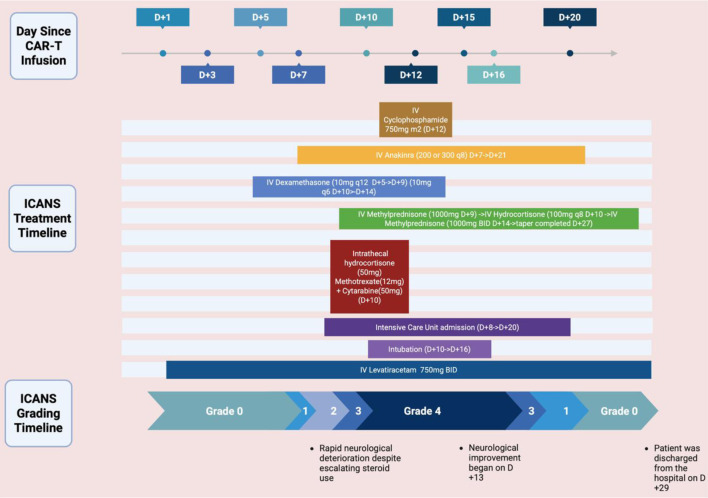
Immune effector cell-associated neurotoxicity syndrome (ICANS) is a serious complication of chimeric antigen receptor T-cell (CAR-T) therapy, associated with significant morbidity and mortality. While corticosteroids and anakinra are cornerstones of treatment, a subset of patients develop severe, steroid-refractory ICANS, highlighting a critical need for more effective therapies. We present the case of a 51-year-old male with relapsed/refractory Philadelphia chromosome-positive (Ph+) B-cell acute lymphoblastic leukemia (B-ALL) who developed grade 4 ICANS following brexucabtagene autoleucel CAR-T therapy. His neurotoxicity was refractory to high-dose corticosteroids, anakinra, and intrathecal chemotherapy. Following administration of low-dose cyclophosphamide (375 mg/m2), patient achieved full neurological recovery. This case suggests that earlier, lower-dose cyclophosphamide may be an effective strategy to mitigate ICANS while preserving CAR-T function, warranting further investigation to define its role in treatment algorithms.


 求助内容:
求助内容: 应助结果提醒方式:

 京公网安备 11010802042870号


