
Transcriptional responses to DHA-induced lipid droplet accumulation in primary adherent mantle cells of Sinonovacula constricta (Lamarck, 1818)
IF 2.2
2区 生物学
Q4 BIOCHEMISTRY & MOLECULAR BIOLOGY
Comparative Biochemistry and Physiology D-Genomics & Proteomics
Pub Date : 2026-06-01
Epub Date: 2025-12-29
DOI:10.1016/j.cbd.2025.101737
引用次数: 0
Abstract
Docosahexaenoic acid (DHA), an essential omega-3 long-chain polyunsaturated fatty acid, is crucial for the development of marine mollusks. Despite its importance, the molecular mechanisms of DHA action in these organisms are poorly understood, primarily due to the lack of reliable in vitro models. This study utilizes the razor clam Sinonovacula constricta as a model organism, establishing a primary adherent cell culture from various tissues, with mantle tissue identified as the optimal source for its rapid migration and low contamination risk. Cells incubated with varying concentrations of DHA (0–400 μM) for 6 h exhibited a concentration-dependent accumulation of lipid droplets (LDs), highlighting the model's suitability for investigating lipid metabolism. Transcriptomic analysis of cells treated with 50 μM DHA identified 848 differentially expressed genes (DEGs), with 747 upregulated and 101 downregulated, indicating the complex effects of DHA. The top 20 significantly upregulated and downregulated DEGs revealed significant involvement in cell signaling transduction, extracellular matrix organization, and substance transport and metabolism. Particularly, lipid metabolism genes, including perilipin 2 and abhydrolase domain containing 2, as well as pathways such as the PPAR signaling pathway and sphingolipid metabolism, were significantly altered, suggesting a reprograming of fatty acid metabolism contributing to LD accumulation. Additionally, pathways related to immune response were notably affected, potentially enhancing cellular health. Collectively, this study provides the first comprehensive insights into the molecular mechanisms underlying DHA-induced LD accumulation in a marine mollusk model at the cellular level, laying a foundation for developing precise nutritional strategies involving DHA in S. constricta aquaculture.
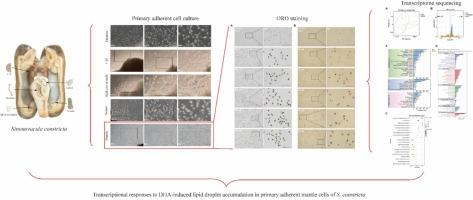
dha诱导的缢蛏原代贴壁套细胞脂滴积累的转录反应(Lamarck, 1818)。
二十二碳六烯酸(DHA)是一种必需的omega-3长链多不饱和脂肪酸,对海洋软体动物的发育至关重要。尽管它很重要,但由于缺乏可靠的体外模型,人们对DHA在这些生物中的作用的分子机制知之甚少。本研究以蛏子缢蛏(Sinonovacula constricta)为模型生物,建立了不同组织的原代贴壁细胞培养,并确定了套膜组织为其快速迁移和低污染风险的最佳来源。在不同浓度的DHA (0-400 μM)中培养6小时的细胞显示出脂滴(ld)的浓度依赖性积累,这表明该模型适合研究脂质代谢。经50 μM DHA处理的细胞转录组学分析发现848个差异表达基因(deg),其中747个上调,101个下调,表明DHA的复杂作用。前20个显著上调和下调的deg表明,它们显著参与细胞信号转导、细胞外基质组织、物质运输和代谢。特别是脂质代谢基因,包括perilippin 2和abhydrolase domain containing 2,以及PPAR信号通路和鞘脂代谢等途径,都发生了显著的改变,表明脂肪酸代谢的重编程导致了LD的积累。此外,与免疫反应相关的途径受到显著影响,可能增强细胞健康。总的来说,本研究首次在细胞水平上全面了解了DHA在海洋软体动物模型中诱导LD积累的分子机制,为制定涉及DHA的缢蛏养殖精确营养策略奠定了基础。
本文章由计算机程序翻译,如有差异,请以英文原文为准。
求助全文
约1分钟内获得全文
求助全文
来源期刊
CiteScore
5.10
自引率
3.30%
发文量
69
审稿时长
33 days
期刊介绍:
Comparative Biochemistry & Physiology (CBP) publishes papers in comparative, environmental and evolutionary physiology.
Part D: Genomics and Proteomics (CBPD), focuses on “omics” approaches to physiology, including comparative and functional genomics, metagenomics, transcriptomics, proteomics, metabolomics, and lipidomics. Most studies employ “omics” and/or system biology to test specific hypotheses about molecular and biochemical mechanisms underlying physiological responses to the environment. We encourage papers that address fundamental questions in comparative physiology and biochemistry rather than studies with a focus that is purely technical, methodological or descriptive in nature.
 求助内容:
求助内容: 应助结果提醒方式:

 京公网安备 11010802042870号


