
Mechanistic insight into the role of lipoglycopeptide drugs in hepatotoxicity

IF 2.5 3区 生物学 Q3 BIOCHEMISTRY & MOLECULAR BIOLOGY
Akash Kumar Jha , Vetriselvan Subramaniyan , Raj Gupta , Arabinda Saha , Ashutosh Kumar
{"title":"Mechanistic insight into the role of lipoglycopeptide drugs in hepatotoxicity","authors":"Akash Kumar Jha ,&nbsp;Vetriselvan Subramaniyan ,&nbsp;Raj Gupta ,&nbsp;Arabinda Saha ,&nbsp;Ashutosh Kumar","doi":"10.1016/j.bbamem.2025.184497","DOIUrl":null,"url":null,"abstract":"<div><div>Understanding how antibiotics interact with membranes is crucial for predicting their off-target effects, particularly hepatotoxicity. This work compares two clinically important glycopeptide antibiotics, Teicoplanin and Oritavancin, using an integrative approach that combines in vivo pathology, lipid biophysics, drug-lipid interactions by NMR spectroscopy, and molecular dynamics simulations. Despite causing little direct disruption to lipid membranes, Teicoplanin produced significant hepatotoxicity, including increased liver enzymes and histopathological loss. Teicoplanin localises at the membrane–aqueous interface, where it forms stable surface-level interactions that have the potential to periodically disrupt membrane-associated processes. On the other hand, due to its deep insertion into the bilayer core, Oritavancin exhibited a more benign hepatic profile, despite causing stronger membrane perturbation. Long-term cellular stress is probably mitigated by this embedded configuration, which facilitates less interaction with membrane receptors. These findings demonstrate that glycopeptide-induced hepatotoxicity is governed by the topology and duration of membrane interactions rather than simply by their magnitude. The study promotes a lipid-centric framework for the logical development of safer, membrane-active treatments and emphasises the value of lipid membrane models and atomistic simulations as predictive tools in early-stage drug evaluation.</div></div>","PeriodicalId":8831,"journal":{"name":"Biochimica et biophysica acta. Biomembranes","volume":"1868 2","pages":"Article 184497"},"PeriodicalIF":2.5000,"publicationDate":"2026-04-01","publicationTypes":"Journal Article","fieldsOfStudy":null,"isOpenAccess":false,"openAccessPdf":"","citationCount":"0","resultStr":null,"platform":"Semanticscholar","paperid":null,"PeriodicalName":"Biochimica et biophysica acta. Biomembranes","FirstCategoryId":"99","ListUrlMain":"https://www.sciencedirect.com/science/article/pii/S0005273625000914","RegionNum":3,"RegionCategory":"生物学","ArticlePicture":[],"TitleCN":null,"AbstractTextCN":null,"PMCID":null,"EPubDate":"2025/12/29 0:00:00","PubModel":"Epub","JCR":"Q3","JCRName":"BIOCHEMISTRY & MOLECULAR BIOLOGY","Score":null,"Total":0}
引用次数: 0

Abstract

Understanding how antibiotics interact with membranes is crucial for predicting their off-target effects, particularly hepatotoxicity. This work compares two clinically important glycopeptide antibiotics, Teicoplanin and Oritavancin, using an integrative approach that combines in vivo pathology, lipid biophysics, drug-lipid interactions by NMR spectroscopy, and molecular dynamics simulations. Despite causing little direct disruption to lipid membranes, Teicoplanin produced significant hepatotoxicity, including increased liver enzymes and histopathological loss. Teicoplanin localises at the membrane–aqueous interface, where it forms stable surface-level interactions that have the potential to periodically disrupt membrane-associated processes. On the other hand, due to its deep insertion into the bilayer core, Oritavancin exhibited a more benign hepatic profile, despite causing stronger membrane perturbation. Long-term cellular stress is probably mitigated by this embedded configuration, which facilitates less interaction with membrane receptors. These findings demonstrate that glycopeptide-induced hepatotoxicity is governed by the topology and duration of membrane interactions rather than simply by their magnitude. The study promotes a lipid-centric framework for the logical development of safer, membrane-active treatments and emphasises the value of lipid membrane models and atomistic simulations as predictive tools in early-stage drug evaluation.
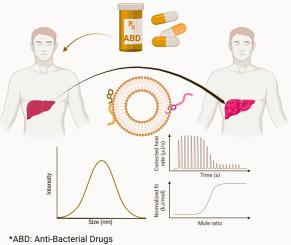
Abstract Image

脂糖肽类药物在肝毒性中的作用机制。
了解抗生素如何与细胞膜相互作用对于预测其脱靶效应,特别是肝毒性至关重要。这项工作比较了两种临床上重要的糖肽抗生素,Teicoplanin和Oritavancin,使用综合方法,结合体内病理,脂质生物物理学,核磁共振波谱的药物-脂质相互作用和分子动力学模拟。尽管Teicoplanin对脂质膜的直接破坏很小,但却产生了显著的肝毒性,包括肝酶增加和组织病理学损失。Teicoplanin定位于膜-水界面,在那里它形成稳定的表面相互作用,具有周期性破坏膜相关过程的潜力。另一方面,由于Oritavancin深入双层核心,尽管会引起更强的膜扰动,但却表现出更良性的肝脏特征。这种嵌入的结构可能减轻了长期的细胞应激,这有助于减少与膜受体的相互作用。这些发现表明,糖肽诱导的肝毒性是由膜相互作用的拓扑结构和持续时间决定的,而不仅仅是由它们的大小决定的。该研究促进了一个以脂质为中心的框架,用于更安全、膜活性治疗的逻辑开发,并强调了脂质膜模型和原子模拟作为早期药物评估预测工具的价值。
本文章由计算机程序翻译,如有差异,请以英文原文为准。
求助全文
约1分钟内获得全文 求助全文
来源期刊
Biochimica et biophysica acta. Biomembranes
Biochimica et biophysica acta. Biomembranes 生物-生化与分子生物学
CiteScore
8.20
自引率
5.90%
发文量
175
审稿时长
2.3 months
期刊介绍: BBA Biomembranes has its main focus on membrane structure, function and biomolecular organization, membrane proteins, receptors, channels and anchors, fluidity and composition, model membranes and liposomes, membrane surface studies and ligand interactions, transport studies, and membrane dynamics.

×
引用
GB/T 7714-2015
复制
MLA
复制
APA
复制
导出至
BibTeX EndNote RefMan NoteFirst NoteExpress
×
提示
您的信息不完整,为了账户安全,请先补充。
现在去补充
×
提示
您因"违规操作"
具体请查看互助需知
我知道了
×
提示
确定
请完成安全验证×
copy
已复制链接
快去分享给好友吧!
我知道了
右上角分享
点击右上角分享
0
联系我们:info@booksci.cn Book学术提供免费学术资源搜索服务,方便国内外学者检索中英文文献。致力于提供最便捷和优质的服务体验。 Copyright © 2023 布克学术 All rights reserved.
京ICP备2023020795号-1
ghs 京公网安备 11010802042870号
Book学术文献互助
Book学术文献互助群
群 号:604180095
Book学术官方微信
小红书


