
Visible light-driven selective oxidative transformation of vicinal diols using ZnS-based photocatalyst in the presence of molecular oxygen
IF 7.6
Q1 ENGINEERING, CHEMICAL
Green Chemical Engineering
Pub Date : 2026-06-01
Epub Date: 2024-11-06
DOI:10.1016/j.gce.2024.11.002
引用次数: 0
Abstract
The heterogeneous photocatalysis for the oxidative cleavage of C–C bond is significant to the transformation of biomass feedstock. In this work, a heterojunction photocatalyst based on the conductor ZnS and C3N4 (CN) material is prepared and employed in the aerobic oxidative cleavage reaction of vicinal diol under visible light irradiation. As a result, it is found that 3ZnS/CN catalyst obtained by a mechanical grinding method shows a high photocatalytic activity. In the photocatalytic oxidative cleavage process of 1-phenyl-1,2-glycol, more than 98.7% conversion of substrate with a 96.2% selectivity of benzaldehyde was attained using O2 as oxidant. In addition, the photocatalyst recycling experiments exhibited that the 3ZnS/CN catalyst still kept a good activity and stability even after being recycled for 5 times. Finally, the active reaction intermediates were investigated by the control experiments and the relative electron paramagnetic resonance (EPR) detection. According to the obtained results and photocatalytic principle, the mechanism for the selective oxidative transformatioin of 1-phenyl-1,2-glycol has been proposed. It gives a promising approach for the catalytic utilization of biomass-based lignin and cellulose.
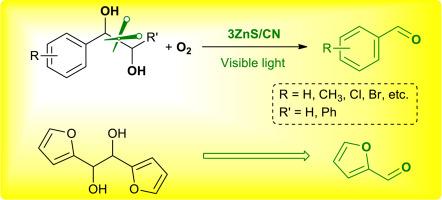
在分子氧存在下,利用zns基光催化剂进行邻二醇的可见光驱动选择性氧化转化
C-C键氧化裂解的非均相光催化作用对生物质原料的转化具有重要意义。本文制备了一种以ZnS和C3N4 (CN)材料为导体的异质结光催化剂,并将其用于邻二醇在可见光下的有氧氧化裂解反应。结果表明,机械研磨法制备的3ZnS/CN催化剂具有较高的光催化活性。在1-苯基-1,2-乙二醇光催化氧化裂解过程中,以O2为氧化剂,底物转化率达98.7%以上,苯甲醛选择性达96.2%。此外,光催化剂回收实验表明,3ZnS/CN催化剂在回收5次后仍保持良好的活性和稳定性。最后,通过对照实验和相对电子顺磁共振(EPR)检测对活性中间体进行了研究。根据所得结果和光催化原理,提出了1-苯基-1,2-乙二醇选择性氧化转化的机理。为生物质木质素和纤维素的催化利用提供了一条很有前途的途径。
本文章由计算机程序翻译,如有差异,请以英文原文为准。
求助全文
约1分钟内获得全文
求助全文
来源期刊
Green Chemical Engineering
Process Chemistry and Technology, Catalysis, Filtration and Separation
CiteScore
11.60
自引率
0.00%
发文量
58
审稿时长
51 days
 求助内容:
求助内容: 应助结果提醒方式:

 京公网安备 11010802042870号


