A. A. Gromov, P. D. Alekseev, A. P. Terekhin, P. A. Maryandyshev
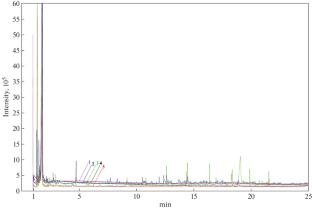
{"title":"Characterization of the Pyrolysis Products of Hydrolytic Lignin and Sewage Sludge Using Pyrolytic Gas Chromatography","authors":"A. A. Gromov, P. D. Alekseev, A. P. Terekhin, P. A. Maryandyshev","doi":"10.3103/S0361521925600348","DOIUrl":null,"url":null,"abstract":"<p>This paper presents the results of a study of the energy potential of nondesign fuels using pyrolytic gas chromatography with mass spectrometric detection (GC–MS). The test materials were samples of sewage sludge (SWS) and hydrolytic lignin (HL) collected in the Arkhangelsk oblast. The initial samples were characterized by their key physicochemical parameters. Attention was paid to an analysis of the chromatograms of pyrolysis products obtained under various temperature conditions. Key temperature ranges of maximum heat release were determined for each type of feedstock. For sewage sludge, the highest yield of high-calorific components determining peak heat release was observed in a range of 400–500°C. For hydrolytic lignin, a similar peak energy release was recorded at a significantly lower temperature of approximately 300°C due to its specific composition. A detailed identification and qualitative assessment of the main components in the pyrolysis products of both fuels was performed using GC–MS and HPLC analysis. The results of this work allowed us to evaluate the suitability of SWS and HL as feedstock for the subsequent energy utilization.</p>","PeriodicalId":779,"journal":{"name":"Solid Fuel Chemistry","volume":"59 6","pages":"444 - 454"},"PeriodicalIF":0.9000,"publicationDate":"2025-12-23","publicationTypes":"Journal Article","fieldsOfStudy":null,"isOpenAccess":false,"openAccessPdf":"","citationCount":"0","resultStr":null,"platform":"Semanticscholar","paperid":null,"PeriodicalName":"Solid Fuel Chemistry","FirstCategoryId":"5","ListUrlMain":"https://link.springer.com/article/10.3103/S0361521925600348","RegionNum":4,"RegionCategory":"工程技术","ArticlePicture":[],"TitleCN":null,"AbstractTextCN":null,"PMCID":null,"EPubDate":"","PubModel":"","JCR":"Q4","JCRName":"CHEMISTRY, MULTIDISCIPLINARY","Score":null,"Total":0}
引用次数: 0
Abstract
This paper presents the results of a study of the energy potential of nondesign fuels using pyrolytic gas chromatography with mass spectrometric detection (GC–MS). The test materials were samples of sewage sludge (SWS) and hydrolytic lignin (HL) collected in the Arkhangelsk oblast. The initial samples were characterized by their key physicochemical parameters. Attention was paid to an analysis of the chromatograms of pyrolysis products obtained under various temperature conditions. Key temperature ranges of maximum heat release were determined for each type of feedstock. For sewage sludge, the highest yield of high-calorific components determining peak heat release was observed in a range of 400–500°C. For hydrolytic lignin, a similar peak energy release was recorded at a significantly lower temperature of approximately 300°C due to its specific composition. A detailed identification and qualitative assessment of the main components in the pyrolysis products of both fuels was performed using GC–MS and HPLC analysis. The results of this work allowed us to evaluate the suitability of SWS and HL as feedstock for the subsequent energy utilization.
期刊介绍:
The journal publishes theoretical and applied articles on the chemistry and physics of solid fuels and carbonaceous materials. It addresses the composition, structure, and properties of solid fuels. The aim of the published articles is to demonstrate how novel discoveries, developments, and theories may be used in improved analysis and design of new types of fuels, chemicals, and by-products. The journal is particularly concerned with technological aspects of various chemical conversion processes and includes papers related to geochemistry, petrology and systematization of fossil fuels, their beneficiation and preparation for processing, the processes themselves, and the ultimate recovery of the liquid or gaseous end products.

 求助内容:
求助内容: 应助结果提醒方式:

 京公网安备 11010802042870号


