
Metabolites involvement in the growth and spread of liver cancer

IF 2.1 Q2 Medicine
Liver Research Pub Date : 2025-12-01 Epub Date: 2025-11-14 DOI:10.1016/j.livres.2025.10.005
Anurag Kumar Gautam , Vipin Kumar , Archana Bharti Sonkar , Amita Singh , Deepankar Yadav , Nitin Rajan , Pranesh Kumar , Sanjay Singh , Sudipta Saha , Vijayakumar Mahalingam Rajamanickam
{"title":"Metabolites involvement in the growth and spread of liver cancer","authors":"Anurag Kumar Gautam ,&nbsp;Vipin Kumar ,&nbsp;Archana Bharti Sonkar ,&nbsp;Amita Singh ,&nbsp;Deepankar Yadav ,&nbsp;Nitin Rajan ,&nbsp;Pranesh Kumar ,&nbsp;Sanjay Singh ,&nbsp;Sudipta Saha ,&nbsp;Vijayakumar Mahalingam Rajamanickam","doi":"10.1016/j.livres.2025.10.005","DOIUrl":null,"url":null,"abstract":"<div><div>Hepatocellular carcinoma (HCC), commonly known as primary liver cancer, is a leading cause of cancer-related mortality worldwide, primarily attributed to changing lifestyles and dietary habits. HCC arises from liver cirrhosis, hepatic fibrosis, or hepatitis B virus infection, and is caused by disruptions in protein and lipid metabolism. These metabolic alterations, recognized as a hallmark of cancer, are pivotal in the progression of chronic liver disease to HCC. Due to its asymptomatic nature in early stages, HCC is often diagnosed at advanced stages when treatment options are limited. Despite being a potentially curative option, liver transplantation remains hindered by high costs and donor scarcity, further compounded by suboptimal long-term success rates. This review examines the critical metabolites that play a part in developing HCC, focusing on their roles as possible biomarkers for disease progression and therapeutic targets. Additionally, the influence of the gut microbiome on HCC development is discussed, highlighting its interplay with metabolic pathways. Understanding the roles of metabolites and the gut microbiome in HCC progression underscores the importance of their potential use in early detection and the development of targeted therapies, offering new avenues for improving patient outcomes.</div></div>","PeriodicalId":36741,"journal":{"name":"Liver Research","volume":"9 4","pages":"Pages 286-297"},"PeriodicalIF":2.1000,"publicationDate":"2025-12-01","publicationTypes":"Journal Article","fieldsOfStudy":null,"isOpenAccess":false,"openAccessPdf":"","citationCount":"0","resultStr":null,"platform":"Semanticscholar","paperid":null,"PeriodicalName":"Liver Research","FirstCategoryId":"3","ListUrlMain":"https://www.sciencedirect.com/science/article/pii/S2542568425000704","RegionNum":0,"RegionCategory":null,"ArticlePicture":[],"TitleCN":null,"AbstractTextCN":null,"PMCID":null,"EPubDate":"2025/11/14 0:00:00","PubModel":"Epub","JCR":"Q2","JCRName":"Medicine","Score":null,"Total":0}
引用次数: 0

Abstract

Hepatocellular carcinoma (HCC), commonly known as primary liver cancer, is a leading cause of cancer-related mortality worldwide, primarily attributed to changing lifestyles and dietary habits. HCC arises from liver cirrhosis, hepatic fibrosis, or hepatitis B virus infection, and is caused by disruptions in protein and lipid metabolism. These metabolic alterations, recognized as a hallmark of cancer, are pivotal in the progression of chronic liver disease to HCC. Due to its asymptomatic nature in early stages, HCC is often diagnosed at advanced stages when treatment options are limited. Despite being a potentially curative option, liver transplantation remains hindered by high costs and donor scarcity, further compounded by suboptimal long-term success rates. This review examines the critical metabolites that play a part in developing HCC, focusing on their roles as possible biomarkers for disease progression and therapeutic targets. Additionally, the influence of the gut microbiome on HCC development is discussed, highlighting its interplay with metabolic pathways. Understanding the roles of metabolites and the gut microbiome in HCC progression underscores the importance of their potential use in early detection and the development of targeted therapies, offering new avenues for improving patient outcomes.
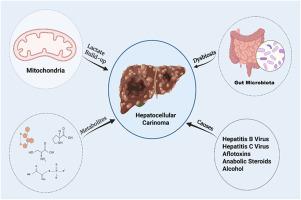
Abstract Image

代谢物参与肝癌的生长和扩散
肝细胞癌(HCC),通常被称为原发性肝癌,是全球癌症相关死亡的主要原因,主要归因于生活方式和饮食习惯的改变。HCC由肝硬化、肝纤维化或乙型肝炎病毒感染引起,由蛋白质和脂质代谢紊乱引起。这些代谢改变被认为是癌症的标志,是慢性肝病向HCC发展的关键。由于早期无症状,HCC通常在治疗选择有限的晚期才被诊断出来。尽管肝移植是一种潜在的治疗选择,但由于成本高和供体稀缺,长期成功率不佳,肝移植仍然受到阻碍。本综述探讨了在HCC发生过程中发挥作用的关键代谢物,重点关注它们作为疾病进展和治疗靶点的可能生物标志物的作用。此外,还讨论了肠道微生物组对HCC发展的影响,强调了其与代谢途径的相互作用。了解代谢物和肠道微生物组在HCC进展中的作用,强调了它们在早期检测和靶向治疗开发中的潜在应用的重要性,为改善患者预后提供了新的途径。
本文章由计算机程序翻译,如有差异,请以英文原文为准。
求助全文
约1分钟内获得全文 求助全文
来源期刊
Liver Research
Liver Research Medicine-Gastroenterology
CiteScore
5.90
自引率
0.00%
发文量
27
审稿时长
13 weeks
×
引用
GB/T 7714-2015
复制
MLA
复制
APA
复制
导出至
BibTeX EndNote RefMan NoteFirst NoteExpress
×
提示
您的信息不完整,为了账户安全,请先补充。
现在去补充
×
提示
您因"违规操作"
具体请查看互助需知
我知道了
×
提示
确定
请完成安全验证×
copy
已复制链接
快去分享给好友吧!
我知道了
右上角分享
点击右上角分享
0
联系我们:info@booksci.cn Book学术提供免费学术资源搜索服务,方便国内外学者检索中英文文献。致力于提供最便捷和优质的服务体验。 Copyright © 2023 布克学术 All rights reserved.
京ICP备2023020795号-1
ghs 京公网安备 11010802042870号
Book学术文献互助
Book学术文献互助群
群 号:604180095
Book学术官方微信
小红书



