Julien Le Friec, Hugo Mourier, Simon Couly, Nicolas Cubedo, Kevin Dubois, Johann Meunier, Benjamin Delprat, Arnaud De Zordo-Banliat, Tahar Ayad, David Virieux, Tsung-Ping Su, Christelle Lasbleiz, Tangui Maurice, Jean-Charles Liévens
{"title":"Positive modulation of sigma-1 receptor: a new weapon to mitigate disease progression in amyotrophic lateral sclerosis.","authors":"Julien Le Friec, Hugo Mourier, Simon Couly, Nicolas Cubedo, Kevin Dubois, Johann Meunier, Benjamin Delprat, Arnaud De Zordo-Banliat, Tahar Ayad, David Virieux, Tsung-Ping Su, Christelle Lasbleiz, Tangui Maurice, Jean-Charles Liévens","doi":"10.1186/s40035-025-00527-z","DOIUrl":null,"url":null,"abstract":"<p><strong>Background: </strong>Amyotrophic lateral sclerosis (ALS) is characterised by degeneration of motor neurons, leading to muscle weakness and progressive paralysis. Currently, no treatment is available to halt or reverse the progression of the disease. Oxidative stress, mitochondrial dysfunction, accumulation of unfolded proteins and inflammation are interconnected key actors involved in ALS. A potent therapeutic strategy would be to find molecules that break this vicious circle leading to neuronal dysfunction and death. Targeting sigma-1 receptor (S1R) could meet this objective, as this chaperone protein modulates many cell survival mechanisms. So far, the impact of S1R activation in ALS has been studied using specific agonists and mostly on the SOD1 mutation that represents only 2% of patients. In the present study, the impact of two different S1R activators, the reference agonist PRE-084 and the positive modulator OZP002, was compared on two key ALS genes: TDP43 and C9orf72.</p><p><strong>Methods: </strong>The dissociation of S1R from Binding immunoglobulin Protein (BiP) was determined using ELISA. OZP002 toxicity was compared to PRE-084 on zebrafish larvae with increasing concentrations. The efficacy of OZP002 and PRE-084 was evaluated on the locomotor escape response of zebrafish expressing mutant TDP43 or one C9orf72 toxic dipeptide. Their effects on NRF2 target gene expression were studied by qPCR. The beneficial effect was further examined on the locomotor performances of TDP43<sup>A315T</sup> mice using rotarod and beam walking tests. We also performed analysis on motor neuron loss and glial reactivity.</p><p><strong>Results: </strong>OZP002 is a positive modulator of S1R, that increases the dissociation of the S1R-BiP complex induced by orthosteric agonists. S1R activation by both OZP002 and PRE-084 restored the locomotor response of ALS zebrafish expressing either TDP43 or one C9orf72 toxic dipeptide. The neuroprotection was due at least in part to the NRF2 cascade stimulation but not with a direct interaction. More importantly, OZP002 and PRE-084 prevented locomotor defects and degeneration of spinal motor neurons in TDP43<sup>A315T</sup> transgenic mice. Astroglial and microglial reactivities were also reduced by both activators.</p><p><strong>Conclusions: </strong>We here emphasize the therapeutic value of S1R activation in mitigating ALS pathology. Additionally, we show that the positive modulators pave the way for the development of new S1R-activating compounds for ALS treatment.</p>","PeriodicalId":23269,"journal":{"name":"Translational Neurodegeneration","volume":"14 1","pages":"68"},"PeriodicalIF":19.1000,"publicationDate":"2025-12-15","publicationTypes":"Journal Article","fieldsOfStudy":null,"isOpenAccess":false,"openAccessPdf":"https://www.ncbi.nlm.nih.gov/pmc/articles/PMC12703938/pdf/","citationCount":"0","resultStr":null,"platform":"Semanticscholar","paperid":null,"PeriodicalName":"Translational Neurodegeneration","FirstCategoryId":"3","ListUrlMain":"https://doi.org/10.1186/s40035-025-00527-z","RegionNum":1,"RegionCategory":"医学","ArticlePicture":[],"TitleCN":null,"AbstractTextCN":null,"PMCID":null,"EPubDate":"","PubModel":"","JCR":"Q1","JCRName":"NEUROSCIENCES","Score":null,"Total":0}
引用次数: 0
Abstract
Background: Amyotrophic lateral sclerosis (ALS) is characterised by degeneration of motor neurons, leading to muscle weakness and progressive paralysis. Currently, no treatment is available to halt or reverse the progression of the disease. Oxidative stress, mitochondrial dysfunction, accumulation of unfolded proteins and inflammation are interconnected key actors involved in ALS. A potent therapeutic strategy would be to find molecules that break this vicious circle leading to neuronal dysfunction and death. Targeting sigma-1 receptor (S1R) could meet this objective, as this chaperone protein modulates many cell survival mechanisms. So far, the impact of S1R activation in ALS has been studied using specific agonists and mostly on the SOD1 mutation that represents only 2% of patients. In the present study, the impact of two different S1R activators, the reference agonist PRE-084 and the positive modulator OZP002, was compared on two key ALS genes: TDP43 and C9orf72.
Methods: The dissociation of S1R from Binding immunoglobulin Protein (BiP) was determined using ELISA. OZP002 toxicity was compared to PRE-084 on zebrafish larvae with increasing concentrations. The efficacy of OZP002 and PRE-084 was evaluated on the locomotor escape response of zebrafish expressing mutant TDP43 or one C9orf72 toxic dipeptide. Their effects on NRF2 target gene expression were studied by qPCR. The beneficial effect was further examined on the locomotor performances of TDP43A315T mice using rotarod and beam walking tests. We also performed analysis on motor neuron loss and glial reactivity.
Results: OZP002 is a positive modulator of S1R, that increases the dissociation of the S1R-BiP complex induced by orthosteric agonists. S1R activation by both OZP002 and PRE-084 restored the locomotor response of ALS zebrafish expressing either TDP43 or one C9orf72 toxic dipeptide. The neuroprotection was due at least in part to the NRF2 cascade stimulation but not with a direct interaction. More importantly, OZP002 and PRE-084 prevented locomotor defects and degeneration of spinal motor neurons in TDP43A315T transgenic mice. Astroglial and microglial reactivities were also reduced by both activators.
Conclusions: We here emphasize the therapeutic value of S1R activation in mitigating ALS pathology. Additionally, we show that the positive modulators pave the way for the development of new S1R-activating compounds for ALS treatment.
期刊介绍:
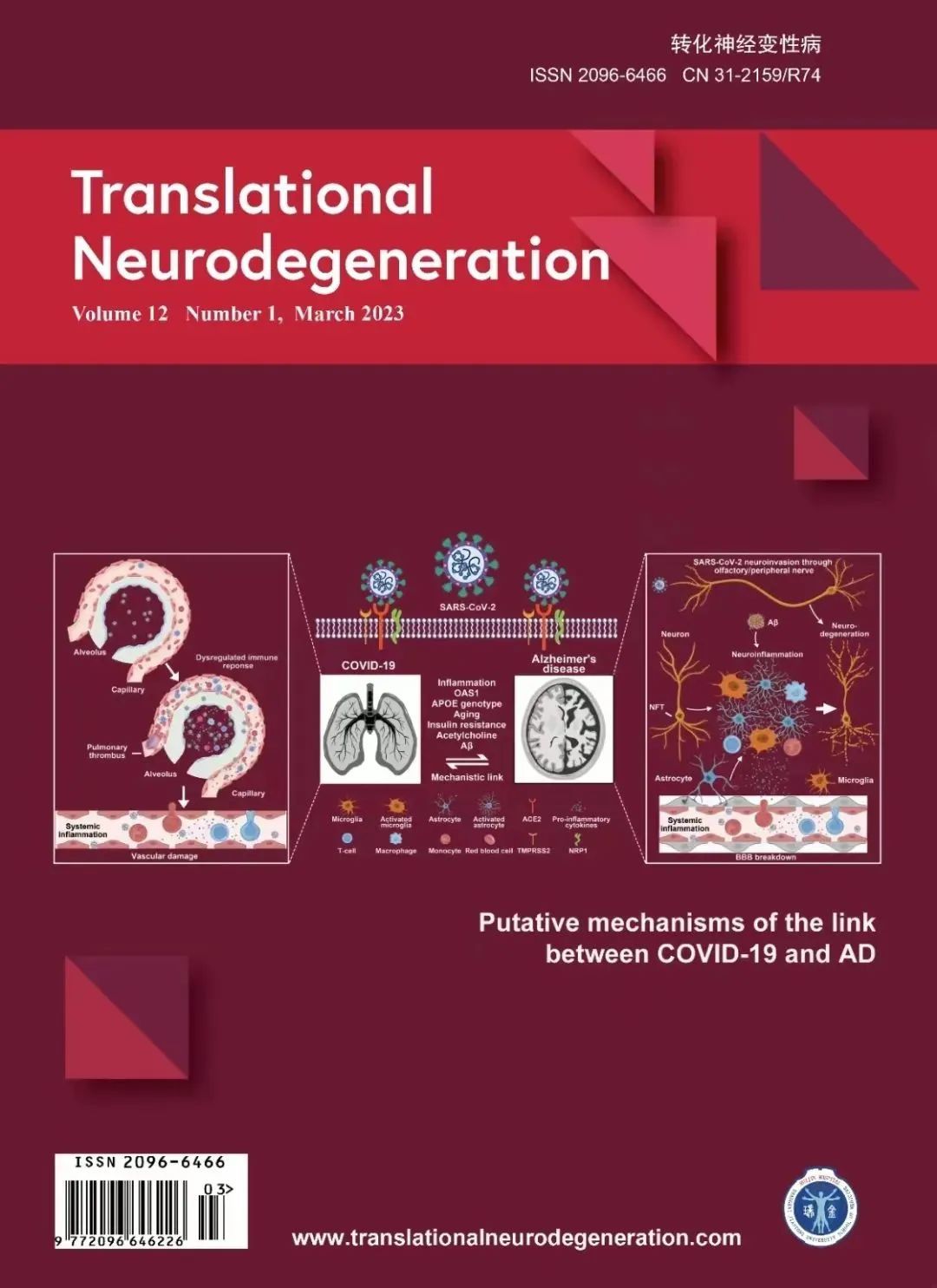
Translational Neurodegeneration, an open-access, peer-reviewed journal, addresses all aspects of neurodegenerative diseases. It serves as a prominent platform for research, therapeutics, and education, fostering discussions and insights across basic, translational, and clinical research domains. Covering Parkinson's disease, Alzheimer's disease, and other neurodegenerative conditions, it welcomes contributions on epidemiology, pathogenesis, diagnosis, prevention, drug development, rehabilitation, and drug delivery. Scientists, clinicians, and physician-scientists are encouraged to share their work in this specialized journal tailored to their fields.



 求助内容:
 应助结果提醒方式:


 京公网安备 11010802042870号


