Alexis S Trujillo, Remi O Labeille, Rijith Jayarajan, Dylan Mack, Frauke Seemann
{"title":"Parental benzo[a]pyrene exposure impacts histone modifications in osteoblast subpopulations.","authors":"Alexis S Trujillo, Remi O Labeille, Rijith Jayarajan, Dylan Mack, Frauke Seemann","doi":"10.1093/eep/dvaf032","DOIUrl":null,"url":null,"abstract":"<p><p>Environmental stressors, such as benzo[a]pyrene (BaP), have been repeatedly associated with developmental bone defects in offspring after parental exposures. Chemical modifications along the histone 3 protein (H3) and histone 4 protein (H4) tails are crucial for osteoblast differentiation. Therefore, H3K4me3, H3K9me3, H3K27me3, H3K27ac, and H4K5ac/K8ac/K12ac have been assessed by immunofluorescence. F1 adults from a transgenic <i>twist:dsred/col10a1:gfp</i> medaka (<i>Oryzias latipes</i>) strain with/without parental BaP exposure were assessed to yield novel data on the histone code of osteoblasts and allow quantification of parental environmental pollutant exposure's interference with chromatin structure regulation. In <i>twist</i> <sup>+</sup> cells, BaP exposure significantly reduced H3K9me3 marks in both male and female fish. Significant reductions of H3K9me3 and H4K5ac/K8ac/K12ac were observed in <i>col10a1</i> <sup>+</sup> cells of male fish with parental BaP exposure. Notable sex-specific differences existed across histone modifications in these osteoblast subpopulations. Understanding the relationship between histone modifications and bone health will improve the assessment of ecological risk and public health impact of BaP pollution and further support the hypothesis that BaP-induced histone modifications are inherited over generations and involved in bone formation in an osteoblast subpopulation-specific manner.</p>","PeriodicalId":11774,"journal":{"name":"Environmental Epigenetics","volume":"11 1","pages":"dvaf032"},"PeriodicalIF":3.2000,"publicationDate":"2025-11-14","publicationTypes":"Journal Article","fieldsOfStudy":null,"isOpenAccess":false,"openAccessPdf":"https://www.ncbi.nlm.nih.gov/pmc/articles/PMC12699992/pdf/","citationCount":"0","resultStr":null,"platform":"Semanticscholar","paperid":null,"PeriodicalName":"Environmental Epigenetics","FirstCategoryId":"1085","ListUrlMain":"https://doi.org/10.1093/eep/dvaf032","RegionNum":0,"RegionCategory":null,"ArticlePicture":[],"TitleCN":null,"AbstractTextCN":null,"PMCID":null,"EPubDate":"2025/1/1 0:00:00","PubModel":"eCollection","JCR":"Q1","JCRName":"GENETICS & HEREDITY","Score":null,"Total":0}
引用次数: 0
Abstract
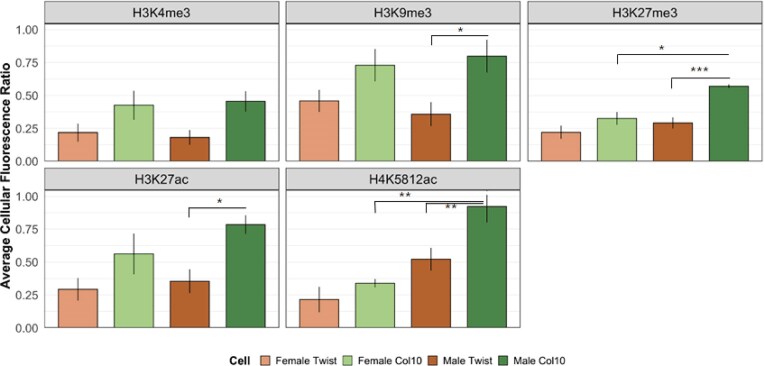
Environmental stressors, such as benzo[a]pyrene (BaP), have been repeatedly associated with developmental bone defects in offspring after parental exposures. Chemical modifications along the histone 3 protein (H3) and histone 4 protein (H4) tails are crucial for osteoblast differentiation. Therefore, H3K4me3, H3K9me3, H3K27me3, H3K27ac, and H4K5ac/K8ac/K12ac have been assessed by immunofluorescence. F1 adults from a transgenic twist:dsred/col10a1:gfp medaka (Oryzias latipes) strain with/without parental BaP exposure were assessed to yield novel data on the histone code of osteoblasts and allow quantification of parental environmental pollutant exposure's interference with chromatin structure regulation. In twist+ cells, BaP exposure significantly reduced H3K9me3 marks in both male and female fish. Significant reductions of H3K9me3 and H4K5ac/K8ac/K12ac were observed in col10a1+ cells of male fish with parental BaP exposure. Notable sex-specific differences existed across histone modifications in these osteoblast subpopulations. Understanding the relationship between histone modifications and bone health will improve the assessment of ecological risk and public health impact of BaP pollution and further support the hypothesis that BaP-induced histone modifications are inherited over generations and involved in bone formation in an osteoblast subpopulation-specific manner.




 求助内容:
求助内容: 应助结果提醒方式:

 京公网安备 11010802042870号


