R. V. Shafigulin, K. Yu. Vinogradov, O. V. Korchagin, V. M. Davydov, E. O. Tokranova, A. V. Bulanova
{"title":"Efficient Catalysts for Oxygen Electroreduction Based on Carbon Nanotubes and Pyrolyzate of the Metalorganic Framework MIL-53(Al)","authors":"R. V. Shafigulin, K. Yu. Vinogradov, O. V. Korchagin, V. M. Davydov, E. O. Tokranova, A. V. Bulanova","doi":"10.1134/S0036024425702462","DOIUrl":null,"url":null,"abstract":"<p>The electrocatalytic properties of materials synthesized on multi-walled carbon nanotubes (MWCNTs) and pyrolyzate of the metalorganic framework Pyr_MIL-53(Al) in the oxygen reduction in an alkaline medium were compared. The catalysts were obtained by doping the supports with iron and cobalt phthalocyanines and modifying them with palladium. According to the IUPAC classification, the materials are type IV adsorbents, having a hysteresis of the H3 type, which indicates the presence of slit-like pores. When the MWCNTs are doped, the ordering of the catalyst surface significantly decreases, probably due to the formation of amorphous carbon during the decomposition of phthalocyanines. When Pyr_MIL-53(Al) is doped, the surface ordering increases, which is probably associated with graphitization of the carbon of the initial Pyr_MIL-53(Al) during the joint pyrolysis with phthalocyanines. The phase composition of the obtained catalysts was studied by XRD: the metals are present in the form of alloys and oxides. In the linear voltammetry mode, the MWCNT_CoPc_FePc_Pd catalyst showed activity in the oxygen reduction reaction (ORR) comparable to that of the commercial platinum electrode; the number of electrons participating in the reaction was more than 3.8. The MWCNT_CoPc_FePc_Pd catalyst exhibited a large electrochemically active surface area and high corrosion resistance associated with the self-activation effect. The trials of the MWCNT_CoPc_FePc_Pd catalyst under membrane electrode unit (MEU) conditions showed high efficiency of the material as an oxygen reduction catalyst for alkaline fuel cells.</p>","PeriodicalId":767,"journal":{"name":"Russian Journal of Physical Chemistry A","volume":"99 12","pages":"3037 - 3049"},"PeriodicalIF":0.8000,"publicationDate":"2025-12-08","publicationTypes":"Journal Article","fieldsOfStudy":null,"isOpenAccess":false,"openAccessPdf":"","citationCount":"0","resultStr":null,"platform":"Semanticscholar","paperid":null,"PeriodicalName":"Russian Journal of Physical Chemistry A","FirstCategoryId":"92","ListUrlMain":"https://link.springer.com/article/10.1134/S0036024425702462","RegionNum":4,"RegionCategory":"化学","ArticlePicture":[],"TitleCN":null,"AbstractTextCN":null,"PMCID":null,"EPubDate":"","PubModel":"","JCR":"Q4","JCRName":"CHEMISTRY, PHYSICAL","Score":null,"Total":0}
引用次数: 0
Abstract
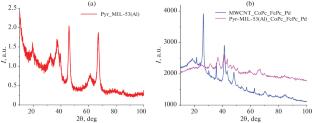
The electrocatalytic properties of materials synthesized on multi-walled carbon nanotubes (MWCNTs) and pyrolyzate of the metalorganic framework Pyr_MIL-53(Al) in the oxygen reduction in an alkaline medium were compared. The catalysts were obtained by doping the supports with iron and cobalt phthalocyanines and modifying them with palladium. According to the IUPAC classification, the materials are type IV adsorbents, having a hysteresis of the H3 type, which indicates the presence of slit-like pores. When the MWCNTs are doped, the ordering of the catalyst surface significantly decreases, probably due to the formation of amorphous carbon during the decomposition of phthalocyanines. When Pyr_MIL-53(Al) is doped, the surface ordering increases, which is probably associated with graphitization of the carbon of the initial Pyr_MIL-53(Al) during the joint pyrolysis with phthalocyanines. The phase composition of the obtained catalysts was studied by XRD: the metals are present in the form of alloys and oxides. In the linear voltammetry mode, the MWCNT_CoPc_FePc_Pd catalyst showed activity in the oxygen reduction reaction (ORR) comparable to that of the commercial platinum electrode; the number of electrons participating in the reaction was more than 3.8. The MWCNT_CoPc_FePc_Pd catalyst exhibited a large electrochemically active surface area and high corrosion resistance associated with the self-activation effect. The trials of the MWCNT_CoPc_FePc_Pd catalyst under membrane electrode unit (MEU) conditions showed high efficiency of the material as an oxygen reduction catalyst for alkaline fuel cells.
期刊介绍:
Russian Journal of Physical Chemistry A. Focus on Chemistry (Zhurnal Fizicheskoi Khimii), founded in 1930, offers a comprehensive review of theoretical and experimental research from the Russian Academy of Sciences, leading research and academic centers from Russia and from all over the world.
Articles are devoted to chemical thermodynamics and thermochemistry, biophysical chemistry, photochemistry and magnetochemistry, materials structure, quantum chemistry, physical chemistry of nanomaterials and solutions, surface phenomena and adsorption, and methods and techniques of physicochemical studies.

 求助内容:
求助内容: 应助结果提醒方式:

 京公网安备 11010802042870号


