
Fracture of ultrathin coating during micro-channel forming process of coated metallic sheet: Experiments and numerical prediction
IF 7.9
2区 材料科学
Q1 ENGINEERING, INDUSTRIAL
Journal of Materials Processing Technology
Pub Date : 2026-02-01
Epub Date: 2025-12-03
DOI:10.1016/j.jmatprotec.2025.119164
引用次数: 0
Abstract
The coating-then-forming process offers a promising route to improve the manufacturing efficiency of metallic bipolar plates in proton exchange membrane fuel cells. However, fracture of ultrathin coatings during forming presents a formidable challenge to the corrosion resistance of coated metallic sheets. To provide theoretical guidance for addressing this issue, this work investigates the coating fracture behavior during the micro-channel forming process through experiments and numerical analysis. Coating cracks were revealed to be concentrated within the fillet and flat regions of the channel ridge, highly sensitive to local strain levels governed by both channel geometry and substrate microstructure. Therefore, a full-field simulation methodology was developed to predict the coating fracture during forming, balancing between computational efficiency with accuracy. Within this numerical framework, hybrid modeling of the metallic sheet substrate was employed, combining local implementation of crystal plasticity in the critical region with homogeneous materials elsewhere. For coating on the critical region, varying failure parameters correlated with substrate microstructure were determined by the microscopic fracture mechanism. Experimental validation confirms that the developed model can precisely predict both coating fractures and formed profiles, notably achieving an 80 % accuracy improvement in crack density compared to conventional approaches. Based on the simulation results, process windows were established to correlate coating fracture and channel geometry with forming parameters, thereby guiding optimization toward the minimization of crack density under geometrical constraints. Following parameter optimization, coating cracks were successfully eliminated at the flat region, demonstrating an effective strategy for maintaining the corrosion resistance after forming.
涂层金属薄板微通道成形过程中超薄涂层的断裂:实验与数值预测
先涂覆后成形工艺为提高质子交换膜燃料电池金属双极板的制造效率提供了一条很有前途的途径。然而,超薄涂层在成形过程中的断裂对涂层金属板的耐腐蚀性能提出了严峻的挑战。为了为解决这一问题提供理论指导,本工作通过实验和数值分析研究了微通道成形过程中涂层的断裂行为。涂层裂纹集中在沟道脊的角状和平坦区域内,对沟道几何形状和衬底微观结构控制的局部应变水平高度敏感。因此,为了在计算效率和精度之间取得平衡,开发了一种预测成形过程中涂层断裂的全场模拟方法。在此数值框架内,采用金属板衬底的混合建模,将临界区域的局部晶体塑性实现与其他地方的均匀材料相结合。对于临界区域的涂层,由微观断裂机制决定了与基体组织相关的不同失效参数。实验验证证实,所开发的模型可以精确预测涂层裂缝和成形轮廓,与传统方法相比,裂缝密度的精度提高了80% %。基于仿真结果,建立工艺窗口,将涂层断口和通道几何形状与成形参数关联起来,从而指导优化在几何约束下实现裂纹密度的最小化。通过参数优化,涂层在平面区域的裂纹被成功消除,证明了一种有效的策略来保持成型后的耐腐蚀性。
本文章由计算机程序翻译,如有差异,请以英文原文为准。
求助全文
约1分钟内获得全文
求助全文
来源期刊
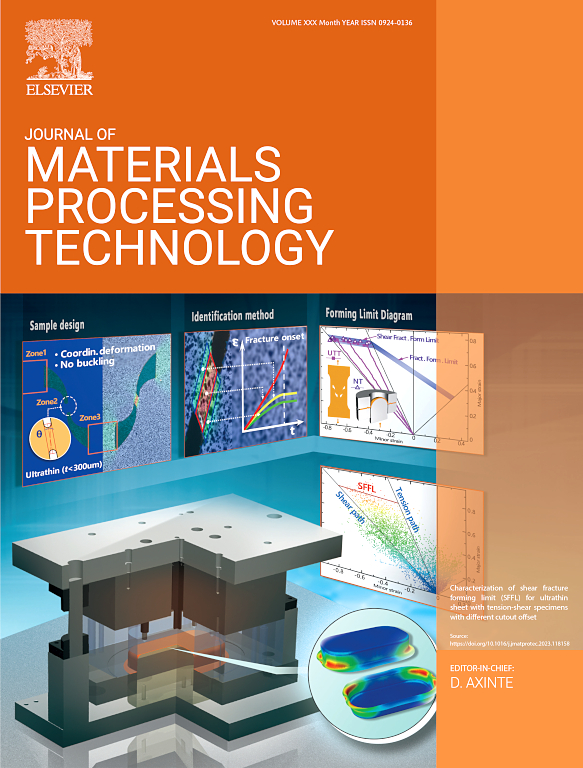
Journal of Materials Processing Technology
工程技术-材料科学:综合
CiteScore
12.60
自引率
4.80%
发文量
403
审稿时长
29 days
期刊介绍:
The Journal of Materials Processing Technology covers the processing techniques used in manufacturing components from metals and other materials. The journal aims to publish full research papers of original, significant and rigorous work and so to contribute to increased production efficiency and improved component performance.
Areas of interest to the journal include:
• Casting, forming and machining
• Additive processing and joining technologies
• The evolution of material properties under the specific conditions met in manufacturing processes
• Surface engineering when it relates specifically to a manufacturing process
• Design and behavior of equipment and tools.
 求助内容:
 应助结果提醒方式:


 京公网安备 11010802042870号


