{"title":"Association between a remimazolam-propofol combination for maintenance of anesthesia and extubation time: a propensity score analysis.","authors":"Takayuki Katsuragawa, Soichiro Mimuro, Hiroki Anezaki, Yuji Suzuki, Tsunehisa Sato, Yoshitaka Aoki, Masakazu Yamaguchi, Yoshiki Nakajima","doi":"10.1186/s40981-025-00836-2","DOIUrl":null,"url":null,"abstract":"<p><strong>Background: </strong>This study aimed to evaluate the effect of combined administration of remimazolam and propofol on extubation time during anesthesia maintenance.</p><p><strong>Methods: </strong>This retrospective study was conducted at Hamamatsu University Hospital, enrolling adult patients who underwent non-cardiac surgery between September 2020 and October 2024. Eligible patients underwent invasive arterial pressure monitoring and anesthesia maintenance with remimazolam alone (RB group), propofol alone (PROP group), or a combination of both (RB + PROP group). Extubation time was defined as the interval between the cessation of sedative administration and tracheal extubation. Propensity score matching was performed after adjusting for age, sex, body mass index, American Society of Anesthesiologists Physical Status, preoperative comorbidities, type of surgery, combined with epidural anesthesia, scheduled or emergency surgery, operation time, and blood loss. The primary endpoint was the extubation time, while the secondary endpoints included the severity of hypotension, assessed by the time-weighted average area under the threshold, and the incidence of postoperative nausea and vomiting.</p><p><strong>Results: </strong>The study included 165, 403, and 178 patients in the RB, PROP, and RB + PROP groups, respectively. After propensity score matching, 75 matched cohorts were analyzed. Among the three groups, significant differences were found in terms of extubation time and hypotension (p < 0.001 and p = 0.04, respectively), whereas the incidence of postoperative nausea and vomiting did not significantly differ (p = 0.23). In multiple comparisons, the RB group (9.0 min) and the RB + PROP group (9.0 min) had significantly shorter extubation times than the PROP group (13.0 min) (each p < 0.001). Time-weighted average area under the threshold was significantly lower in the RB group (0.74 mmHg) than in the PROP group (2.03 mmHg) (p = 0.03).</p><p><strong>Conclusion: </strong>Extubation time with combined remimazolam and propofol was comparable to that with remimazolam alone, and both were shorter than that with propofol alone.</p>","PeriodicalId":14635,"journal":{"name":"JA Clinical Reports","volume":" ","pages":"5"},"PeriodicalIF":1.2000,"publicationDate":"2025-12-04","publicationTypes":"Journal Article","fieldsOfStudy":null,"isOpenAccess":false,"openAccessPdf":"https://www.ncbi.nlm.nih.gov/pmc/articles/PMC12779813/pdf/","citationCount":"0","resultStr":null,"platform":"Semanticscholar","paperid":null,"PeriodicalName":"JA Clinical Reports","FirstCategoryId":"1085","ListUrlMain":"https://doi.org/10.1186/s40981-025-00836-2","RegionNum":0,"RegionCategory":null,"ArticlePicture":[],"TitleCN":null,"AbstractTextCN":null,"PMCID":null,"EPubDate":"","PubModel":"","JCR":"Q3","JCRName":"ANESTHESIOLOGY","Score":null,"Total":0}
引用次数: 0
Abstract
Background: This study aimed to evaluate the effect of combined administration of remimazolam and propofol on extubation time during anesthesia maintenance.
Methods: This retrospective study was conducted at Hamamatsu University Hospital, enrolling adult patients who underwent non-cardiac surgery between September 2020 and October 2024. Eligible patients underwent invasive arterial pressure monitoring and anesthesia maintenance with remimazolam alone (RB group), propofol alone (PROP group), or a combination of both (RB + PROP group). Extubation time was defined as the interval between the cessation of sedative administration and tracheal extubation. Propensity score matching was performed after adjusting for age, sex, body mass index, American Society of Anesthesiologists Physical Status, preoperative comorbidities, type of surgery, combined with epidural anesthesia, scheduled or emergency surgery, operation time, and blood loss. The primary endpoint was the extubation time, while the secondary endpoints included the severity of hypotension, assessed by the time-weighted average area under the threshold, and the incidence of postoperative nausea and vomiting.
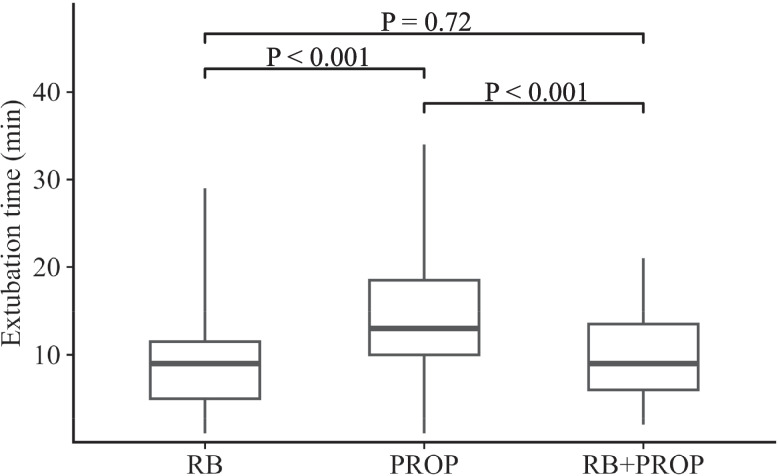
Results: The study included 165, 403, and 178 patients in the RB, PROP, and RB + PROP groups, respectively. After propensity score matching, 75 matched cohorts were analyzed. Among the three groups, significant differences were found in terms of extubation time and hypotension (p < 0.001 and p = 0.04, respectively), whereas the incidence of postoperative nausea and vomiting did not significantly differ (p = 0.23). In multiple comparisons, the RB group (9.0 min) and the RB + PROP group (9.0 min) had significantly shorter extubation times than the PROP group (13.0 min) (each p < 0.001). Time-weighted average area under the threshold was significantly lower in the RB group (0.74 mmHg) than in the PROP group (2.03 mmHg) (p = 0.03).
Conclusion: Extubation time with combined remimazolam and propofol was comparable to that with remimazolam alone, and both were shorter than that with propofol alone.
期刊介绍:
JA Clinical Reports is a companion journal to the Journal of Anesthesia (JA), the official journal of the Japanese Society of Anesthesiologists (JSA). This journal is an open access, peer-reviewed, online journal related to clinical anesthesia practices such as anesthesia management, pain management and intensive care. Case reports are very important articles from the viewpoint of education and the cultivation of scientific thinking in the field of anesthesia. However, submissions of anesthesia research and clinical reports from Japan are notably decreasing in major anesthesia journals. Therefore, the JSA has decided to launch a new journal, JA Clinical Reports, to encourage JSA members, particularly junior Japanese anesthesiologists, to publish papers in English language.


 求助内容:
求助内容: 应助结果提醒方式:

 京公网安备 11010802042870号


