Ivana Nikodijevic, Kareena Sagar, Angelica Fiuza, Tara Krishna, Ayana King, Kylie Getz, Damali Campbell
{"title":"COVID-19 vaccine attitudes and news consumption patterns among pregnant and postpartum individuals in an urban setting.","authors":"Ivana Nikodijevic, Kareena Sagar, Angelica Fiuza, Tara Krishna, Ayana King, Kylie Getz, Damali Campbell","doi":"10.1515/crpm-2025-0005","DOIUrl":null,"url":null,"abstract":"<p><strong>Objectives: </strong>Pregnant individuals face increased COVID-19 symptom severity, yet vaccination rates remain low. The study aimed to identify strategies for improving vaccine adherence by examining pregnant individuals' attitudes toward the COVID-19 vaccine and their news consumption habits.</p><p><strong>Case presentation: </strong>A total of 58 pregnant and postpartum individuals were surveyed in the Obstetrics & Gynecology clinic at an urban academic medical center in Newark, NJ from June to December 2023. The 88-item survey assessed sociodemographic characteristics, vaccination status, pandemic-related risk perception, resource accessibility, and news sources. Sixty-six percent of participants reported receiving the COVID-19 vaccine. Vaccinated individuals were more likely to agree with pro-vaccine statements. Many respondents, regardless of vaccination status, selected \"neither agree nor disagree\" for anti-vaccine claims including those related to infertility or miscarriage. Participants who preferred traditional news sources (e.g. television broadcasts) were more likely to support pro-vaccine statements, while social media users expressed greater uncertainty.</p><p><strong>Conclusions: </strong>Concerns about the safety and efficacy of the COVID-19 vaccine were key in hesitancy among pregnant individuals, with social media contributing to this hesitancy. Our study highlights the need for holistic and effective communication from healthcare providers, evidence-based information across media platforms, and increased vaccine accessibility to improve vaccine adherence.</p>","PeriodicalId":9617,"journal":{"name":"Case Reports in Perinatal Medicine","volume":"14 1","pages":"20250005"},"PeriodicalIF":0.2000,"publicationDate":"2025-12-03","publicationTypes":"Journal Article","fieldsOfStudy":null,"isOpenAccess":false,"openAccessPdf":"https://www.ncbi.nlm.nih.gov/pmc/articles/PMC12671479/pdf/","citationCount":"0","resultStr":null,"platform":"Semanticscholar","paperid":null,"PeriodicalName":"Case Reports in Perinatal Medicine","FirstCategoryId":"1085","ListUrlMain":"https://doi.org/10.1515/crpm-2025-0005","RegionNum":0,"RegionCategory":null,"ArticlePicture":[],"TitleCN":null,"AbstractTextCN":null,"PMCID":null,"EPubDate":"2025/1/1 0:00:00","PubModel":"eCollection","JCR":"Q4","JCRName":"OBSTETRICS & GYNECOLOGY","Score":null,"Total":0}
引用次数: 0
Abstract
Objectives: Pregnant individuals face increased COVID-19 symptom severity, yet vaccination rates remain low. The study aimed to identify strategies for improving vaccine adherence by examining pregnant individuals' attitudes toward the COVID-19 vaccine and their news consumption habits.
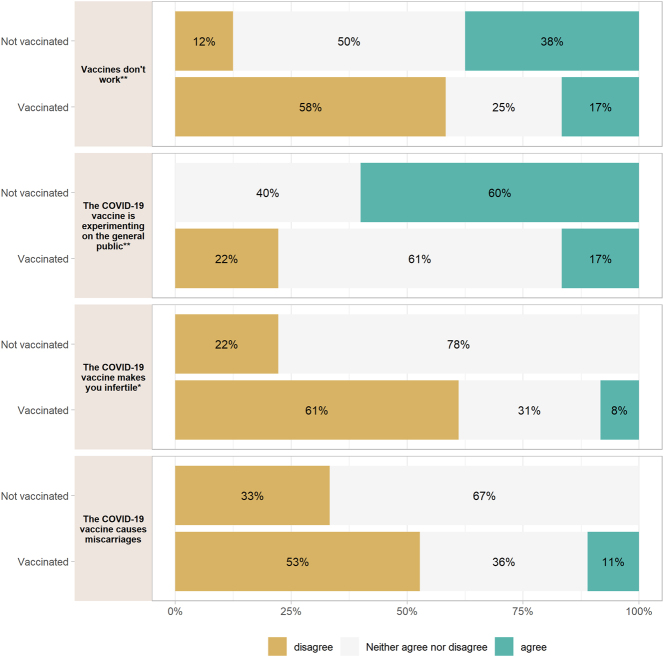
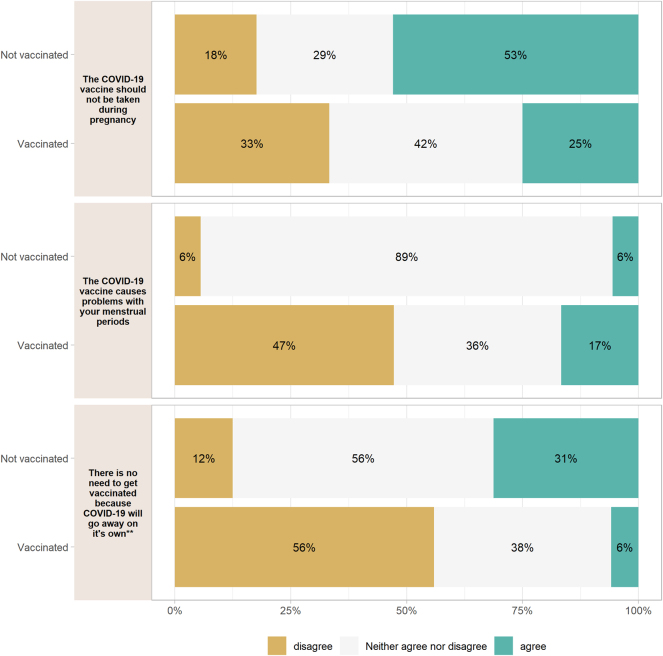
Case presentation: A total of 58 pregnant and postpartum individuals were surveyed in the Obstetrics & Gynecology clinic at an urban academic medical center in Newark, NJ from June to December 2023. The 88-item survey assessed sociodemographic characteristics, vaccination status, pandemic-related risk perception, resource accessibility, and news sources. Sixty-six percent of participants reported receiving the COVID-19 vaccine. Vaccinated individuals were more likely to agree with pro-vaccine statements. Many respondents, regardless of vaccination status, selected "neither agree nor disagree" for anti-vaccine claims including those related to infertility or miscarriage. Participants who preferred traditional news sources (e.g. television broadcasts) were more likely to support pro-vaccine statements, while social media users expressed greater uncertainty.
Conclusions: Concerns about the safety and efficacy of the COVID-19 vaccine were key in hesitancy among pregnant individuals, with social media contributing to this hesitancy. Our study highlights the need for holistic and effective communication from healthcare providers, evidence-based information across media platforms, and increased vaccine accessibility to improve vaccine adherence.
期刊介绍:
Case Reports in Perinatal Medicine is a double-blind peer-reviewed journal. The objective of the new journal is very similar to that of JPM. In addition to evidence-based studies, practitioners in clinical practice esteem especially exemplary reports of cases that reveal specific manifestations of diseases, its progress or its treatment. We consider case reports and series to be brief reports describing an isolated clinical case or a small number of cases. They may describe new or uncommon diagnoses, unusual outcomes or prognosis, new or infrequently used therapies and side effects of therapy not usually discovered in clinical trials. They represent the basic concept of experiences for studies on representative groups for further evidence-based research. The potential roles of case reports and case series are: Recognition and description of new diseases Detection of drug side effects (adverse or beneficial) Study of mechanisms of disease Medical education and audit Recognition of rare manifestations of disease.



 求助内容:
求助内容: 应助结果提醒方式:

 京公网安备 11010802042870号


