{"title":"Root coverage using recombinant human fibroblast growth factor-2 treated connective tissue graft: Case studies.","authors":"Guo-Liang Cheng, Satoru Urano, Yu-Chang Wu, Rami Alsabbagh, Hsun-Liang Chan","doi":"10.1002/cap.10323","DOIUrl":null,"url":null,"abstract":"<p><strong>Background: </strong>This case study documents the application of connective tissue graft (CTG) combined with biologics on treating challenging gingival recession cases of mandibular anterior teeth caused by orthodontic tooth movement.</p><p><strong>Methods: </strong>Three patients presented for periodontal consultation due to gingival recession resulting from orthodontic treatment. The patients reported esthetic concerns and discomfort while brushing their teeth. The gingival defects were mainly localized to the mandibular incisors, with recession depths ranging from 1 to 5 mm and complicated by loss of papilla and a lack of keratinized tissue. RT2 gingival recession with thin gingival phenotype was confirmed. All gingival defects were managed using recombinant human fibroblast growth factor-2 (rhFGF-2) treated CTG. The recipient sites were prepared using tunnel or modified tunnel techniques. CTG harvested from the hard palate was treated with rhFGF-2 for 3 min then inserted into the prepared tunnel space and secured with a sling suture technique for coronal advancement.</p><p><strong>Results: </strong>The three patients were followed from 6 months to 6 years. Generally, initial wound healing was within normal limits during the first several weeks. The recession defects were successfully covered, achieving a nearly 100% root coverage rate. The combination of CTG+rhFGF-2 resulted in satisfying recession depth reduction, papilla augmentation, and gain of keratinized tissue. Patients were satisfied with the improvement of esthetics and function.</p><p><strong>Conclusions: </strong>This innovative approach demonstrates that rhFGF-2 treated CTG significantly improves the mucogingival problems caused by orthodontic treatment. Successful phenotype modification provides functional and esthetic improvement as well as long-term stability of periodontal health.</p><p><strong>Plain language summary: </strong>Receding gums are a common complication after wearing dental braces, which sometimes can be severe if the initial gum tissue is thin. This complication could cause tooth sensitivity, discomfort when brushing, and compromised esthetics. To regenerate the lost tissue, a connective tissue graft (CTG) harvested from the roof of the oral cavity is very commonly used as a transplantation option with substantial supporting evidence. However, for cases of severe gum recession, CTGs still have limitations on treatment. Therefore, clinicians and researchers are dedicated to improving treatment outcomes by adding biomaterials to the graft to enhance clinical outcomes. A relatively new material, recombinant human fibroblast growth factor-2 (rhFGF-2), has proven to be effective in periodontal regenerative treatments and could potentially augment the soft tissue regenerative capacity of the graft. This case study documents the application of rhFGF-2 in combination with CTGs for treating severe gum recession in three patients. The treatment results demonstrate significant improvements with follow-up data ranging from 6 months to 6 years. These improvements include the coverage of exposed root surfaces, regeneration of tissue between teeth, and thickening of gum tissue. Patients were satisfied with the positive changes in function and esthetics resulting from this approach.</p>","PeriodicalId":55950,"journal":{"name":"Clinical Advances in Periodontics","volume":" ","pages":"354-363"},"PeriodicalIF":0.9000,"publicationDate":"2025-12-01","publicationTypes":"Journal Article","fieldsOfStudy":null,"isOpenAccess":false,"openAccessPdf":"https://www.ncbi.nlm.nih.gov/pmc/articles/PMC12780481/pdf/","citationCount":"0","resultStr":null,"platform":"Semanticscholar","paperid":null,"PeriodicalName":"Clinical Advances in Periodontics","FirstCategoryId":"1085","ListUrlMain":"https://doi.org/10.1002/cap.10323","RegionNum":0,"RegionCategory":null,"ArticlePicture":[],"TitleCN":null,"AbstractTextCN":null,"PMCID":null,"EPubDate":"2025/12/2 0:00:00","PubModel":"Epub","JCR":"Q3","JCRName":"DENTISTRY, ORAL SURGERY & MEDICINE","Score":null,"Total":0}
引用次数: 0
Abstract
Background: This case study documents the application of connective tissue graft (CTG) combined with biologics on treating challenging gingival recession cases of mandibular anterior teeth caused by orthodontic tooth movement.
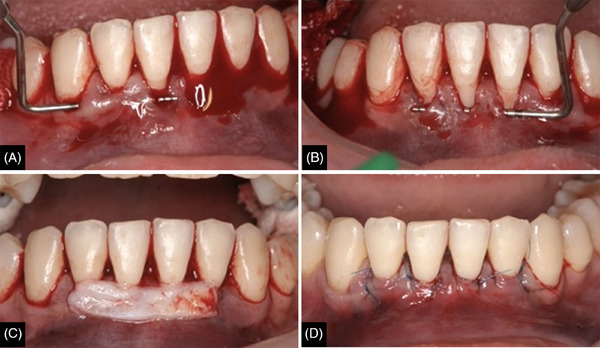
Methods: Three patients presented for periodontal consultation due to gingival recession resulting from orthodontic treatment. The patients reported esthetic concerns and discomfort while brushing their teeth. The gingival defects were mainly localized to the mandibular incisors, with recession depths ranging from 1 to 5 mm and complicated by loss of papilla and a lack of keratinized tissue. RT2 gingival recession with thin gingival phenotype was confirmed. All gingival defects were managed using recombinant human fibroblast growth factor-2 (rhFGF-2) treated CTG. The recipient sites were prepared using tunnel or modified tunnel techniques. CTG harvested from the hard palate was treated with rhFGF-2 for 3 min then inserted into the prepared tunnel space and secured with a sling suture technique for coronal advancement.
Results: The three patients were followed from 6 months to 6 years. Generally, initial wound healing was within normal limits during the first several weeks. The recession defects were successfully covered, achieving a nearly 100% root coverage rate. The combination of CTG+rhFGF-2 resulted in satisfying recession depth reduction, papilla augmentation, and gain of keratinized tissue. Patients were satisfied with the improvement of esthetics and function.
Conclusions: This innovative approach demonstrates that rhFGF-2 treated CTG significantly improves the mucogingival problems caused by orthodontic treatment. Successful phenotype modification provides functional and esthetic improvement as well as long-term stability of periodontal health.
Plain language summary: Receding gums are a common complication after wearing dental braces, which sometimes can be severe if the initial gum tissue is thin. This complication could cause tooth sensitivity, discomfort when brushing, and compromised esthetics. To regenerate the lost tissue, a connective tissue graft (CTG) harvested from the roof of the oral cavity is very commonly used as a transplantation option with substantial supporting evidence. However, for cases of severe gum recession, CTGs still have limitations on treatment. Therefore, clinicians and researchers are dedicated to improving treatment outcomes by adding biomaterials to the graft to enhance clinical outcomes. A relatively new material, recombinant human fibroblast growth factor-2 (rhFGF-2), has proven to be effective in periodontal regenerative treatments and could potentially augment the soft tissue regenerative capacity of the graft. This case study documents the application of rhFGF-2 in combination with CTGs for treating severe gum recession in three patients. The treatment results demonstrate significant improvements with follow-up data ranging from 6 months to 6 years. These improvements include the coverage of exposed root surfaces, regeneration of tissue between teeth, and thickening of gum tissue. Patients were satisfied with the positive changes in function and esthetics resulting from this approach.




 求助内容:
求助内容: 应助结果提醒方式:

 京公网安备 11010802042870号


