Caipeng Qin, Yun Peng, Fei Wang, Yuxuan Song, Yiqing Du, Tao Xu
{"title":"Clinical significance of tumor location in non-muscle-invasive bladder cancer: A single-center longitudinal cohort analysis.","authors":"Caipeng Qin, Yun Peng, Fei Wang, Yuxuan Song, Yiqing Du, Tao Xu","doi":"10.14440/bladder.2024.0053","DOIUrl":null,"url":null,"abstract":"<p><strong>Background: </strong>Recurrence of non-muscle-invasive bladder cancer (NMIBC) still presents a significant clinical challenge, with the contributing factors yet to be fully understood.</p><p><strong>Objective: </strong>This study explored the clinical implications of tumor location in NMIBC recurrence.</p><p><strong>Methods: </strong>An observational cohort study was conducted, including 108 NMIBC patients who experienced a total of 344 NMIBC diagnoses (both primary and recurrent) between 1999 and 2019. Clinical information was collected for primary and recurrent tumors. Tumor locations were classified into 10 categories: bladder neck (neck), dome, posterior, anterior, trigone, right, right rear, left, multiple site(s), and others. The association between tumor location and recurrence was systematically analyzed.</p><p><strong>Results: </strong>The median follow-up period lasted for 28 months (range: 2-88 months), the median recurrence interval was 13.5 months, and 44 patients (40.7%) progressed into muscle-invasive disease. Univariate analysis revealed that tumor location within the bladder significantly impacted recurrence-free interval, progression-free survival, and overall survival. Tumors situated in the bladder neck, dome, right posterior wall, and trigone demonstrated significantly shorter recurrence-free intervals, rendering these areas high-risk regions. The original tumor site was the most common relapse location, and the recurrence interval shortened as the number of recurrences increased. Over time, the recurrence pattern shifted, with tumors most frequently recurring in the left wall, multiple sites, right wall, and posterior wall.</p><p><strong>Conclusion: </strong>The findings suggest that bladder cancer most commonly recurs at the original site, with high-risk locations linked to shorter recurrent intervals and greater risks for disease progression. In addition, the recurrence interval tends to decrease with successive recurrences.</p>","PeriodicalId":72421,"journal":{"name":"Bladder (San Francisco, Calif.)","volume":"12 4","pages":"e21200057"},"PeriodicalIF":0.0000,"publicationDate":"2025-10-06","publicationTypes":"Journal Article","fieldsOfStudy":null,"isOpenAccess":false,"openAccessPdf":"https://www.ncbi.nlm.nih.gov/pmc/articles/PMC12661538/pdf/","citationCount":"0","resultStr":null,"platform":"Semanticscholar","paperid":null,"PeriodicalName":"Bladder (San Francisco, Calif.)","FirstCategoryId":"1085","ListUrlMain":"https://doi.org/10.14440/bladder.2024.0053","RegionNum":0,"RegionCategory":null,"ArticlePicture":[],"TitleCN":null,"AbstractTextCN":null,"PMCID":null,"EPubDate":"2025/1/1 0:00:00","PubModel":"eCollection","JCR":"","JCRName":"","Score":null,"Total":0}
引用次数: 0
Abstract
Background: Recurrence of non-muscle-invasive bladder cancer (NMIBC) still presents a significant clinical challenge, with the contributing factors yet to be fully understood.
Objective: This study explored the clinical implications of tumor location in NMIBC recurrence.
Methods: An observational cohort study was conducted, including 108 NMIBC patients who experienced a total of 344 NMIBC diagnoses (both primary and recurrent) between 1999 and 2019. Clinical information was collected for primary and recurrent tumors. Tumor locations were classified into 10 categories: bladder neck (neck), dome, posterior, anterior, trigone, right, right rear, left, multiple site(s), and others. The association between tumor location and recurrence was systematically analyzed.
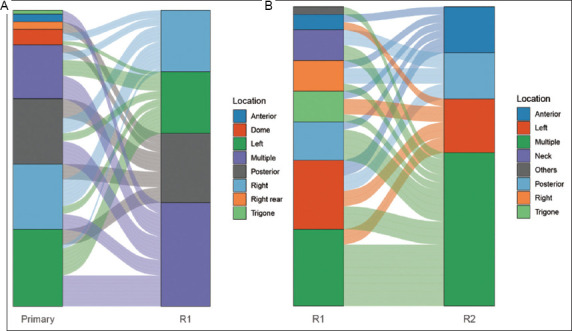
Results: The median follow-up period lasted for 28 months (range: 2-88 months), the median recurrence interval was 13.5 months, and 44 patients (40.7%) progressed into muscle-invasive disease. Univariate analysis revealed that tumor location within the bladder significantly impacted recurrence-free interval, progression-free survival, and overall survival. Tumors situated in the bladder neck, dome, right posterior wall, and trigone demonstrated significantly shorter recurrence-free intervals, rendering these areas high-risk regions. The original tumor site was the most common relapse location, and the recurrence interval shortened as the number of recurrences increased. Over time, the recurrence pattern shifted, with tumors most frequently recurring in the left wall, multiple sites, right wall, and posterior wall.
Conclusion: The findings suggest that bladder cancer most commonly recurs at the original site, with high-risk locations linked to shorter recurrent intervals and greater risks for disease progression. In addition, the recurrence interval tends to decrease with successive recurrences.



 求助内容:
求助内容: 应助结果提醒方式:

 京公网安备 11010802042870号


