Christophe Maes, Dipak Kalra, Tracy Acito, Nadir Ammour, Paul Basset, Sarah Burge, Peter Castleyn, Ross Caldow, Camille Couvert, Amy Cramer, Chris Harrison, Joeri Holtzem, Pavitra Mariappan, Paul Jacobs, Lars Fransson, Veronique Berthou, Laurice Jackson, Nancy Wetzel, Christopher Thompson, Sharon Klein, Robert Green, Fakhry Kaoukdji, Michael Ward, Felix Nensa, Joe Lengfellner, Anna Patruno, Dawn Snow, Isabel Virchow, Angela Fritsche, Pascal Coorevits, Mats Sundgren
{"title":"Accelerating eSource scale-up in oncology clinical trials: The i~HD Task Force initiative.","authors":"Christophe Maes, Dipak Kalra, Tracy Acito, Nadir Ammour, Paul Basset, Sarah Burge, Peter Castleyn, Ross Caldow, Camille Couvert, Amy Cramer, Chris Harrison, Joeri Holtzem, Pavitra Mariappan, Paul Jacobs, Lars Fransson, Veronique Berthou, Laurice Jackson, Nancy Wetzel, Christopher Thompson, Sharon Klein, Robert Green, Fakhry Kaoukdji, Michael Ward, Felix Nensa, Joe Lengfellner, Anna Patruno, Dawn Snow, Isabel Virchow, Angela Fritsche, Pascal Coorevits, Mats Sundgren","doi":"10.1017/pcm.2025.10004","DOIUrl":null,"url":null,"abstract":"<p><p>eSource - particularly EHR-to-EDC - is an emerging paradigm in clinical research that enables automated transfer of electronic health record (EHR) data into electronic data capture (EDC) systems, with the potential to reduce site burden, improve data quality and accelerate oncology clinical trial workflows. However, widespread implementation remains limited due to technical, regulatory and operational barriers. To address these challenges, the European Institute for Innovation through Health Data (i~HD) launched the eSource Scale-Up Task Force in 2024. This multi-stakeholder initiative brings together leading oncology centres and pharmaceutical sponsors to establish a consensus-driven roadmap for eSource adoption. Central to this effort are three foundational resources: readiness criteria for early adopters, a performance indicator framework for monitoring success and an operational playbook to guide implementation. This article provides a structured overview of the Task Force's objectives, collaborative model and outputs, with specific attention to its focus on interoperability, regulatory alignment and real-world validation. While initially developed for oncology, the Task Force's framework is applicable across therapeutic areas characterized by data-intensive workflows.</p>","PeriodicalId":72491,"journal":{"name":"Cambridge prisms, Precision medicine","volume":"3 ","pages":"e5"},"PeriodicalIF":0.0000,"publicationDate":"2025-10-14","publicationTypes":"Journal Article","fieldsOfStudy":null,"isOpenAccess":false,"openAccessPdf":"https://www.ncbi.nlm.nih.gov/pmc/articles/PMC12644958/pdf/","citationCount":"0","resultStr":null,"platform":"Semanticscholar","paperid":null,"PeriodicalName":"Cambridge prisms, Precision medicine","FirstCategoryId":"1085","ListUrlMain":"https://doi.org/10.1017/pcm.2025.10004","RegionNum":0,"RegionCategory":null,"ArticlePicture":[],"TitleCN":null,"AbstractTextCN":null,"PMCID":null,"EPubDate":"2025/1/1 0:00:00","PubModel":"eCollection","JCR":"","JCRName":"","Score":null,"Total":0}
引用次数: 0
Abstract
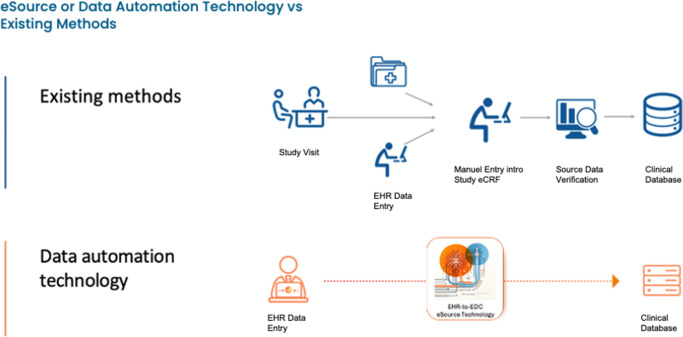
eSource - particularly EHR-to-EDC - is an emerging paradigm in clinical research that enables automated transfer of electronic health record (EHR) data into electronic data capture (EDC) systems, with the potential to reduce site burden, improve data quality and accelerate oncology clinical trial workflows. However, widespread implementation remains limited due to technical, regulatory and operational barriers. To address these challenges, the European Institute for Innovation through Health Data (i~HD) launched the eSource Scale-Up Task Force in 2024. This multi-stakeholder initiative brings together leading oncology centres and pharmaceutical sponsors to establish a consensus-driven roadmap for eSource adoption. Central to this effort are three foundational resources: readiness criteria for early adopters, a performance indicator framework for monitoring success and an operational playbook to guide implementation. This article provides a structured overview of the Task Force's objectives, collaborative model and outputs, with specific attention to its focus on interoperability, regulatory alignment and real-world validation. While initially developed for oncology, the Task Force's framework is applicable across therapeutic areas characterized by data-intensive workflows.



 求助内容:
求助内容: 应助结果提醒方式:

 京公网安备 11010802042870号


