
Unsourced Random Access: A Comprehensive Survey
IF 50.6
1区 计算机科学
Q1 COMPUTER SCIENCE, INFORMATION SYSTEMS
IEEE Communications Surveys and Tutorials
Pub Date : 2026-01-01
Epub Date: 2025-11-26
DOI:10.1109/COMST.2025.3637685
引用次数: 0
Abstract
Multiple access communication systems enable numerous users to share common communication resources, playing a crucial role in wireless networks. With the emergence of the sixth generation (6G) and beyond communication networks, supporting massive machine-type communications with sporadic activity patterns is expected to become a critical challenge. Unsourced random access (URA) has emerged as a promising paradigm to address this challenge by decoupling user identification from data transmission through the use of a common codebook. This survey offers a comprehensive overview of URA solutions, encompassing both theoretical foundations and practical applications. We present a systematic classification of URA solutions across three primary channel models: Gaussian multiple access channels (GMACs), single-antenna fading channels, and multiple-input multiple-output (MIMO) fading channels. For each category, we analyze and compare state-of-the-art solutions in terms of performance, complexity, and practical feasibility. Additionally, we discuss critical challenges such as interference management, computational complexity, and synchronization. The survey concludes with promising future research directions and potential methods to address existing limitations, providing a roadmap for researchers and practitioners in this rapidly evolving field.无来源随机存取:一项综合调查
多址通信系统使众多用户能够共享共同的通信资源,在无线网络中起着至关重要的作用。随着第六代(6G)及以后通信网络的出现,支持具有零星活动模式的大规模机器类型通信预计将成为一项关键挑战。无源随机访问(URA)已经成为解决这一挑战的一个有前途的范例,它通过使用通用代码本将用户识别与数据传输分离。这项调查提供了市建局解决方案的全面概述,包括理论基础和实际应用。我们针对三种主要信道模型提出了URA解决方案的系统分类:高斯多址信道(gmac)、单天线衰落信道和多输入多输出(MIMO)衰落信道。对于每个类别,我们从性能、复杂性和实际可行性方面分析和比较最先进的解决方案。此外,我们还讨论了干扰管理、计算复杂性和同步等关键挑战。该调查总结了未来有希望的研究方向和解决现有局限性的潜在方法,为这一快速发展的领域的研究人员和从业者提供了路线图。
本文章由计算机程序翻译,如有差异,请以英文原文为准。
求助全文
约1分钟内获得全文
求助全文
来源期刊
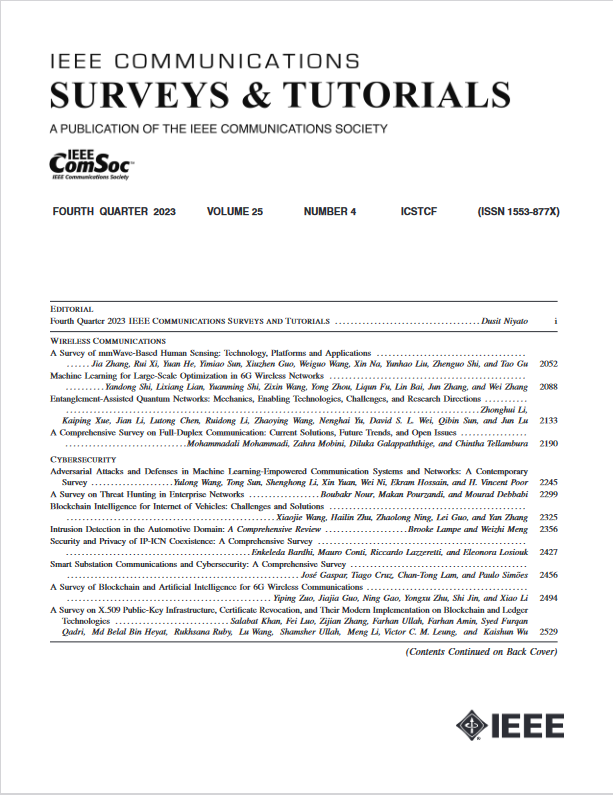
IEEE Communications Surveys and Tutorials
COMPUTER SCIENCE, INFORMATION SYSTEMS-TELECOMMUNICATIONS
CiteScore
80.20
自引率
2.50%
发文量
84
审稿时长
6 months
期刊介绍:
IEEE Communications Surveys & Tutorials is an online journal published by the IEEE Communications Society for tutorials and surveys covering all aspects of the communications field. Telecommunications technology is progressing at a rapid pace, and the IEEE Communications Society is committed to providing researchers and other professionals the information and tools to stay abreast. IEEE Communications Surveys and Tutorials focuses on integrating and adding understanding to the existing literature on communications, putting results in context. Whether searching for in-depth information about a familiar area or an introduction into a new area, IEEE Communications Surveys & Tutorials aims to be the premier source of peer-reviewed, comprehensive tutorials and surveys, and pointers to further sources. IEEE Communications Surveys & Tutorials publishes only articles exclusively written for IEEE Communications Surveys & Tutorials and go through a rigorous review process before their publication in the quarterly issues.
A tutorial article in the IEEE Communications Surveys & Tutorials should be designed to help the reader to become familiar with and learn something specific about a chosen topic. In contrast, the term survey, as applied here, is defined to mean a survey of the literature. A survey article in IEEE Communications Surveys & Tutorials should provide a comprehensive review of developments in a selected area, covering its development from its inception to its current state and beyond, and illustrating its development through liberal citations from the literature. Both tutorials and surveys should be tutorial in nature and should be written in a style comprehensible to readers outside the specialty of the article.
 求助内容:
 应助结果提醒方式:


 京公网安备 11010802042870号


