Maarja Soomann, Seraina Prader, Philipp K A Agyeman, Geraldine Blanchard-Rohner, Michael Buettcher, Christian R Kahlert, Nicole Ritz, Aikaterini Theodoropoulou, Jana Pachlopnik Schmid, Johannes Trück
{"title":"Natural History of Swiss Infants with Non-SCID T-cell Lymphopenia Detected by Newborn Screening: A Cohort Study.","authors":"Maarja Soomann, Seraina Prader, Philipp K A Agyeman, Geraldine Blanchard-Rohner, Michael Buettcher, Christian R Kahlert, Nicole Ritz, Aikaterini Theodoropoulou, Jana Pachlopnik Schmid, Johannes Trück","doi":"10.1007/s10875-025-01945-4","DOIUrl":null,"url":null,"abstract":"<p><strong>Background: </strong>Newborn screening (NBS) by quantification of T-cell receptor excision circles (TREC) identifies a considerable number of infants with T-cell lymphopenia (TCL) other than severe combined immunodeficiency (SCID). While some of these children have well-defined inborn errors of immunity (IEI), many lack a clear genetic diagnosis, complicating their management and causing prognostic uncertainty.</p><p><strong>Objective: </strong>To characterize the natural history of non-SCID TCL detected through NBS in Swiss infants between 2019 and 2023.</p><p><strong>Methods: </strong>Clinical, genetic and laboratory data from all non-SCID TCL cases were extracted from the national NBS registry and analyzed.</p><p><strong>Results: </strong>Out of 435 985 screened infants, 42 patients were identified with non-SCID, non-congenital athymia TCL, without an obvious secondary cause. A clear genetic diagnosis of IEI was established in 20 (48%) patients. Infants with confirmed IEI had significantly lower total T-cell, CD4 + T-cell and recent thymic emigrant (RTE) counts on initial lymphocyte phenotyping. In contrast, those with an unclear genetic diagnosis despite full investigations demonstrated faster normalization of total T-cell counts (hazard ratio 5.2, 95% CI 1.9 to 14.5, p = 0.001). All infants with initial CD4 + T-cell < 0.3 × 10<sup>9</sup>/L showed minimal recovery of T-cell counts and remained on long-term prophylactic measures. All infants with an unclear genetic diagnosis despite investigations were able to discontinue prophylaxis at median age 6 months without experiencing opportunistic or severe infections.</p><p><strong>Conclusion: </strong>Infants with non-SCID TCL identified by NBS represent a heterogenous group, ranging from severe, persistent TCL to mild, transient lymphopenia. Management should be tailored based on individual immunological and genetic profiles.</p>","PeriodicalId":15531,"journal":{"name":"Journal of Clinical Immunology","volume":"45 1","pages":"166"},"PeriodicalIF":4.1000,"publicationDate":"2025-11-25","publicationTypes":"Journal Article","fieldsOfStudy":null,"isOpenAccess":false,"openAccessPdf":"https://www.ncbi.nlm.nih.gov/pmc/articles/PMC12647285/pdf/","citationCount":"0","resultStr":null,"platform":"Semanticscholar","paperid":null,"PeriodicalName":"Journal of Clinical Immunology","FirstCategoryId":"3","ListUrlMain":"https://doi.org/10.1007/s10875-025-01945-4","RegionNum":2,"RegionCategory":"医学","ArticlePicture":[],"TitleCN":null,"AbstractTextCN":null,"PMCID":null,"EPubDate":"","PubModel":"","JCR":"Q1","JCRName":"IMMUNOLOGY","Score":null,"Total":0}
引用次数: 0
Abstract
Background: Newborn screening (NBS) by quantification of T-cell receptor excision circles (TREC) identifies a considerable number of infants with T-cell lymphopenia (TCL) other than severe combined immunodeficiency (SCID). While some of these children have well-defined inborn errors of immunity (IEI), many lack a clear genetic diagnosis, complicating their management and causing prognostic uncertainty.
Objective: To characterize the natural history of non-SCID TCL detected through NBS in Swiss infants between 2019 and 2023.
Methods: Clinical, genetic and laboratory data from all non-SCID TCL cases were extracted from the national NBS registry and analyzed.
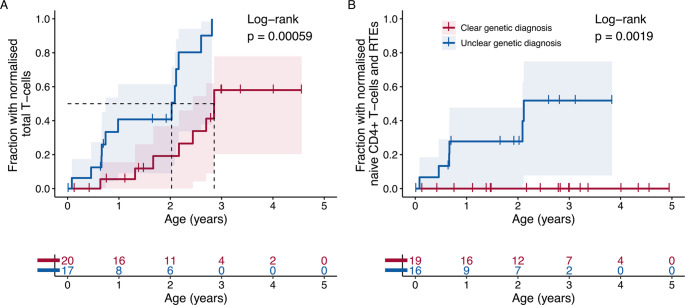
Results: Out of 435 985 screened infants, 42 patients were identified with non-SCID, non-congenital athymia TCL, without an obvious secondary cause. A clear genetic diagnosis of IEI was established in 20 (48%) patients. Infants with confirmed IEI had significantly lower total T-cell, CD4 + T-cell and recent thymic emigrant (RTE) counts on initial lymphocyte phenotyping. In contrast, those with an unclear genetic diagnosis despite full investigations demonstrated faster normalization of total T-cell counts (hazard ratio 5.2, 95% CI 1.9 to 14.5, p = 0.001). All infants with initial CD4 + T-cell < 0.3 × 10⁹/L showed minimal recovery of T-cell counts and remained on long-term prophylactic measures. All infants with an unclear genetic diagnosis despite investigations were able to discontinue prophylaxis at median age 6 months without experiencing opportunistic or severe infections.
Conclusion: Infants with non-SCID TCL identified by NBS represent a heterogenous group, ranging from severe, persistent TCL to mild, transient lymphopenia. Management should be tailored based on individual immunological and genetic profiles.
期刊介绍:
The Journal of Clinical Immunology publishes impactful papers in the realm of human immunology, delving into the diagnosis, pathogenesis, prognosis, or treatment of human diseases. The journal places particular emphasis on primary immunodeficiencies and related diseases, encompassing inborn errors of immunity in a broad sense, their underlying genotypes, and diverse phenotypes. These phenotypes include infection, malignancy, allergy, auto-inflammation, and autoimmunity. We welcome a broad spectrum of studies in this domain, spanning genetic discovery, clinical description, immunologic assessment, diagnostic approaches, prognosis evaluation, and treatment interventions. Case reports are considered if they are genuinely original and accompanied by a concise review of the relevant medical literature, illustrating how the novel case study advances the field. The instructions to authors provide detailed guidance on the four categories of papers accepted by the journal.



 求助内容:
求助内容: 应助结果提醒方式:

 京公网安备 11010802042870号


